

REVIEW – After Geralt’s third adventure, I had a hard time enjoying another RPG quite as much for a good while. The Witcher 3 did not simply present an enormous world to me; it filled that world with people, stories, and decisions that could turn an ordinary monster hunt into an unforgettable adventure. Remastered now does more than make that world prettier: it revisits Geralt’s movement, combat, and character progression while wisely leaving the story alone. Eleven years later, the white-haired witcher has certainly not lost his touch.
Geralt of Rivia, the charismatic, stoic mutant monster hunter with a wonderfully sarcastic sense of humor, has become one of gaming’s genuine icons. He has also become part of Poland’s cultural success story: the Polish prime minister even gave Barack Obama a copy of The Witcher 2. What an acknowledgment for a development team when its game is presented to the American president. What part of our own cultural output would we Hungarians hand over with that much confidence?
My first encounter with the original game’s beta came in 2006, during a press trip while I was an editor at GameStar. It was love at first sight, even though that version certainly had its share of problems. You could already tell that this was not another immaculately polished fantasy world we were being invited into. Everything around Geralt was dirtier, crueler, and more human, while his humor provided a wonderful counterweight to the misery he kept encountering.
Naturally, I completed the first two games when they launched, then went through both again before the third arrived. I wanted to carry over saves in which the characters’ fates reflected my decisions, but that was only one reason. I simply wanted to experience everything again before embarking on the next story. Few games have persuaded me to do that, but with The Witcher, it never occurred to me that this might be a waste of time.
Eleven years have passed since the third game’s release, and CD Projekt RED’s adventure has become a legend. The 2022 next-gen upgrade already brought me back to Geralt, and Remastered now addresses details that were beginning to show their age despite all the happy memories. However much I love this world, I am not about to call my character’s inability to negotiate a trivial obstacle an artistic achievement. The stories can remain just as we remember them; the controls are welcome to improve.

New Skills, Same Old Romantic Problems
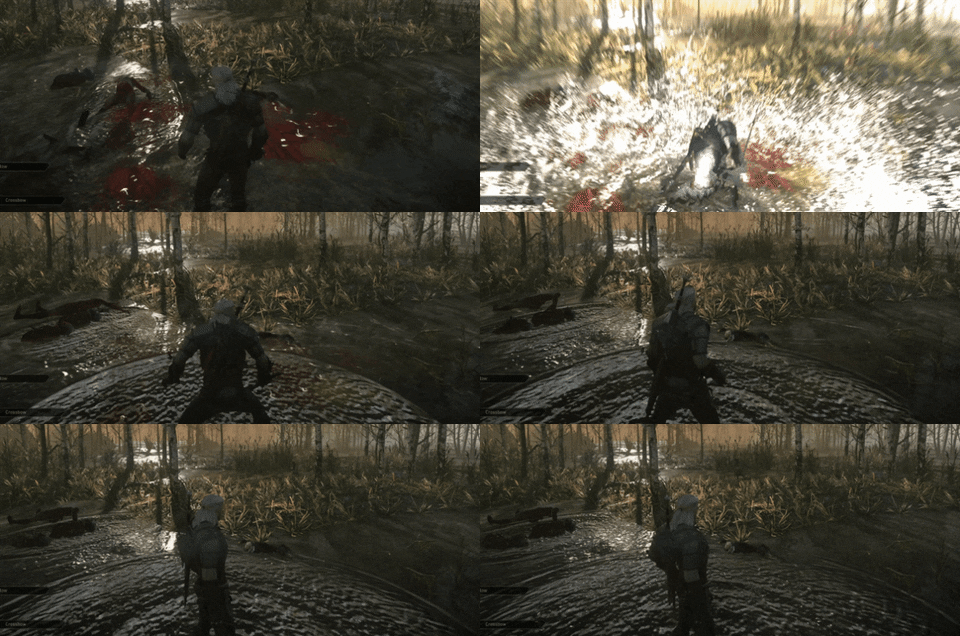
Remastered does not stop at giving Geralt’s beard a makeover. There are new combat animations and finishers, a camera that follows fights more effectively, and revisions to climbing and obstacle traversal. I particularly welcome that: I have always preferred watching a witcher wrestle with a monster rather than a waist-high fence. Roach’s handling and collision avoidance have also been improved, so perhaps we will have fewer reasons to question the horse’s parentage on our travels.
Abilities have been organized into a proper tree with interconnected prerequisites, and their bonuses have been rebalanced. Our old saves remain, but the points need to be reallocated, so it is worth reconsidering even a familiar sword-focused, magic-focused, or alchemy-heavy Geralt. Reforge finally stops equipment appearances from restricting our choices: Hattori and Yoana can alter our gear without changing its statistics. That means more to me than playing dress-up. In a game like this, I would rather my hero did not become increasingly badly dressed simply because I keep finding stronger armor.
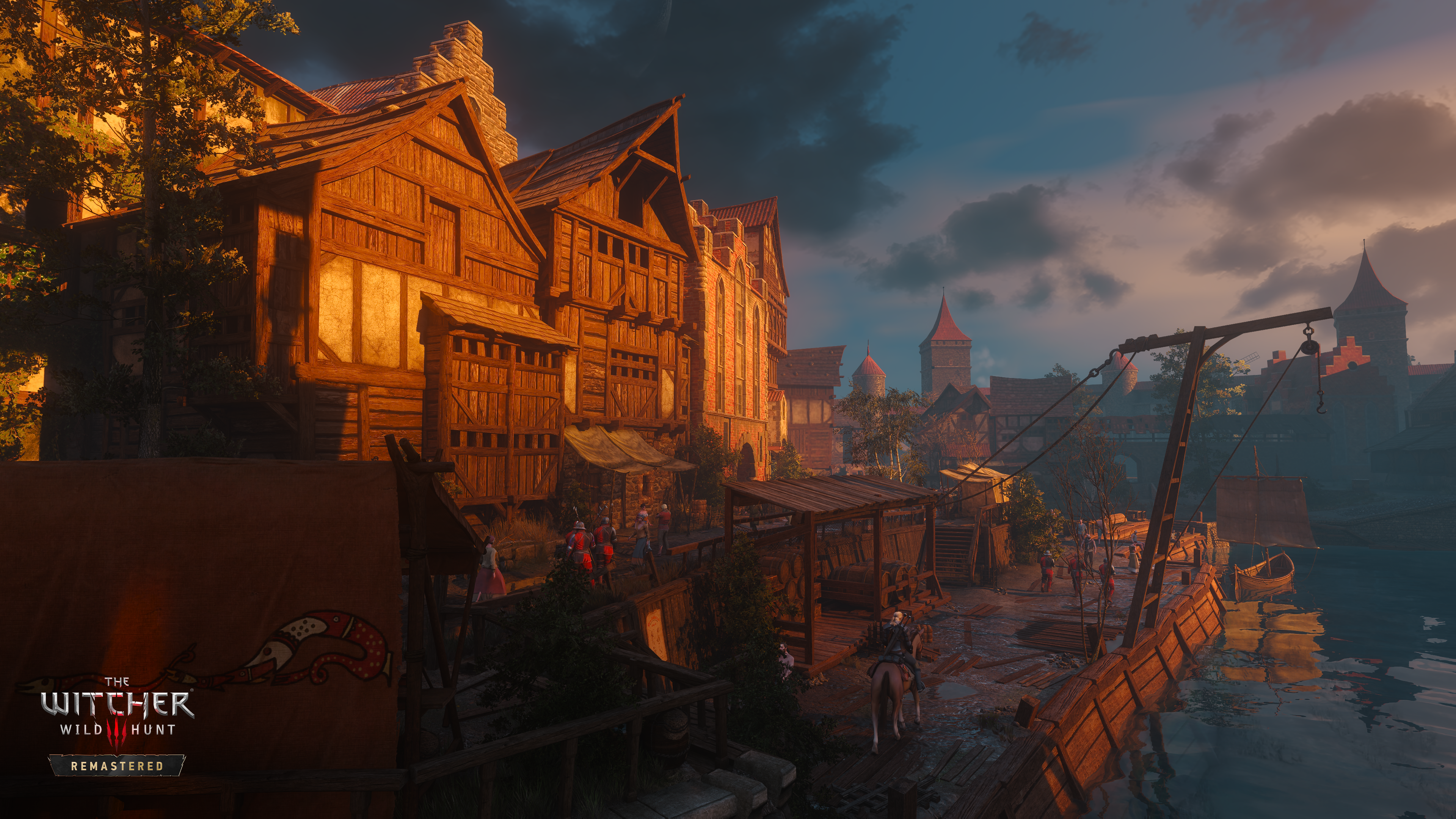
New lighting, more detailed vegetation, and updated textures arrive alongside PC path tracing and PSSR with a ray-tracing mode targeting 60 fps on PS5 Pro. Photo mode has expanded, and mods are reaching consoles too. Better still, the September 29 upgrade does not require buying the game again: on PC, PS5, and Xbox Series X|S, we can update for free if we already have it, while a Switch copy also gets us the Switch 2 version. Hearts of Stone and Blood and Wine are included. The Polish team really is doing its fans a favor here, rather than asking to be celebrated for putting the game in a new box.
New Features
The underlying game remains the same, and I mean that as a compliment. The Bloody Baron’s story does not need a new ending to work again, and Novigrad is not interesting merely because it has received another prettier edition. Content from earlier updates remains too, including the quest and equipment inspired by Netflix’s The Witcher series. Anyone who has stayed away since the original launch will therefore discover more convenient ways of doing things, along with an additional detour and improved graphics. Returning players, meanwhile, should notice how many fewer small irritations stand between them and the adventure.
With the 2022 next-gen edition, choosing between the two graphics modes did not take me long. I enabled ray tracing, admired the lighting for a while, then switched back to Performance once I started seriously fighting and riding. I could feel the benefit of Geralt’s smoother movement with every dodge, whereas the stumbles that accompanied prettier illumination did not inspire quite the same enthusiasm. A better-looking scene doesn’t help much when I am busy getting annoyed by how the game responds. Back then, 60 fps added more to the experience for me than the more attractive lighting effects.
On PS5 Pro, Remastered tries to make that choice unnecessary: its ray-tracing mode also targets 60 fps. That makes sense, because I do not only want to admire Geralt standing in front of landscapes; I want to enjoy the swordplay too. PC path tracing pushes lighting further, but the hardware has to keep up. I do not consider lowering a setting a personal defeat if it saves me from a gorgeous postcard that moves in fits and starts. For me, the right configuration is the one I forget about while playing.
I already liked the inclusion of modders’ work in the earlier update. More detailed textures, characters, and monsters belonged to the same world rather than looking like somebody was desperate to demonstrate how differently they could do things. Battered houses remained battered houses, only with every crack more visible, and creatures gained enough detail to make close encounters even less appealing. Work from the HD Reworked Project appears again among Remastered’s updated assets. It is good to see the developers doing more than acknowledging years of community effort: they are actually using it.

Camera, Map, and Photo Mode
The closer camera already made it enjoyable to linger behind Geralt in the next-gen upgrade. A narrow street or crowded room feels different when the character is not so distant, but during a fight, knowing where the next blow is coming from matters more than elegantly framing his shoulder. That is why separate camera settings for different situations are useful. Remastered’s wider-field-of-view exploration camera and dynamic combat camera further improve that flexibility. They bring us closer to events without necessarily sacrificing our view of the surroundings.
Photo mode presents an entirely different danger: it is easy to spend too much time with it in this game. There were already countless moments I wanted to freeze, whether it was a perfectly executed sword strike or the misty Skellige coast. Now we can choose characters, poses, and props for the picture, and change the time of day and weather. Anyone who enjoys that sort of thing will have plenty to get absorbed in. Everyone else only needs to look around: The Witcher 3 supplies photographable scenes without elaborate staging.
The map filters have a less spectacular but equally useful role. In a world this size, the screen quickly fills with markers, and before long we are no longer looking at where we want to go but at what remains to be cleared away. I appreciate being able to reduce that clutter rather than opening the map onto the entire Continent’s to-do list. Combined with faster console loading, it makes returning to an unfinished quest or a distant merchant more appealing. A detour can then become another small adventure instead of an errand with a lengthy loading screen attached.

More Convenient Sign Casting
Quick Sign casting is one of those improvements I got used to almost immediately. The old selection wheel regularly interrupted a fight’s momentum while I picked the next spell; direct button combinations let a dodge, a Sign, and a counterattack follow one another much more naturally. Not having to disappear into a menu between sword strikes matters far more than it might sound on paper. Accessing Igni faster does not make me a better witcher, of course: I still need to understand what the situation calls for. The controls just keep getting in the way between me and the next move every time.

The Netflix-Inspired Quest
Fortunately, the television-related equipment was not simply dumped into a chest in front of Geralt. The associated quest takes us somewhere ominous, tells its own story, and is worth playing even without having watched a minute of Netflix’s adaptation. Fans can naturally enjoy the outfits and references, but the entire mission does not depend on those connections. What matters more to me is becoming involved in another case I want to understand better than the initial briefing allows.
Naturally, we use Witcher Senses, follow clues, talk, and fight. That same list could describe plenty of other quests, but the number of times we press a particular button is hardly what makes them identical or different. What matters is whom we meet, what we learn about them, and how our understanding of the story changes along the way. This detour works because it gives us a reason to be there beyond acquiring equipment. The armor at the end is a reward, not a substitute for a story.
I am considerably less affectionate about the PC launch’s technical faults. October 1’s 5.00c hotfix had to address saving problems, dialogue volume, and issues caused by HairWorks. Fixing them is welcome, but this sort of disruption is particularly irritating in a game that has already been through so many editions. I like Geralt and dislike save errors; there is no contradiction to resolve there. These problems do not erase the old adventure’s achievements, but neither do those achievements make the remaster automatically faultless.

Not Without My Adopted Daughter
The Witcher series has plenty to be proud of, but its most dazzling quality remains the way it weaves its stories. In the third game, our cynical monster hunter is looking for Cirilla, or Ciri, his former pupil and adopted daughter. With her white hair and scarred face, she even somewhat resembles Geralt, despite never undergoing the witchers’ alchemical, poison-fueled mutations. Their personal bond matters considerably more than the resemblance: this is not another contract Geralt can settle by collecting his money and moving on.
The premise is simple, then, but it develops into an enormous number of storylines, interesting or genuinely funny characters, and excellent main and side quests. We become involved in political games and try to save mages from the pyre, including Triss Merigold, already familiar as a possible lover from the previous installment. The world does not politely wait while Geralt attends to his own business. People disappear, flee, or attempt to make a living from the war, and their stories remain interesting even when they do not take us a step closer to Ciri. Detours consequently carry weight rather than merely supplying levels and equipment.

Mentioning Triss also means acknowledging Yennefer of Vengerberg, who occupies a very particular place in Sapkowski’s novels and Geralt’s history. My friend Berrr would call her “the love of his life,” then probably choose his words more carefully after their next argument. Alongside the familiar faces, we encounter unforgettable figures such as the Bloody Baron, the witches of the swamp, and Dudu, the shapeshifting doppler. None is easy to forget, and none of their stories can be reduced to the function they performed in our quest log.
True love notwithstanding, Geralt has always had an eye for women, and there are plenty of opportunities to indulge that inclination here. Keira Metz, for example, is a beautiful, cool blonde who is also clever. You really do need to watch yourself around her. After The Witcher 2, I particularly appreciated having more room for romance again, with relationships amounting to more than a handful of disposable lines.
The intimate scenes are not the only ones receiving careful attention, either. Even a conversation with an ordinary peasant can become a properly staged scene, full of gestures, expressions, and inflections that sometimes tell us more than the words themselves. Add the excellent writing, and I suddenly find myself caring more about a supporting character’s fate than about the entire central conflicts of other games. Very few earlier RPGs made me feel this thoroughly part of their worlds.

Wandering the Northern Kingdoms
The attention lavished on the smallest details of the stories extends to the world’s appearance. The Northern Kingdoms already astonished me in the original game with their colors, environmental detail, and carefully realized characters. Yet I loved them for more than looking attractive. An abandoned house, a muddy yard, and trees bending in the wind combine into a place where I believe people once lived and something happened to them. The revised lighting and textures enrich that atmosphere rather than trying to compensate for its absence.
Part of the reason I originally chose the PC version over the PS4 was to see everything in maximum detail. After patch 1.10, I could enable Nvidia HairWorks without quite so much damage to the frame rate. At the time, The Witcher 3 was unquestionably among my best-looking games of 2015, with Batman: Arkham Knight providing its strongest competition on PS4. Eleven years later, a technical achievement naturally means something different, but the artistic work has aged much better than many contemporary graphical showpieces. I can still recognize this game immediately from its locations.

The wonderfully atmospheric music and sound deserve just as much attention. The English voice acting even uses different accents to distinguish regions and social backgrounds, rather than having everyone speak identically in different clothes. After my disappointment with the first game’s Hungarian dub, I was particularly grateful for that. Meanwhile, the surroundings are constantly audible: leaves rustle, wind whistles, and musicians play in town squares and taverns. I do not merely see that I am in a forest or an inn; I hear the whole place. Often that alone makes me want to linger before moving to the next task.
During combat, Percival’s vocals and the energetic music get the blood moving immediately, while exploration brings brooding, ominous, or melancholy melodies. This is particularly effective when we pass an abandoned village or some other trace of the war. The game is not afraid to leave quieter, less comfortable moments between spectacular encounters. Its happier scenes matter more as a result, because we know the kind of world in which somebody has managed to find a little joy.

Beyond its audiovisual richness, this world is extraordinarily alive. Huge medieval cities and rustic villages are inhabited by prosperous citizens, destitute beggars, thieves, bandits, and sex workers going about their lives. Performers entertain people in the squares, peasants work the fields, and ragged children play among village puddles. Together, these details tell us much more about a place than an introductory speech explaining how its inhabitants live. Not everybody is waiting for our next question, and that is precisely why simply walking among them can be so enjoyable.
War, meanwhile, has taken its toll across the region. We hear about soldiers looting, massacring people, and committing sexual violence; elsewhere, the surroundings reveal exactly what happened to the inhabitants. Naturally, there is also no shortage of monsters of every description, so Geralt has plenty of work. Yet the stories repeatedly make us question whether the fanged, misshapen creature is actually the worst resident of the area. The game can be much crueler in that respect than when it simply shows blood and severed limbs.

Silver for Monsters, Steel for Humans
Fortunately, Geralt arrives with appropriate weapons and magic for both groups. While The Witcher 2’s combat attracted plenty of criticism, almost everything fell into place for me in the third installment. Swordplay is fast, dynamic, forceful, and very bloody, but we have to pay attention to the rhythm of attacking, defending, counterattacking, and alternating quick and strong strikes. Charging recklessly at everybody while hammering attack is a good way to die at greater difficulties. The Witcher may be an experienced monster hunter, but he will not handle the timing on our behalf.
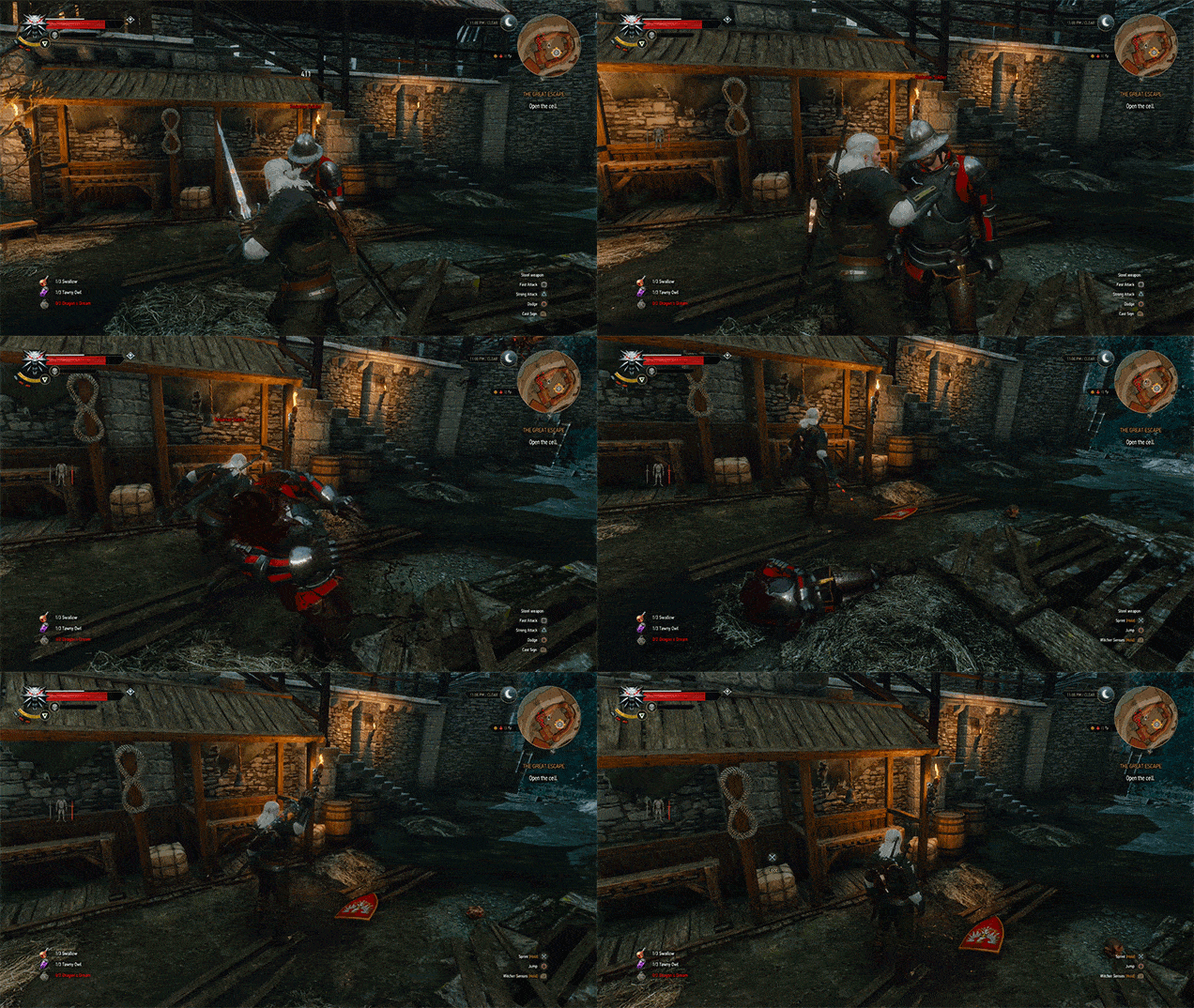
Listing the different moves makes them sound more complicated than they feel in play. On a PlayStation controller, X handles rolling, Circle dodging, Triangle strong attacks, and Square quick ones, and we soon develop a feel for when to use each. Stepping just outside a strike’s path is not the same as creating more distance, just as we cannot always afford to commit to a longer attack animation. Remastered builds on that familiar foundation through its new movements and camera. I appreciate that the developers did not insist on building an entirely different system from something that already worked.
Combat is not as merciless as in Bloodborne or the Dark Souls games, but a mistimed attack or missed defense can still be punished severely. Attempting a quick slash while the enemy is already bringing down its own strike can remove enough health to leave us staring in disbelief. Fast attacks remain a useful tactic, since they can stagger several opponents. We simply have to recognize when to stop pressing the attack and get out of the way. Remember: this is a witcher, not a ninja, and preparation is as much a part of the profession as cutting things apart.

Geralt’s magical abilities and knowledge of alchemy consequently provide considerably more than optional spectacle. On higher difficulties, we need to learn what works against each opponent, because not every problem can be solved with a sword. Before a serious encounter, it is worth considering which oil, potion, or Sign might be most helpful; Igni, for example, can prove particularly useful against creatures vulnerable to fire. During the fight, we still need to adapt to what happens. Those victories mean the most to me: the ones where I was not only more skillful than the opponent but better prepared.
The alchemy system lets us create potions, blade oils, and other useful preparations through a thankfully straightforward interface. Plants, fruit, and organs harvested from monsters give us reasons to search forests, fields, cupboards, and chests, while merchants can supply recipes. The things accumulating in our bags consequently have a genuine purpose. An item that seemed like another oddly named ingredient along the road may become particularly welcome before the next contract. Monster hunting really does involve more than finding the next enemy and hitting it until its health runs out.

“I’m Not Much of a Talker…” (Geralt) “Could Have Fooled Me!” (Me)
The superbly written conversations must not be overlooked either. We have plenty of opportunities to steer a discussion in the direction we want, and our answers often have consequences reaching further than expected. Geralt is no prince arriving on a white horse: he is a cynical professional who likes to point out that other people’s disputes are none of his business. Yet his best stories are precisely those that make maintaining that distance increasingly difficult. We must decide when to remain the monster hunter working for payment and when we cannot simply walk away.
It is rarely possible to say with complete confidence which answer will make the situation “good,” but our particular Geralt emerges from those decisions nonetheless. He can be a tougher mercenary who keeps his feelings carefully hidden or a much more compassionate person beneath the gruff remarks, yet neither attitude guarantees a happy ending every time. That is why these feel like actual decisions rather than a moral test marked with colored icons. I did not generate the protagonist as I might in a Dragon Age game, but his fate and relationships feel entirely mine. When the consequences of an earlier choice return later, blaming it all on what the game wanted no longer makes much sense.
A Masterpiece
The Witcher 3: Wild Hunt set the bar extraordinarily high by building a living RPG with its own identity from Sapkowski’s world. Serious, frequently bleak stories, dark fairy tales, and legends drawing on Slavic folklore coexist with wry humor and the characters’ very familiar human failings. It provokes genuine emotional reactions and holds my interest beyond collecting a quest reward. Some stories leave me considering what I might have done differently for a good while afterward. There is not much higher praise I can give an RPG.
Remastered adds a new look, revised movement, and reworked character progression without overwriting the original game’s identity. The story remains brilliant, combat is enjoyable, and higher difficulties make us work properly for our victories. Technical faults do not deserve a pass simply because the Witcher name is attached, but the adventure remains the rare masterpiece I fell in love with. Amid so many interchangeable open worlds, Geralt’s story still speaks with an unmistakable voice of its own. There is no getting around it: becoming hooked on this world again is remarkably easy.
-Gergely Herpai „BadSector”-
Pro:
+ An extraordinarily beautiful and atmospheric dark-fantasy world
+ First-rate stories, quests, and unforgettable characters
+ Reworked movement, combat, and skill progression in a free upgrade
Contra:
– Another PC launch affected by frustrating technical problems
– The best-looking graphics settings need powerful hardware
– Loading older saves requires reallocating skill points
Publisher: CD Projekt RED
Developer: CD Projekt RED and Yigsoft
Genre: Open-world action RPG
Platforms: PC, PlayStation 5, Xbox Series X|S, Nintendo Switch 2
Release: May 19, 2015 – original game; October 15, 2019 – Nintendo Switch; December 14, 2022 – next-gen update; September 29, 2026 – Remastered
The Witcher 3: The Wild Hunt
Gameplay - 10
Graphics - 10
Story - 10
Music/audio - 10
Ambiance - 10
10
MASTERPIECE
The Witcher 3: Wild Hunt sets the bar very high for open world RPGs. Sapkowski’s original world in its video game representation is as stunning as it is challenging and thought-provoking at the same time. The Witcher 3: The Wild Hunt stands out as a gem of an RPG overflowing with creativity. Geralt’s latest adventure is a real masterpiece.







Leave a Reply