

RETRO – Of all the traditional fantasy universes, Warhammer is one of the most atmospheric and merciless, which is why I always eagerly anticipate every new PC game set in its world. Unfortunately, recent years have brought us nothing but adaptations of Warhammer 40,000, and it’s taken eight long years for me to finally swing the warhammer once again in the classic fantasy setting. The first Hungarian-developed Warhammer game is now celebrating its 20th anniversary.
“There is no escape from Chaos… It will mark us all…” These ominous words greet us in the opening cinematic of Warhammer: Mark of Chaos, another spectacular achievement from the award-winning Digic Pictures. Once again, the Hungarian animation studio has pulled out all the stops, creating the perfect atmosphere for the brand-new strategy game developed by another Hungarian team, Black Hole Entertainment. In many respects, the game could even be considered a remake of the legendary Warhammer classic Dark Omen. Black Hole has clearly poured an enormous amount of effort and passion into this project, but it almost seems as though that memorable line from the introduction has caught up with the developers themselves… “Chaos will mark us all…”

When Miniatures Come to Life
Whenever I walk past Trollbarlang, a store specializing in fantasy tabletop games, I always stop for a few minutes to admire the Warhammer miniatures on display. My fascination doesn’t quite extend to actually buying any of these little warriors, partly because I got my fill of playing with toy soldiers during my childhood with Playmobil figures, and partly because I’m afraid I might become hopelessly addicted to what is, after all, an outrageously expensive hobby. Fortunately, the world of video games offers a much more affordable way to bring the Warhammer universe to life, complete with its orcs, ratmen, goblins, dwarfs, and arrogant, battle-hardened Imperial soldiers.
The first game set in the classic Warhammer universe, 1995’s Shadow of the Horned Rat, enjoyed only modest success, despite being one of the earliest DirectX games for Windows 95. Its rotatable pseudo-3D engine was quite impressive for the time, while its regiment-based command system, familiar today from the Total War series, was an entertaining concept in its own right. The atmosphere was excellent, too, but it was the sequel, Dark Omen, that truly demonstrated what this approach could accomplish.

I struggled and struggled with Shadow of the Horned Rat, but no matter how hard I tried, I could never bring myself to love it. Dark Omen, on the other hand, was love at first sight. Its outstanding and, at the time, relatively innovative combat system was a welcome departure from the conventional real-time strategy formula that everyone seemed determined to clone in 1998. The memorable characters, charismatic heroes, thrilling battles, missions, and adventures kept me completely glued to my computer. I even managed to finish the game, despite its final missions being brutally difficult.
Let’s fast-forward to the present day. Unfortunately, we’ve had to wait eight entire years for another strategy game set in the classic fantasy universe of Warhammer rather than its futuristic 40,000 counterpart…

All Aboard the Nostalgia Express
Ah, nostalgia… There’s something wonderful about looking back on those magnificent games of years gone by, the ones that kept us awake through countless sleepless nights.
I’m absolutely convinced that Black Hole Entertainment was specifically targeting players who still remember Dark Omen with genuine affection. After all, the gameplay, controls, and combat system of Mark of Chaos bear an almost uncanny resemblance to those of that beloved classic.
Just like Dark Omen, the game features carefully structured stories told through linear campaigns. The main difference is that while the original only allowed us to fight on the side of the “good guys,” commanding the mercenary captain Morgan Bernhardt, Mark of Chaos offers two separate campaigns. We can take control of Stefan von Kessel, a young champion of the Empire, or Thorgar the Blooded One, one of the Chaos forces’ fearsome warriors. This is a genuinely welcome addition, considering that Dark Omen only allowed players to command Chaos armies in multiplayer. Another excellent idea is that both campaigns tell the story of the same war from two opposing perspectives, complete with different endings. For all these thoughtful touches, the developers deserve a generous helping of brownie points.

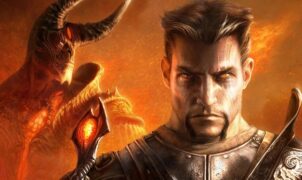
Unfortunately, both campaigns initially suffer from rather formulaic storytelling, and I found their characters relatively uninteresting. Compare Morgan Bernhardt, the cunning, battle-scarred mercenary captain of Dark Omen, with Stefan von Kessel, the typical hotheaded young hero of this adventure, and the former emerges as a far more original and compelling character. That’s true even though the writers have conveniently given Kessel a face marked by evil, presumably to make him seem a little more intriguing.
To be perfectly frank, the predictable storyline becomes even more noticeable because the cutscenes are so disappointingly poor, both technically and in terms of their presentation. This is particularly striking after Digic Pictures’ spectacular opening cinematic. The videos are badly compressed, and whenever the camera moves in for a close-up of the 3D character models, it feels as though we’re looking at an entire family descended from some unfortunate, hatchet-faced caveman.
Here’s a particularly telling example: if the narrator hadn’t explicitly mentioned the “marks of Chaos” on Kessel’s face during the introduction to the Imperial campaign, I swear I would never have noticed them in the cutscenes. They were perfectly visible in his 3D portrait, but even after knowing what to look for, I practically had to strain my eyes to make them out in the animated sequences.
Both campaigns do eventually develop more interesting storylines as the game progresses. Unfortunately, there are still far too many of those painfully static conversations in which the characters simply stand around delivering their lines.

Total Warhammer
As we advance across the campaign map and move from one mission to the next, we occasionally have the opportunity to venture off the main route and explore a few side paths. These essentially represent optional missions, and without them, the entire strategic map would be almost completely pointless. Admittedly, the map itself is relatively attractive and reasonably detailed, but its overwhelmingly grayish-brown color scheme becomes so depressing after a while that simply looking at it is enough to drain the joy out of life. What really irritated me, though, was that certain locations serve absolutely no purpose. We arrive at one of these destinations expecting something to happen, only to be greeted by a short description along the lines of “Enemy armies passed through this area, leaving nothing but blood and ruins in their wake.” And that’s it.
The various towns aren’t particularly elaborate either, but at least they’re far more useful. These static screens allow us to strengthen and upgrade our armies and heroes, purchase new armor, weapons, magical items, and horses, and sell off any unwanted equipment our heroes happen to be carrying. One especially peculiar design decision is that instead of recruiting fresh soldiers from the local peasantry to replace our fallen troops, we simply visit a temple and resurrect the dead! The same applies to our heroes, should they happen to have shuffled off this mortal coil as well.
I actually suspect the developers introduced this system to avoid having to implement one of Dark Omen‘s more interesting mechanics. In that game, constantly replacing fallen soldiers with fresh recruits gradually diluted the experience of a regiment, eventually turning a battle-hardened veteran unit into a collection of inexperienced beginners. One welcome convenience in Mark of Chaos is that we can instantly return to any previously captured town with a single click on the campaign map whenever we need to strengthen our forces. Unfortunately, this also breaks the illusion of traveling through a coherent world, particularly since reaching every other destination requires following a rigidly predetermined route.

A Living Tabletop Battlefield
All right, let’s face it: no matter how generously we try to dress it up, the campaign map is hardly anything to write home about. Fortunately, the battles that form the very heart of the game are a completely different story. The combat system will be immediately familiar to anyone who has played Dark Omen or the Total War series: we command individual regiments, and success depends far more on intelligent positioning and making the most of each unit’s strengths than on simply overwhelming the enemy with superior numbers. For example, launching a cavalry charge downhill can make an enormous difference, as can positioning artillery on a hilltop or inside a tower. From such elevated positions, our gunners enjoy an excellent view of the battlefield and can hit targets at considerably greater distances. Speaking of firing lines, it’s also essential to pay attention to natural obstacles. If a building or hillside blocks the line of fire between our cannons and their intended target, our dutiful artillery crews will cheerfully blast the obstacle instead, leaving the enemy soldiers completely unharmed.
That’s especially frustrating because every accurate artillery hit can inflict tremendous damage on a large regiment, just as it would on a real battlefield. It’s quite common for the survivors of a devastating bombardment to lose their nerve and flee in complete panic. Terrain also plays an important role for other types of troops. Musketeers, for instance, can take cover behind defensive palisades and cut down advancing enemies from relative safety, while cavalry charging downhill in the proper formation can become absolutely lethal.
Unfortunately, while we’re on the subject of formations, I have to point out that there simply aren’t enough of them. Most strategy games offer a greater variety of tactical arrangements. The battlefields themselves, however, look like magnificent miniature tabletop environments brought vividly to life. We fight across beautifully detailed and wonderfully varied locations featuring towers, rolling hills, autumn forests, snow-covered landscapes, fortresses, castles, and small towns. Many of these places have already been corrupted and left to rot by the forces of Chaos, creating such unsettling, diseased environments that some encounters can genuinely send a chill down your spine.
Another major attraction is the enormous variety of imaginative units that could only belong to the Warhammer universe. Thanks to their relatively advanced technology, the armies of the Empire can deploy musketeers, cannons, and even primitive machine guns. The forces of Chaos, meanwhile, supplement their usual orcs and ratmen with all manner of horrifying demonic creatures that descend upon the human armies. Both sides also have access to aerial units: majestic eagles and terrifying harpies can wreak havoc among ground troops when deployed effectively.

Buff Those Troops!
Of course, brute strength is far from the only factor that matters on the battlefield. A whole range of elements determines whether our glorious army emerges victorious or whether its few remaining survivors run away with their tails between their legs. Perhaps the most important consideration is morale, since inspired and confident troops can perform remarkably well even against overwhelming odds. Conversely, once our soldiers become frightened and lose their nerve, only special items or abilities can persuade them to return to the front lines.
The various strengthening spells cast by our heroes also play an enormous role in determining the outcome of battle. These buffs can improve the performance of friendly units so dramatically that even the most desperate situations can suddenly turn in our favor. Other heroic spells allow us to inflict devastating damage on enemy formations. We just need to make sure that these heavenly “blessings” actually land where they’re supposed to.

Controlling individual regiments is extremely straightforward. A click of the left mouse button orders our soldiers to move to the desired location, while the right button determines which direction they should face. Before each engagement, we’re given enough time to arrange our troops carefully. Ideally, ranged units and artillery should occupy elevated, well-protected positions, while cavalry should be stationed on the flanks so they can charge into the enemy’s side at just the right moment. Infantry, meanwhile, belongs in the center, where it can absorb the impact of incoming assaults.
So the controls themselves are perfectly fine, but friendly fire works in a rather “interesting” way and occasionally caused me tremendous frustration. Fortunately, musketeers don’t seem to inflict much damage on our own soldiers, or at least I never noticed them causing particularly serious casualties. The devastating firepower of our cannons, however, can easily slaughter our own troops if we don’t keep a constant eye on what they’re doing.
Because cannons fire so slowly, it’s not uncommon for our cavalry to have already cut the enemy to pieces by the time a particularly unfortunate cannonball finally reaches its destination. Picture the scene: our victorious soldiers have just dispatched the last ratman and are roaring in triumph when a stray cannonball suddenly lands right in the middle of their formation. Thanks to this exceptionally “intelligent” shot, half our own regiment is wiped out in an instant. It would have been much better if the developers had provided some way to prevent our brilliant artillery crews from committing these spectacular blunders, because sometimes they caused far more damage than they were worth.

Make Warhammer, Not Love!
The most enjoyable part of the entire game is undoubtedly its multiplayer mode, which does an excellent job of recreating the rules and gameplay of the original tabletop experience. We can assemble our own armies using a points-based system, with every player receiving exactly the same number of points to ensure a reasonably balanced contest. The more powerful a unit or regiment is, the more points it costs. This forces us to think carefully about whether we want to crush our favorite opponent with a small number of extremely powerful but expensive warriors, or overwhelm them with a much larger force of weaker, cheaper troops. After all, there’s a lot to be said for the old principle that enough little guys can eventually bring down even the biggest bruiser.
Multiplayer naturally includes the familiar free-for-all mode, essentially a traditional deathmatch, but the siege battles and reinforcement-based modes are considerably more interesting. In these matches, players must capture specific strategic points on the map that generate gold, which can then be spent on purchasing additional troops. Multiplayer battles generally last much longer than the more heavily scripted encounters of the single-player campaigns, partly because a cleverly executed maneuver can suddenly turn the tables on an opponent who seemed certain to win just moments earlier.
Unfortunately, connecting to the servers is currently rather buggy, and some of these problems remain even after installing the patch. Thankfully, multiplayer is also available over a local area network. The trouble is that not everyone has the time or opportunity to organize a good old-fashioned LAN party…

A Shaky Four
Warhammer: Mark of Chaos is a very good strategy game, but its rather weak storyline, outdated and painfully dull cutscenes, and a few irritating shortcomings in the interface prevent it from reaching its full potential. Despite all my nitpicking, however, the Hungarian developers have done an impressive job, and in a strategy game like this, multiplayer is ultimately what matters most. If future patches can get the servers working properly, there’s enormous potential for some truly spectacular multiplayer battles. All things considered, this Warhammer adventure has turned out pretty well! Now bring on the expansion or, better yet, a proper sequel!
-Bad Sector- (2006)
Pros:
+ The Warhammer universe truly comes to life
+ Excellent tactical combat inspired by Dark Omen and Total War
+ Digic Pictures’ spectacular opening cinematic
Cons:
– Overly linear campaigns
– Certain perfectly logical tactics simply don’t work
– A disappointing storyline
Publisher: Namco-Bandai
Developer: Black Hole Entertainment
Genre: Strategy
Release: 2006
Warhammer: Mark of Chaos
Gameplay - 8.4
Graphics (2006) - 7.8
Story - 6.2
Music/audio - 7.5
Atmosphere - 7.2
7.4
GOOD
Warhammer is a very good strategy game, but its rather weak story, outdated and dull cutscenes, and a few minor interface shortcomings hold it back. Despite these criticisms, the Hungarian developers did an impressive job in 2006, and in a strategy game like this, multiplayer is what matters most.






Leave a Reply