
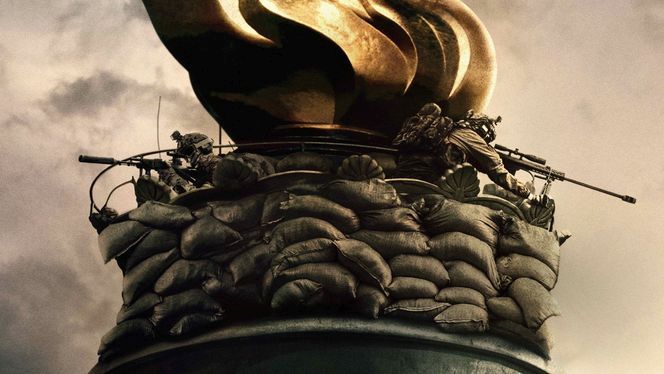
MOVIE NEWS – After the U.S. midterm elections, audiences are taking another look at one of the most disputed world-building choices in Alex Garland’s Civil War. California and Texas joining the same faction sounded implausible when the film premiered, but Texas’s political shift has unexpectedly brought the fiction closer to reality.
Alex Garland’s dystopian war film depicts a fractured United States divided among several factions fighting across the country. In the story led by Kirsten Dunst, the greatest attention went to the Western Forces, an alliance that placed traditionally Democratic California and conservative Texas on the same side. The movie never offered a detailed explanation for what brought the two states together, and that silence inspired a flood of jokes and theories on social media.
Civil War, which we previously examined in our full review, was never designed as a party-political map. Garland used the alliance to place viewers in a country that felt familiar but had become unpredictable, where the logic of war had already overridden its former ideological fault lines.
Texas’s political turn has changed the film’s most debated idea
According to the source, the November 3 midterm elections turned Texas Democratic after decades of Republican dominance. James Talarico won a Senate seat by nearly twelve points, while Gina Hinojosa prevailed in the gubernatorial race. The shift stands out because Texas has become one of the strongest centers of American conservatism in recent years, while California remains a defining stronghold of the Democratic Party.
After the results, a widely shared post declared that “everyone owes Alex Garland an apology.” What appeared completely unbelievable when the film opened now seems at least a little less ridiculous. That does not make an actual military alliance between California and Texas realistic, but the instability of political maps supports one of Garland’s assumptions: in a severe crisis, familiar camps can reorganize with remarkable speed.
Garland deliberately refused to answer every question
The director has previously made clear that he feels no obligation to explain every detail of his fictional world. In his view, cinema has room for many approaches, and enough films already provide a clean answer to every question. The origins of the Western Forces therefore remained intentionally vague. Viewers were not meant to reconcile party platforms but to experience the consequences of war.
Across its 109 minutes, the factions mainly provide a framework for a story about journalism, polarization and the human cost of violence. Alongside the Western Forces, the Florida Alliance, the New People’s Army and the Loyalist States all appear, but Garland never reduces any of them to a simple political puzzle. Texas’s electoral turn has not fulfilled the film’s prediction; it has merely shown how quickly supposedly permanent political categories can become outdated.
Source: 3DJuegos