
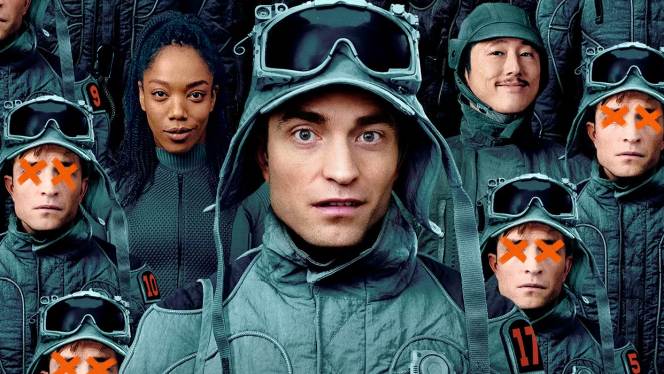
MOVIE REVIEW – Robert Pattinson throws himself into a deliberately goofy performance in Bong Joon Ho’s latest film—unfortunately, with limited success. The Parasite director’s third English-language feature attempts to repurpose the sharp social critique and dark aesthetic of Snowpiercer and Okja, but the result is more chaotic than compelling.
Two Mickeys might be fun, but by the seventh or eighth iteration (as hinted in Edward Ashton’s sci-fi novel Mickey7)—or an even more absurd number like the 18 seen in Bong’s adaptation—the sight of an endless parade of Robert Pattinson clones quickly wears thin. With Mickey 17, the Snowpiercer director returns to familiar ground, crafting an over-the-top sci-fi satire set in a bleak future where Earth is no longer habitable, interplanetary colonization is essential, and the success of a four-year mission to the frozen wasteland of Niflheim depends on expendable human duplicates known as Expendables.

Pattinson’s Intergalactic Misfortune
Pattinson is no stranger to spacefaring roles, having ventured into the unknown in Claire Denis’ artful sci-fi film High Life. This time, however, he dials down his intelligence to play a hapless loser so desperate to escape a loan shark back on Earth that he blindly signs up for an interstellar expedition—without reading the fine print. That mistake quite literally costs him his life, as Mickey 1 (the original version of the character) agrees to have his body scanned, his memories archived, and his existence replicated and recycled indefinitely—each time a previous iteration meets an unfortunate end.
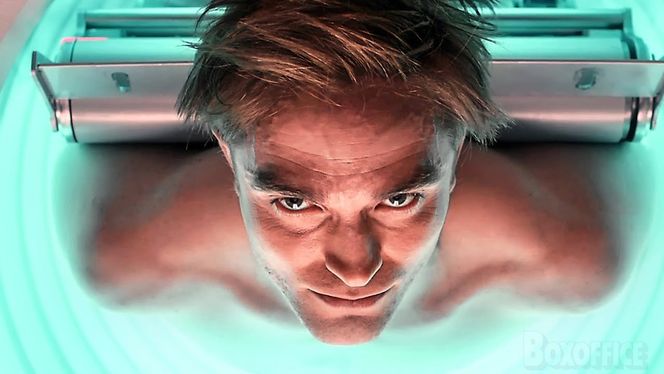
It’s a premise that immediately raises a host of logical questions—like why there’s only one Expendable aboard, or why this cutting-edge memory duplication technology isn’t being put to better use. But Bong isn’t interested in those answers. Instead, he leans into a string of morbid slapstick gags, showing lifeless (or barely functional) Mickeys being unceremoniously dumped into an incinerator chute for recycling. Pattinson, adopting a whiny, Steve Buscemi-like narration, explains that each new clone is cobbled together from the remains of the previous one—ashes to ashes, trash to trash—before being spat out by what looks like a giant 3D printer.
Bong’s supposedly satirical screenplay makes it clear just how little the human crew values the Expendables—and by extension, how little the director seems to think of human nature. This point is hammered home through a series of darkly comedic bits, like when a careless technician forgets to set up a gurney, causing a freshly printed, still-wobbly Mickey to splatter onto the floor. In another moment, a maintenance worker accidentally unplugs the machine mid-process, which perhaps explains why Mickey 17 turns out slightly less self-loathing than his predecessors. But in the end, their purpose remains the same: to die. Mickey is sent on missions deemed too dangerous for the “real” crew members to risk.
In other words, to enjoy Mickey 17—which Warner Bros. is set to release in IMAX on March 7, two weeks after its Berlin Film Festival premiere—you have to be entertained by the sheer variety of ways in which Mickey gets obliterated. From vaccine trials to atmospheric tests on alien worlds, Bong’s imagination knows no bounds. If this all seems paradoxical coming from a filmmaker often labeled a humanist, then perhaps Bong isn’t quite the idealist his fans think he is. Instead, he emerges as a blunt, adolescent-minded satirist—one working in the same provocative, hyper-stylized vein as Paul Verhoeven’s Starship Troopers.
Dark Satire or Just Overblown Chaos?
For die-hard Bong Joon Ho fans, the film’s loud, irreverent humor might feel like a nostalgic callback to the director’s previous English-language efforts—the grotesque meat-industry satire Okja and the class-warfare thrill ride Snowpiercer. But ironically, this is where Bong’s style feels the least effective. While Mickey 17 earns some credit for its absurdist wit—along with the nearly monochromatic, future-noir aesthetic crafted by cinematographer Darius Khondji and production designer Fiona Crombie—the film ultimately collapses under its own weight. Ironically, the same over-the-top tendencies that undermine the story also make Mark Ruffalo’s deliberately Trumpian villain nearly unbearable to watch.
The narrative picks up four years into an interstellar colonization mission on the ice planet Niflheim, where Mickey 17 has been left to die in a frozen cavern—abandoned by his supposed best friend, Timo (Steven Yeun). The last thing the poor Expendable sees is the gaping maw of a massive, fur-covered beast that looks like an oversized armadillo—dubbed “Creepers” by Ruffalo’s dim-witted commander, Kenneth Marshall, a man whose leadership skills fall somewhere between clueless and outright dangerous.
In the film’s muddled moral logic, Expendables have been outlawed on Earth, yet their use—and subsequent disposal—is totally acceptable on other planets. Marshall, a washed-up politician turned self-proclaimed prophet at the head of the corporate-religious entity overseeing the colonization effort, has the final say over Mickey’s fate. According to some completely arbitrary rule, there can never be more than one version of a person alive at the same time—a logic that stands in stark contrast to the Star Wars universe, where an army of identical, obedient clones forms the backbone of a galactic military machine.

Two Mickeys Enter, One Mickey Leaves
Although Timo assumes that the Creeper devours Mickey 17, the creature doesn’t actually kill him. By the time the half-frozen survivor stumbles back to the ship, his successor has already been printed—meaning one of them has to go. Though genetically identical and equipped with the same memories, each iteration exhibits slight personality shifts. Mickey 18, for instance, is noticeably more assertive, immediately asserting dominance over his more passive predecessor. Pattinson makes these differences clear with his physicality, portraying Mickey 17 as hunched and awkward, his unfortunate bowl-cut only adding to his underdog status.
Both Mickeys want to survive, initially setting them against each other. But they also both develop an interest in Nasha (Naomi Ackie), the ship’s free-spirited, rule-breaking crew member, who rather enjoys the idea of two Mickeys competing for her attention—so long as her rival, Kai (Anamaria Vartolomei), doesn’t spill the secret. This dynamic leads to an odd power game, with both women manipulating the situation to their advantage, while Mickey 18 quietly plots a mutiny.
The plot is fairly straightforward, yet Bong seems determined to complicate it. Ruffalo’s character—sporting a wavy Colonel Sanders-style hairdo, unnaturally white teeth, and an accent that refuses to stay consistent—becomes increasingly despotic the farther the mission drifts from Earth. Lurking at his side is his wife, Ylfa (Toni Collette), a master manipulator who feeds his worst instincts—like his irrational belief that the Creepers are a threat and must be exterminated—while indulging her bizarre and all-consuming obsession with sauces. This ridiculous duo channels the exaggerated corporate buffoons of Okja, played by Tilda Swinton and Jake Gyllenhaal, with equally garish outfits and performances so over-the-top they border on parody. Bong may be attempting to highlight the absurdity of our own world, but the sheer excess of it all just makes the film exhausting.

Endless Clones, Limited Patience
In Ashton’s novel, there were “only” 10 iterations of Mickey, but Bong enthusiastically cranks the number up to 17, putting both the character—and Pattinson himself—through the wringer. The actor fully commits to the role, shedding every ounce of his Twilight heartthrob image to embody a character who is, quite frankly, pitiful. For most of the film, he’s trapped in a Groundhog Day-style time loop, forced to relive the same miserable existence over and over while enduring tactless questions about what it feels like to die repeatedly.
As it turns out, modern science already has a rudimentary version of this cloning technology—albeit limited to stem cells rather than fully developed, memory-imprinted human beings. At least this method spares its subjects the physical and psychological torment of being recycled on repeat. But does slapping Pattinson’s perpetually exasperated face onto this concept make us think about it in a new way?
The film recycles familiar themes—the divide between social classes, the moral imperative of compassion—but despite its darkly comedic approach, Bong doesn’t seem to be saying anything particularly new. Mickey 17 is visually striking but narratively hollow, producing more clones than actual substance. One viewing is more than enough.
-Gergely Herpai “BadSector”-
Mickey 17
Direction - 6.4
Actors - 7.6
Story - 5.6
Visuals/music/audio - 7.6
Ambiance - 6.6
6.8
FAIR
Mickey 17 is an ambitious but unfocused satire that dazzles visually but struggles to deliver a compelling message. Pattinson throws himself into the role, but the film’s excessive bombast and overstuffed narrative quickly become exhausting. Bong’s latest sci-fi vision is big on style but ultimately short on impact.









Leave a Reply