
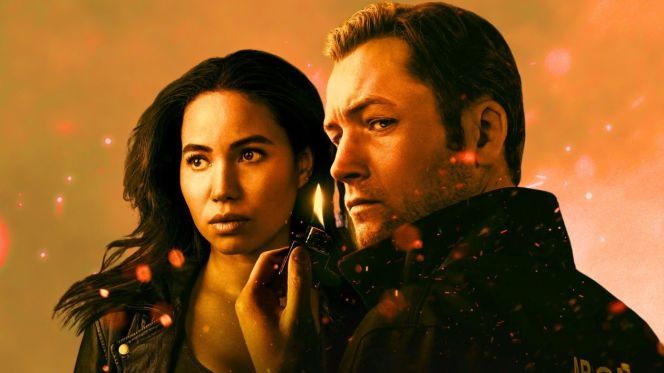
SERIES REVIEW – Apple TV Plus’s new drama, Smoke, makes a grand entrance with its bold visuals: even after just three episodes, it’s clear that this show isn’t just about arson—it’s about mood, noir aesthetics, and the haunting pulse of Thom Yorke’s signature opening credits. The misty, evergreen forests around Vancouver give the Pacific Northwest setting a character of its own, where every shot is thick with atmosphere, every line drips with sarcasm, and the cast never misses a beat of dry self-awareness. This is a series where visuals and style hold the reins—plot often drifts in like a lost ember and disappears again into the postmodern haze. Based on the opening trio of episodes, Smoke is more a playground for style and genre games than a classic crime drama. If you’re into genre subversion, deadpan narration, and self-aware twists, you’re in for a treat.
If you’re looking for a show where style suffocates the story, Smoke is the full package. Narrative drive fizzles fast, but every scene pops visually.
The first episode doesn’t so much kick open the door as it blows the roof off: the opening credits—four descending notes that could be straight from any Radiohead album—are pure Thom Yorke, who composed and performed “Dialing In” for the show. Even at this early stage, Yorke’s haunting score sets a brooding, melancholy mood.

Noir, Satire, and Pop Culture Go Up in Smoke
The next big punch lands in the very first scene, which plays like a tongue-in-cheek riff on Woody Allen’s Manhattan, only dumber and smokier. Our wannabe novelist-narrator, Dave Gudsen (Taron Egerton), tries to wax philosophical about fire while slow-motion flames devour buildings. His first lines stumble and stall, but soon he’s off to the races with gems like: “Fire couldn’t care less about your wallet, your gun, or whether your manhood measures up to your Glock.” You realize right away this isn’t your typical drama.
Dave Gudsen, both chief arson investigator and self-important would-be writer, isn’t just trying to put out literal fires—he’s busy penning a barely-disguised action novel where his own chiseled alter-ego is the hero. By episode three, it’s clear Egerton is going all in with this oddball, high-pitched, relentlessly chipper character who’s impossible to take seriously, not that you need to. The show’s comedic high points come courtesy of Gudsen’s cringe-worthy prose, delivered with the kind of misplaced confidence that would make Garth Marenghi blush. A favorite excerpt: “He felt his heart stir—yes, his heart, but other parts of him too.”
There’s even a moment where Gudsen writes up his new partner, disgraced detective Michelle Calderone (Jurnee Smollett from Lovecraft Country), describing her as instantly turned on by his touch—a bit so over-the-top it wouldn’t feel out of place in an episode of Delocated – Witness Protection Comedy.

Sparks Fly, But Where’s the Fire?
But Smoke isn’t just a showcase for Yorke’s brooding melodies, deadpan humor, burning buildings, and damp pine forests. The fictional city of Umberland was brought to life mostly in Vancouver, and the setting manages to feel both grounded and dreamlike. Dennis Lehane (whose resume includes Gone Baby Gone and The Wire) reunites with Egerton after their work on Black Bird, a partnership that gives the series plenty of prestige on paper. Visually, Smoke is a feast: the moody, sometimes deliberately murky cinematography channels David Fincher, and directors like Kari Skogland (The Falcon and the Winter Soldier) keep things sharp.
The supporting cast is equally stacked: Greg Kinnear nails the mustachioed, “no whiskey on a weeknight” fire chief; Anna Chlumsky brings her trademark exasperation as an undercover operative that recalls her Veep days; John Leguizamo is a scene-stealing, hard-drinking firefighter who describes his ex-partner Gudsen as: “That bizarre, annoying anal abscess who deserves to have his eyes plucked out and his balls dunked in a punchbowl full of chlamydia.” These barbed one-liners perfectly sum up the show’s absurdist sense of humor—even if character development sometimes takes a back seat to meta jokes and pop culture nods.
Genre Fireworks, Drama Fizzles
Smoke constantly teeters between refined, ironic tone and the suspense you’d expect from a true crime drama. The atmosphere is what really sells it: Thom Yorke’s theme, the damp Pacific Northwest mystique, and Lehane’s character-driven writing all elevate the show. Still, there are plenty of times when it’s all smoke, no fire: style wins, but real narrative heat is rare. No matter how clever the direction or twisted the gags, the labyrinthine character drama often gets lost in the satire, genre parody, and postmodern self-awareness. Still, if you’re a sucker for dark, sardonic, genre-bending mysteries, this one’s tailor-made for you. For others, it’ll be more of a visual joyride—memorable mostly for its haze.
-Gergely Herpai “BadSector”-
Smoke
Direction - 7.2
Actors - 7.3
Story - 6.6
Visuals/Music/Sounds/Action - 8.1
Ambience - 7.2
7.3
GOOD
Smoke is stylish, self-aware, and bitingly satirical—a series where pop culture in-jokes, punchlines, and noir tropes are as important as any actual drama. Apple TV Plus’s experiment in crime reinvention is best for viewers who don’t mind if the smoke rarely catches fire.







Leave a Reply