
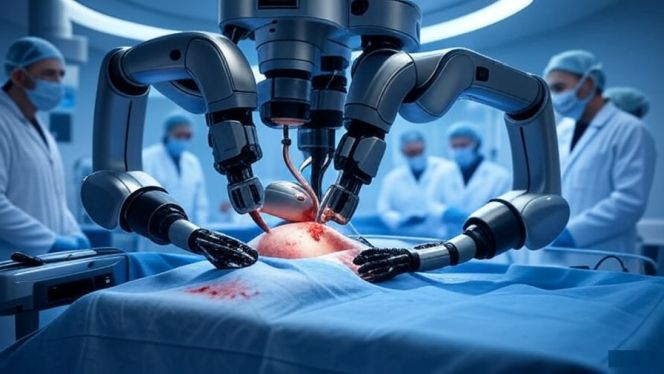
TECH NEWS – Artificial intelligence has successfully carried out surgery in an experiment by following surgeons’ vocal instructions.
Medical technology is advancing at a science-fiction pace. A surgical robot has recently hit a huge milestone in both “soft” and “hard” skills: a robot managed to successfully operate on a pig’s gallbladder, guided only by voice commands.
“This work marks a significant leap compared to previous efforts, as it addresses some fundamental barriers to deploying autonomous surgical robots in real-world settings,” said the study’s lead author, Ji Woong “Brian” Kim. Before the procedure, the robot was trained on videos of the operation. Then, during the actual gallbladder removal, it carried out the surgery by responding to verbal commands from the lead surgeon. The robot was even able to adapt in real-time to emergencies and changes in plan. This process is remarkably similar to how human surgeons learn such procedures, meaning these robots could potentially be trained using the same methods and understanding as medical students. This could make robot training feasible even in hospitals that lack advanced technical resources.
“That’s what makes this so inhumanly difficult, because how do you describe it? How do you write this in code? Can I watch a human learn what I’m supposed to do? If the answer is yes, then things, if not trivial, become significantly easier,” Dr. Mathias Unberath, associate professor at Johns Hopkins University, told IFLScience.
This learning method is called imitation learning, and it’s something people do all the time. When robots do it, it usually combines machine learning and data input, but here it was mostly based on video and voice training. In this study, the robots performed gallbladder removal with 100% accuracy after watching the instructional materials.
The prospect of autonomous surgical robots that can be easily trained via natural language and respond to unexpected changes is even more promising. This could open up healthcare access for far more people in need, with many more robots helping deliver care around the world.
Source: PCGamer, IFLScience















Leave a Reply