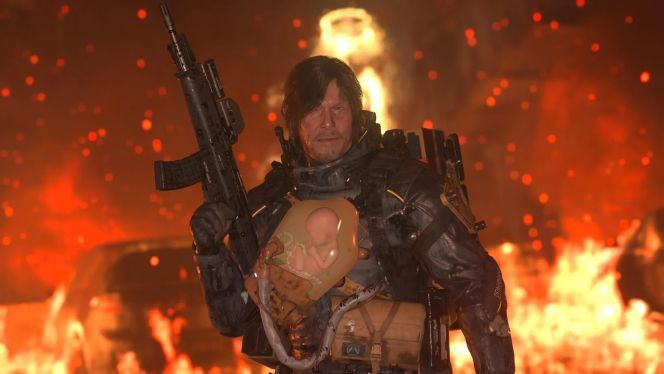
REVIEW – After five and a half years, Hideo Kojima returns to his most unique game with the sequel to Death Stranding. While the core of this extraordinary sci-fi open world action-adventure “delivery simulator” remains intact, there are enough gameplay innovations here to make it clear this is a true sequel and not just a Death Stranding 1.5. But what truly sets it apart is a jaw-dropping story that would make the finest sci-fi films and series blush, with Norman Reedus reprising his role as the immortal courier Sam “Porter” Bridges, who, after a brief introduction in Mexico, is tasked with uniting Australia.
We pick up eleven months after the events of the first Death Stranding. Sam Porter Bridges (Norman Reedus), having united America and bid a cathartic, Kojima-style farewell to Bridges, now lives in hiding in Mexico with Lou, his adopted daughter (formerly BB, the special “baby” he carried throughout the first game). His reclusive life is upended when Fragile (Lea Seydoux), once a courier with teleportation powers, seeks him out with a mission from the UCA: help expand their chiral network into Mexico. Sam only agrees if the UCA “forgives” him for not cremating Lou’s BB body, leaves him and Lou alone, and allows him to reconnect with his old friend Deadman (Guillermo del Toro, the iconic director who played one of the first game’s most original characters). Deadman reveals the existence of a “plate gate” that can teleport someone straight from Mexico to Australia—and, in a shocking twist, that Lou isn’t actually BB 28 and was never registered in the UCA’s system. Sam returns to his hideout, but dramatic events (no spoilers here) soon thrust him onto Fragile’s hovering, futuristic ship—the Magellan—and eventually to Australia, where the true open-world adventure begins.

Kojima: Master of Sci-Fi Storytelling
Death Stranding 2’s narrative, steeped in the signature Kojima blend of wild sci-fi and surreal, mind-bending moments, is a masterclass in interactive storytelling. If you thought Kojima had already pushed the boundaries of his craft with the first Death Stranding, think again: the sequel’s twists and gut-punch revelations prove he’s poured even more of himself into this project. It may sound cliché, but this really feels like Kojima’s magnum opus, the work of a Japanese legend who always secretly wanted to be a film director—and, in a sense, has become one, with his games evolving into full-blown “interactive movies.”
But make no mistake—unlike the ‘90s FMV games, the complex, addictive, and incredibly enjoyable gameplay here is as much a part of the experience as the meticulously crafted cutscenes. Let’s linger on those surreal, often David Lynch-inspired cinematic sequences: these are good enough to stand alone as a movie or sci-fi series, with top-tier performances throughout. Norman Reedus delivers what might be the performance of his career—whether he’s speaking in that gravelly baritone about past traumas or conveying deep bitterness and exhaustion with a single glance.
He’s not alone: Lea Seydoux is even better here than in her Bond roles, and Troy Baker’s portrayal of the villain Higgs is jaw-dropping—hard to believe it’s the same man who played Joel in The Last of Us. As much as you loved Joel, you’ll despise Higgs; his unrelenting cynicism brings endless misery to our heroes. If Joel’s fate in The Last of Us Part II was the ultimate gut punch, then in Death Stranding 2 you’ll want to tear Higgs limb from limb—a grotesque, grand-guignol clown and one of gaming’s most memorable, repulsive, yet strangely compelling antagonists.
Don’t overlook the supporting cast: alongside del Toro, there’s George Miller (the Mad Max director) as Tarman, the Magellan’s “tar-handed” commander, and Dollman, a living doll possessed by a human soul (or Kojima’s recurring “Ka”). And finally, there’s Luca Martinelli, now playing a supernatural commando in place of Mads Mikkelsen. You might’ve seen him in The Old Guard 2, but Kojima wrings even more from his acting chops here.
This story—full of twists, unique characters, and existential stakes—will glue you to the screen. Even if you’re slogging through pitch-black tar or blizzards in your battered vehicle, you’ll keep pushing forward just to unravel the final mysteries of this haunting sci-fi world—a story that doubles as a bleak parable for the extinction of humanity. And when those end credits roll, expect a catharsis so powerful you’ll want to watch every last name. (Yes, there’s a post-credits scene—and maybe a hint at Death Stranding 3.)

Delivery Man in Distress
The story may be unique, but the gameplay is even more polished. Every aspect of the sequel’s mechanics has been improved. Sure, you’ll still trek on foot for several missions, but soon enough, you’ll get vehicles—now even more sci-fi than before. I used my mini-truck for almost everything, even though you get access to some truly bizarre options like a floating coffin “hoverboard” for snow, water, or tar (I stuck to the truck for bigger hauls and main quests).
Alternative delivery options abound: buildable gliders, cannons that launch you across the map like a modern Baron Munchausen (then parachute down), and the strangest of all—teleporting hot springs, courtesy of Heartman’s ever-nauseated female colleague. (That’s classic Kojima for you.)
Package delivery still works as before: arrive, kneel, stash your cargo, then chat with blurry—later, fully visible—holograms once you connect them to the chiral network. Honestly, after dozens of these, I got a bit bored—most “clients” spout the same lines, only the main story NPCs offer something different, and even that isn’t always compelling. Unlike the first game, there are fewer celebrity cameos, which I welcomed: in replaying the original before Death Stranding 2, the likes of Herman Hulst or Geoff Keighley actually pulled me out of the world.

When It’s Time to Fight…
I’ll admit: I didn’t use every new tool. I put my faith in my upgraded mini-truck, eventually outfitted with dual machine guns that automatically shredded human, robotic, and supernatural foes alike.
Combat is the most overhauled part of Death Stranding 2. Lazy types can rely on vehicle-mounted auto-guns, while others can shoot manually (with some weapons) while driving. The arsenal has ballooned since the original—I loved the minigun, and by the finale, the “quad rocket launcher” made short work of the towering bosses.
Speaking of bosses: the gigantic BT monsters (no Hungarian dub this time, sorry!) and Higgs fights are even more epic and maybe a tad harder than before. Don’t expect Bloodborne-level difficulty—some tactics, careful positioning, and decent aim are all you need, no razor-sharp reflexes required.

The Visuals Still Set the Standard…
I played the first Death Stranding on PS4 Pro in 2019 and was blown away by its visuals—the Decima Engine (a gift from the Horizon Zero Dawn devs after Konami fired Kojima post-MGS V) was pushed to the absolute limit. Nothing I’d seen came close to that level of photorealism, and honestly, Death Stranding 2 might be the best-looking PS5 game yet. I can’t wait for the PC version, where the Decima’s power will shine even more—maybe then I’ll have a 21:9 4K OLED to take it all in.
The visuals aren’t just for show—the cinematics and post-apocalyptic landscapes both benefit. In cutscenes, the facial animation and subtle expressions are astonishing; outside, the remnants of civilization and otherworldly weather effects are jaw-dropping. The blizzards atop snowy peaks and the surreal sights during BT attacks stand out. Sam descends into “hell” again and again—these scenes are chillingly realistic, even if they’re not quite as creative as the warzone flashbacks from the original.
Visually, it’s a five-star experience—same goes for the audio. French singer-songwriter Woodkid and Swedish composer Ludvig Forssell (who also scored the first game and MGS V: The Phantom Pain) are behind the soundtrack. Woodkid was brought in after the passing of Ryan Karazija of Low Roar, whose tracks were iconic in the first game. The music is haunting, catchy, and seamlessly woven into the experience—it’s on repeat as I write this.
The Beach Awaits… Again!
For me, alongside Clair Obscur, Death Stranding 2 is already my Game of the Year contender—but I haven’t picked a winner yet. Kojima has outdone himself: the atmosphere is phenomenal, and if you’re at all receptive to this unique gameplay style, it’s incredibly addictive. This artistic, surreal story will keep you glued to the screen until you finally solve the tragic mysteries and discover if your handlers are who they claim to be. It was a wild ride—and I can’t wait for the PC port!
-Gergely Herpai “BadSector”-
Pros:
+ Incredibly unique sci-fi story
+ Cinematic cutscenes and outstanding acting
+ More refined, varied gameplay
Cons:
– Delivery missions can become repetitive
– Sometimes overly surreal or slow-paced sections
– This distinctive style won’t appeal to everyone
Developer: Kojima Productions
Publisher: Sony Interactive Entertainment
Genre: Sci-fi action-adventure, open world
Release: June 26, 2025 (PS5)
Death Stranding 2: On the Beach
Gameplay - 9.6
Graphics - 9.8
Story - 9.4
Music/Audio - 9.4
Ambience - 9.8
9.6
MASTERPIECE
Death Stranding 2 is a worthy successor, with Kojima outdoing himself in every way. Its atmosphere, breathtaking visuals, and movie-worthy story set a new standard for the genre. It’s sure to be divisive, but for those willing to embrace it, this is an experience you’ll never forget.