
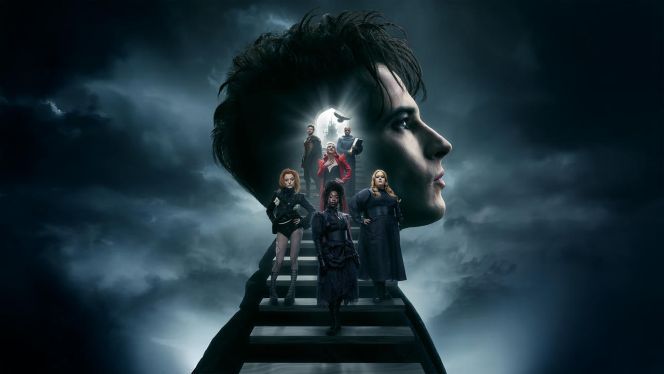
SERIES REVIEW – This new season of Netflix’s The Sandman dares to bring Neil Gaiman’s legendary arc, The Kindly Ones, to the screen. In the original comics, this storyline delivered multiple compelling twists and deep character arcs, concluding a seven-year run with a layered narrative that always rewards a revisit. Here, the adaptation struggles for unity and feels scattered, a side effect of inconsistent, sometimes rushed adaptation choices.
For its latest chapters, Netflix’s The Sandman turns to one of Neil Gaiman’s most ambitious sagas, The Kindly Ones. The original comic is filled with riveting developments and character journeys, culminating in a coherent story that invites—and even demands—multiple readings to uncover its many secrets.
The show, however, never quite reaches the same cohesion, stumbling instead through an adaptation that too often feels fragmented and hurried, undermining what made the source material so enduring in the first place.

Dreams, Blood, and Family Catastrophe
Now, Morpheus (Tom Sturridge) is forced to confront the consequences of ending his own son Orpheus’s (Ruairi O’Connor) life. Among the Endless, the act of spilling family blood is the ultimate taboo, and Desire (Mason Alexander Park) was eager to set this trap.
Yet, it was Orpheus who wanted death—after all, he had long since been reduced to nothing but a head, which makes any sort of social existence a challenge. Even though Morpheus has inflicted much harsher punishments on others in the past, it’s his most merciful, self-sacrificing decision that now threatens to be his undoing. The script barely pauses to consider the arbitrary cruelty of these cosmic rules, choosing instead to plunge headlong into a realm of Greek tragedy. The Eumenides—also called the Furies—were the ancient goddesses of vengeance, and the Greeks addressed them as “the Kindly Ones” as much out of fear as respect. These are not spirits anyone wants to antagonize, and Dinita Gohil, Nina Wadia, and Souad Faress play them with precisely the right chill.

A Downfall of Epic Proportions
Fittingly, in a saga echoing the themes of Greek tragedy, it is Morpheus himself who unknowingly sets the wheels of his own downfall in motion. He reaches out to Loki (Freddie Fox), who is hiding on Earth in a gaudy disguise, hoping that the god of mischief will be an ally against the relentless Furies.
Loki, of course, owes his freedom to Morpheus—but is hardly known for repaying debts. Instead, he would rather erase those who would call in his IOUs. Together with his partner Puck (Jack Gleeson), Loki schemes to frame Morpheus for a crime beyond imagination. He never tricks Morpheus into directly committing the act—there’s no simple manipulation here, only the tragedy of fate. The result, thanks to Loki’s machinations, is two tragic heroes on a collision course: Lyta Hall (Razane Jammal), who all too easily believes Morpheus has done her irreparable harm, and whose grief is forged into a weapon. Her almost willful gullibility makes it a chore to sympathize with her, and it’s difficult to be invested in such a flat antagonist.
Supporting Players Who Steal the Show
Thankfully, Fox brings infectious energy to his role as the scheming Loki—a far cry from Tom Hiddleston’s more playful Marvel version. Fox even channels the look of a young David Bowie, the inspiration for Gaiman’s Lucifer, and it’s easy to imagine him ruling over Hell in a more comic-accurate incarnation, even if he doesn’t get his own nightclub here.
Loki’s connection to fire, a hallmark of myth, is explored in some of the show’s more shocking and horror-tinged sequences. Meanwhile, Jack Gleeson’s Puck is a genuine highlight, his morally gray take offering more depth than the original comics ever allowed. Still, the true scene-stealers of the season are Jenna Coleman as Johanna Constantine (the series’ gender-flipped version of DC’s iconic supernatural detective) and Boyd Holbrook as the Corinthian, now a redeemed version of the first season’s nightmare villain. Coleman’s presence lights up the screen, and the chemistry between her and Holbrook absolutely sizzles. Corinthian may be a literal nightmare, but compared to Constantine’s love life, he seems like a safe bet.
-Gergely Herpai “BadSector”-
The Sandman 2. Season 2. Part
Direction - 6.4
Actors - 7.3
Story - 5.4
Visuals/Music/Sounds - 7.6
Ambience - 7.7
6.9
FAIR
The Sandman’s second season finale lands as more tragedy than dream, with visuals and cast still dazzling but a structure too fractured to recapture the comic’s magic. Despite the convolutions, Gaiman’s world and these unforgettable characters keep drawing fans back for more. Even with all its flaws, it remains a series worth revisiting.





Leave a Reply