
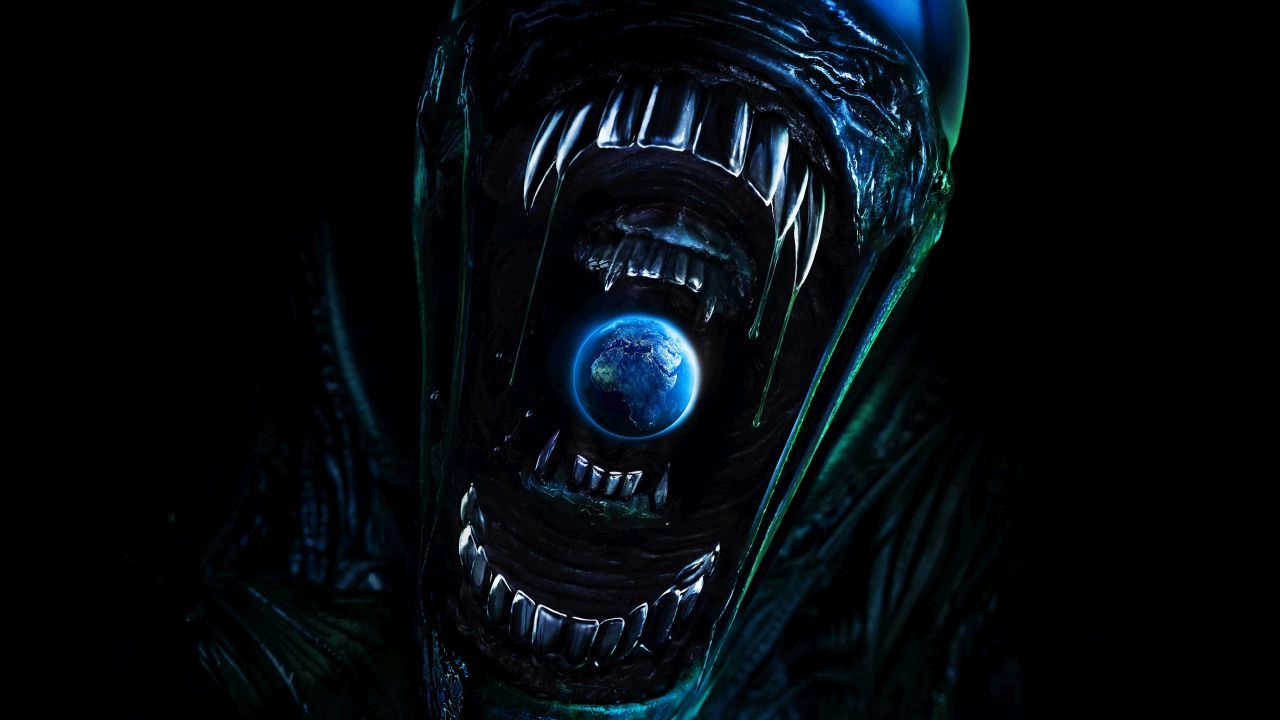
SERIES REVIEW – In a twist that few fans could’ve predicted, the least memorable element of FX’s bold new sci-fi series isn’t the alien — it’s the Alien. Set in a near-future dystopia where megacorporations run the planet and their founders chase immortality like it’s just another business metric, Noah Hawley’s Alien: Earth trades in the usual Xeno thrills for something headier and far more disturbing. Just like he did with Fargo, Hawley isn’t interested in a beat-for-beat retelling. He’s chasing a vibe — Ridley Scott’s cold-sweat aesthetic mashed up with James Cameron’s maximalist terror-fantasy. The result? A weird, weighty remix that works better than it has any right to.
While the debut season never quite goes full Scottian operatic horror or Cameron-esque sci-fi shootout, Hawley’s vision shares their core obsession: wrestling with the unknown, and accepting that some questions are better left unanswered. Alien: Earth wobbles at times — it lacks the tight tonal grip of Fargo — but still manages to open up the franchise in chilling, unexpected ways. We’ve left behind the narrow steel corridors. This thing wants to breathe.

The Serpent’s Just Slithering at This Point
The Alien saga has gone through the industrial grinder — from the high-concept curiosity of Prometheus to the gloriously grim Alien: Covenant, followed by a trail of forgettable sequels and cringeworthy spin-offs (Alien: Resurrection, anyone? AVP?). What was once a cinematic apex predator has been demoted to generic sci-fi monster-of-the-week. Honestly, we miss David — the galaxy’s most poetic psycho-bot — and we’d kill to see Scott wrap up his trilogy. But the Xenomorph has been fumbled by more B-list directors than a facehugger has limbs, and recent appearances feel more like fanboy scratch-itches than actual storytelling. New ship. New alien. Same blood-slick hide-and-seek.
But Alien: Earth glances back — it’s set two years before the 1979 original — and dodges most of the prequel pitfalls. As the saying goes: if someone screams in space but no one hears it… do they scream? Maybe. But Hawley’s not playing in zero-G. This nightmare is firmly grounded on Earth — and it’s somehow more chaotic than our current unraveling reality.

Five Megacorps to Rule Them All
The opening episode wastes no time laying it out: we’re in full Gibsonian territory now — governments are extinct, and the world’s been carved up by five corporate superpowers. Threshold. Lynch. Dynamic. Prodigy (aka “the new face,” as one character wryly notes). And, of course, the ever-looming, ever-evil Weyland-Yutani — the same soulless beast that once derailed Ripley’s shot at retirement. Six decades ago, they launched a mission to collect every horrifying alien freak they could find. Research, they said. Purely academic.
It goes to hell fast. The USCSS Maginot doesn’t land on friendly turf — it crash-lands in a Prodigy-controlled city. Enter Boy Kavalier (Samuel Blenkin), the smirking, messianic founder of Prodigy, who immediately slaps a “mine now” sticker on the wreckage — and more importantly, its contents. What’s onboard is close to what you’d expect… but not quite. Just as Fargo reimagined its core archetypes, Alien: Earth repositions its monster. The Xenomorph still represents cosmic inevitability — the universe’s coldest “no” to our desperate “please” — but Giger and Rambaldi’s infamous death-dealer is no longer flying solo. It’s part of an ensemble. And these new horrors? They’re just as committed to wiping us out. Behind them lurk true monsters: an egomaniac trillionaire, invisible boardroom cabals, and their monstrous lackeys. Don’t try counting them. It won’t help. What they do to flesh is sickening. What they do to pain? Worse.

Wendy: Pinocchio by Way of Frankenstein
Even when you’re not sure which alien is about to violate the Geneva Convention, the show’s most inspired twist isn’t a creature — it’s Wendy. Sydney Chandler delivers a gut-punch performance as a dying child whose mind is transferred into a synthetic adult body. Fragile in life, she’s now a hybrid powerhouse — part human, part machine, all potential nightmare.
Wendy and her gang still act like kids (props to Jonathan Ajayi and Adarsh Gourav for their gleefully savage turns), but they’re thrown into very adult situations — like crawling through a derelict tower to recover an entire rogue zoo of interstellar death-beasts. And just to dial up the pathos, there’s Wendy’s brother, Hermit (Alex Lawther), a medic for Prodigy’s PMC squad, still grieving the sister he thought he lost. You can imagine his reaction when he realizes she’s alive — assuming, of course, his face isn’t melted off by a Xeno before the big reunion.
Wendy is the emotional core, but Hermit is the audience surrogate. His bravery, bewilderment, and desperation guide us through the madness. And the questions this raises? Harsh. If you preserve someone’s mind but toss their body, are they still the same person? The show’s tech-dystopia feels uncomfortably current. And the aliens haven’t even started slicing yet.
It’s not an easy watch — especially for anyone squeamish about children in peril — but it’s not all gloom. Timothy Olyphant’s Kirsh is a scene-stealing heir to Fassbender’s David: a stylish sociopath babysitting mutant hybrids, basically the galaxy’s creepiest nanny. If season two happens, just let Olyphant go full mad-scientist — it’d be pure gold.
Babou Ceesay adds chaotic depth as Morrow, a cybernetic survivor of the Maginot crash. And when Essie Davis (The Babadook) turns up as a disturbingly maternal therapist for emotionally nuked hybrids, it’s enough to make your skin crawl. In a good way.
The Alien’s Just Background Noise Now
This is where Alien: Earth stumbles hardest — its atmosphere. The tone occasionally slips. Some plot turns feel more forced than earned. And worst of all? The monster doesn’t hit. The “perfect organism” is overexposed — too many medium shots, too much slo-mo, not enough mystique. The elegance is gone. Every appearance raises questions it never bothers to answer, which undercuts the season’s biggest reveals. By the finale, the Xenomorph feels like a footnote — which is, weirdly, kind of a win (nostalgia fatigue is real), but also a missed opportunity. With the right handling, that beast still has bite.
The show’s scattered heroes — when they’re not dodging space-spawn — are stuck in existential limbo, haunted by past failures and future extinction. How much is humanity willing to sacrifice just to keep breathing? And if there’s nothing left to live for, is survival even survival? Alien protagonists never win. They just buy one more gasp. Hermit eventually gets that — and accepts it. There’s no escape hatch. Extinction isn’t just probable. It feels inevitable.
Unless — and it’s a big “unless” — the kids somehow pull it off. If not, there’s only one other option: adapt… or die. And Alien: Earth dares to ask: is there really a difference?
-Gergely Herpai „BadSector”-
Alien: Earth
Direction - 8.1
Actors - 7.8
Story - 7.6
Music/Audio/Sounds/horror - 9.1
Ambience - 8.6
8.2
EXCELLENT
Noah Hawley’s take on the Alien mythos is weird, unsettling, and thrillingly original. With childlike hybrids, corpo-run dystopias, and stomach-churning body horror, the franchise gets a much-needed mutation. The Xenomorph may fade into the background — but the dread never does.














Leave a Reply