
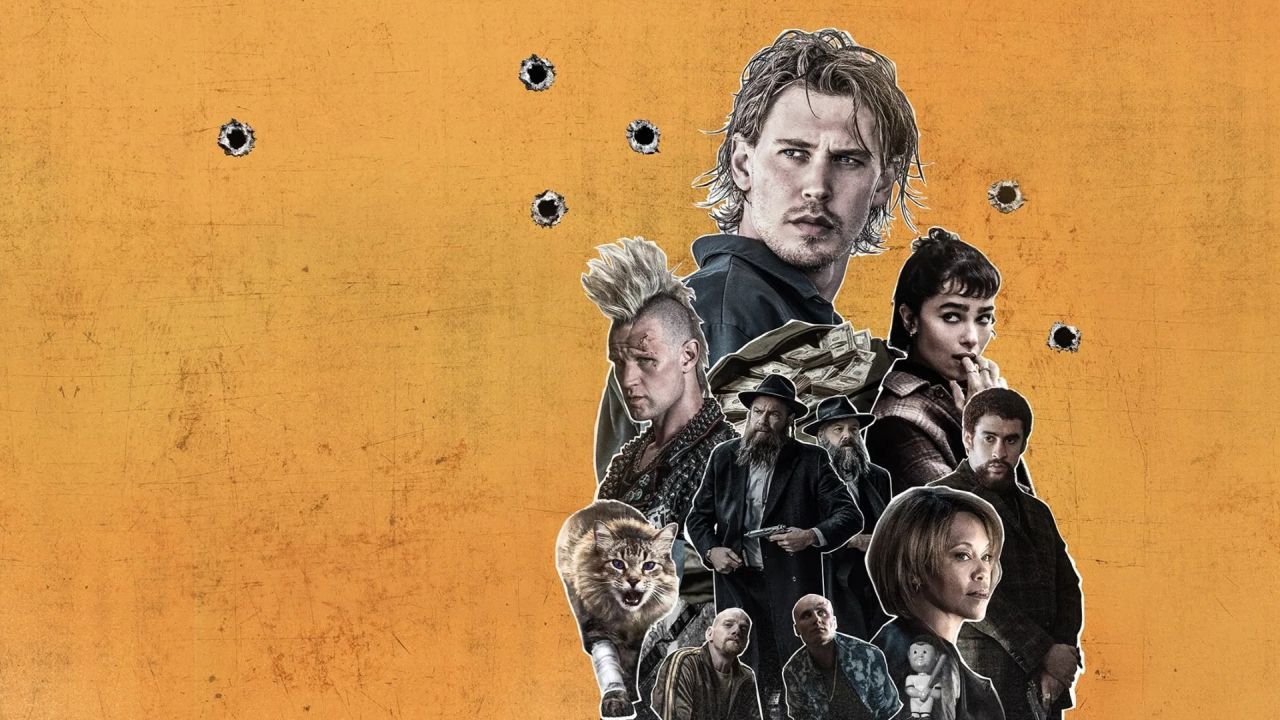
MOVIE REVIEW – Austin Butler ditches the rock-star swagger to play a painfully familiar screw-up in Darren Aronofsky’s high-octane crime caper. Known for grim, art-house nightmares like Requiem for a Dream, the director loosens his grip on heavy melodrama and instead takes us on a frenetic, grimy joyride through his hometown – a film that recalls After Hours, only with the bodies stacking up in every alley.
There are two benchmarks that define a true movie star. First: can they carry an entire film on their shoulders? In Caught Stealing, Butler does it with an effortless, easygoing charisma that keeps every supporting player orbiting around him. The second: can their name alone draw audiences into theaters? We’ll find out soon enough when Aronofsky’s scuzzy, misfit-driven thriller opens in Hungary on August 28. Here Butler gives what might be his most approachable, down-to-earth performance to date—even as the story keeps dragging him into bloodier, nastier corners.
For Aronofsky, the project marks a sharp left turn. Butler plays Hank Thompson, a washed-up New York bartender who spends his nights glued to Giants games, knowing in his gut that he should’ve been hitting home runs, not pouring shots. He still swings like a champ, but a drunk-driving crash a decade earlier shattered his knee and ended his shot at glory. The accident still haunts him in nightmares—a smart departure from Charlie Huston’s novel, which separated the injury from the crash entirely.

The Neighbor, the Cat, and a Doomed Nice Guy
Huston himself penned the adaptation, reshaping Hank to better fit Butler’s conflicted golden-boy vibe. Hank hails from California, and it shows: unlike hardened New Yorkers who barrel past strangers without a glance, Hank actually sees people. He slips a few bucks to the homeless man outside his stoop, treats his neighbors with respect, and even agrees to watch over a cat for Russ (Matt Smith), the drug-pushing English punk with the flaming orange Mohawk next door.
That generosity becomes either his undoing or his salvation. When Russ vanishes, a rogues’ gallery of thugs storms Hank’s rundown apartment looking for something—a key, as it turns out, though no one knows what it unlocks. The first pair of heavies (Nikita Kukushkin and Yuri Kolokolnikov) thrash Hank so savagely that he wakes up in a hospital missing a kidney. And that’s just the beginning. More goons line up at his door until Hank realizes his only options are to play along or end up in a body bag.
Like its protagonist, the film pays unusually close attention to the people around him. That’s why the ensemble is so memorable: Hank’s feisty paramedic girlfriend Yvonne (Zoë Kravitz), a stone-faced detective (Regina King), his washed-up biker boss Paul (Griffin Dunne), the aforementioned Russian bruisers, two terrifying Orthodox brothers (Liev Schreiber and Vincent D’Onofrio), and a wild-card Puerto Rican gangster (a gleefully unhinged cameo by Bad Bunny that feels air-lifted out of a Guy Ritchie flick).

New York Grit, Gallows Humor, and Plenty of Corpses
Aronofsky doesn’t flash the stylistic fireworks of Ritchie, but the unpredictable encounters and grim slapstick beat down the door with the same chaotic energy as Lock, Stock and Two Smoking Barrels. Griffin Dunne’s appearance is practically a neon sign pointing to the inspiration: Aronofsky openly channels Martin Scorsese’s After Hours, while longtime cinematographer Matthew Libatique fills the screen with a restless blend of grime and kinetic city glow.
Stretched over several tense days, the story follows Hank as he scrambles to shake off Russ’s enemies and keep innocents from getting slaughtered. But he’s no John Wick; he’s just a regular guy drowning in regret and booze, not a super-assassin polishing off bad guys. In lesser hands, those details would feel like clichés. Huston, however, weaves them into a portrait of a man in crisis without tipping his hand toward a neat redemption arc.
And Hank isn’t fueled by revenge. Even after losing a kidney, he doesn’t go hunting payback—he’s smart enough to duck out of the Russians’ way next time. What he does obsess over is Russ’s cat, Bud, a cranky Maine coon (played by Tonic, the same feline from Pet Sematary) who mauls everyone but Hank. That says more about his core nature than any speech could. How often do antiheroes in movies like this stop to call their moms?
A Loser’s Odyssey Through the Big Apple
Hank may not be a killer, but his old athletic reflexes serve him well. In a Chinatown chase, he slides under a truck’s tailgate like he’s stealing home, and later he wields a baseball bat as if it were forged for combat. Releasing in the same window as Spike Lee’s Highest 2 Lowest, Caught Stealing showcases New York’s cultural sprawl: from the Unisphere and Shea Stadium at Flushing Meadows to the beaches of Coney Island and Brighton Beach.
Where four of Aronofsky’s last five movies premiered in Venice, this one hits theaters at home, boosted by a wave of advance sneak previews. On the surface, it might look like a lighter detour from the director of Pi, The Wrestler, and The Whale. In truth, Aronofsky gets us just as close to Hank as he did to those characters. For Butler, it’s not the dazzling showcase of Elvis or Dune, but stripped down to his gray briefs, the stardom speaks for itself.
-Gergely Herpai “BadSector”-
Caught Stealing
Direction - 8.2
Actors - 8.1
Story - 8.4
Visuals/Music/Sounds/Action - 8.4
Ambience - 8.2
8.3
EXCELLENT
Darren Aronofsky steps away from his trademark gloom to craft a darkly funny, blood-splattered New York crime ride. Austin Butler proves he can hold the screen with ease, playing a loser turned unlikely survivor. Caught Stealing is grimy, gripping, and far more human than it first appears.







Leave a Reply