
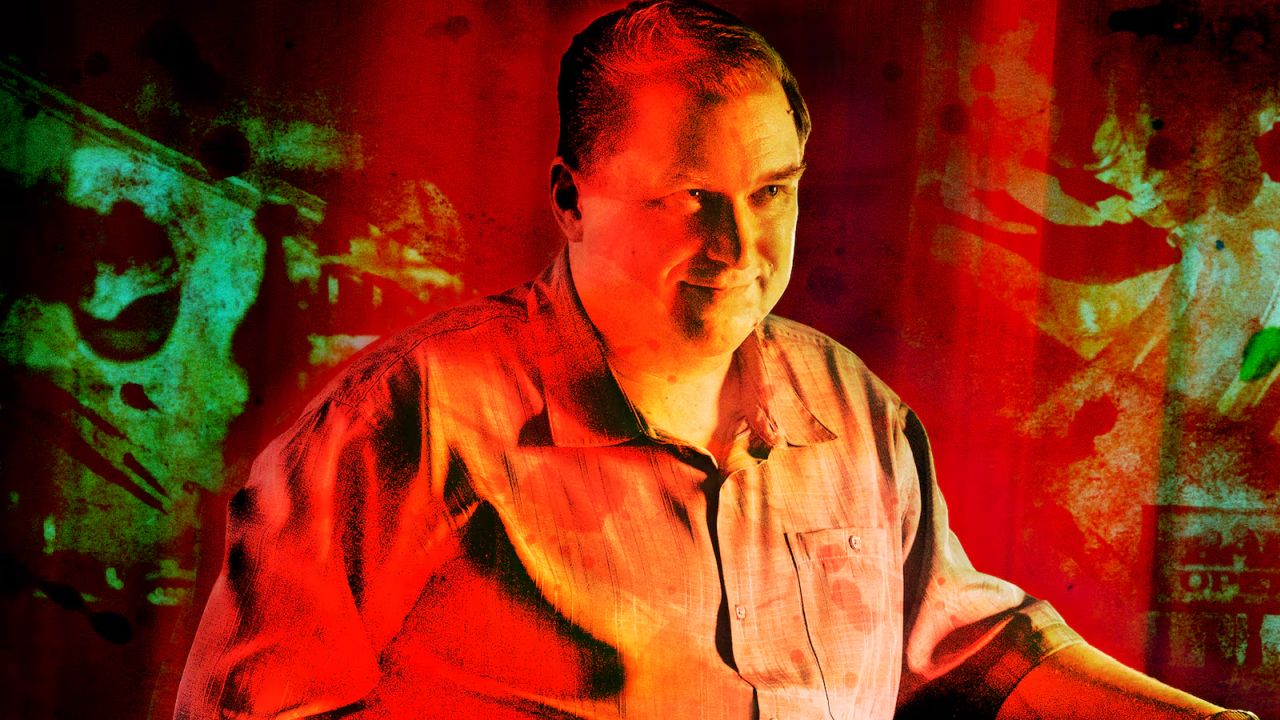
SERIES REVIEW — True-crime works best when it stops polishing a notorious perpetrator’s legend and turns the spotlight back on the lives that vanished. Devil in Disguise: John Wayne Gacy does exactly that: it strips away the aura that built up around Gacy and shows, in plain terms, where society looked the other way and where institutions stumbled, allowing the “killer clown” to operate for years. There’s no cheap shock value here; the show leans on empathy and on stories that were pushed aside, while calmly mapping out who bears responsibility. We watched the first three episodes of this chilling series on SkyShowtime in Hungary.
Seven years ago, one of prestige TV’s defining anthology entries, American Crime Story: The Assassination of Gianni Versace, flipped the vantage point: it rewound from the headline crime to follow the lesser-known victims of Andrew Cunanan, pulling the forgotten out from behind a famous name. In 2023, HBO’s docuseries Last Call: When a Serial Killer Stalked Queer New York reached a similar conclusion: homophobia doesn’t just distort public memory — it also skews how police respond when gay men are targeted. The same victim-first approach links the Scandinavian drama The Investigation — which, in the Kim Wall case, purposefully kept the perpetrator nameless — and Liz Garbus’s work on the Gilgo Beach and University of Idaho murders, where the narrative is anchored to those who were killed. That outlook gives Gacy’s story a new backbone here as well: instead of putting the “monster” on a pedestal, the show restores faces and lives that myth-making usually covers up.

Taking the Myth Apart Without Sensationalism
At first glance, Devil in Disguise: John Wayne Gacy on SkyShowtime could be mistaken for a side branch of a Ryan Murphy project: Netflix’s anthology Dahmer – Monster: The Jeffrey Dahmer Story likewise used the notoriety of a Midwestern nightmare as its launch pad. This series, however, stays firmly on the victim-centered track rather than chasing spectacle: it methodically dismantles the “killer clown” template Gacy burned into the culture. Showrunner Patrick Macmanus (Dr. Death, The Girl from Plainville) deliberately avoids the usual tabloid bait — no straight-on shots of clown paint, no graphic killings, no grandstanding courtroom set pieces. The endpoint is known — a guilty verdict followed by a death sentence — so the focus shifts to the human errors and institutional failures that got us there.
Here, the choice to leave things unseen doesn’t soften the blow; it clarifies it. Where many shows would fixate on gore, this one lingers with families, everyday spaces, and the blind spots of the investigation. Spectacle gives way to consequences, names, and accountability.

The Missing, From Rob Piest to the Unnamed
The story opens with the final victim, suburban Chicago teenager Rob Piest (Ryker Baloun), taken from his workplace while his mother (Marin Ireland) waited in the car. Detectives Rafael Tovar (Gabriel Luna) and Joe Kozenczak (James Badge Dale) close in quickly — in part because the contractor covered his tracks with startling sloppiness: multiple witnesses saw him speaking to Piest, and an earlier sodomy conviction only deepens suspicion. As pressure mounts, Gacy can’t keep quiet; he invites officers into his home and practically points out where to dig. The relative ease of the arrest makes the later recovery of remains beneath the house and around the property even more sickening: if it was this straightforward now, who failed — and why — during the six prior years?
Episode titles, structure, and flashbacks all insist on the victims’ individuality: one young man feeling out his sexuality in a hostile world; another surviving through sex work; someone written off as a troublemaker; another simply looking for decent pay. Often we never even see them alongside Gacy — the show trusts viewers to connect the last quiet moments to the tragedy that followed. These aren’t case numbers; they’re interrupted lives, cut short by club-door policies, police bias, and the absence of shared databases.
Marin Ireland traces a bruising arc from panic to fury to spent acceptance. At times, the season tips toward the didactic — Kozenczak’s frank admission about his “blind spots,” for example — and the episodic rhythm can echo itself, but the overall focus stays clear.

The Man Behind the Makeup: A Level-Headed Close-Up
Michael Chernus plays Gacy without showy menace — which is exactly why it’s unnerving. Viewers may know him from Severance or Orange Is the New Black; that modest, approval-seeking presence fits Gacy’s needy, overplayed Midwestern folksiness a little too well. The aim is straightforward: peel back the legend and reveal an ordinary — if appalling — man driven by a father’s judgment, internalized prejudice, and self-loathing.
Between Gacy and the audience stands defense attorney Sam Amirante (Michael Angarano), a familiar face from the local scene whose internal conflict — defending someone he’s convinced is guilty — is less gripping than the cumulative loss of life. As a device, though, it works: we get close to Gacy’s compulsive lying and self-deception without being trapped in his point of view. Amirante gives proximity without identification.
Despite a few bumps, the creators’ intent remains unmistakable: to justify revisiting one of the most exhaustively covered crime sprees of the 20th century and to say something meaningful about the people and failures involved. That clarity is what so many exploitative entries lack.
-Gergely Herpai BadSector-
Devil in Disguise: John Wayne Gacy
Direction - 7.2
Actors - 8.1
Story - 7.6
Music/Audio - 8.2
Ambiance - 7.5
7.7
GOOD
Devil in Disguise: John Wayne Gacy keeps its focus squarely on the victims, prioritizing consequences and institutional failures over graphic detail. Its myth-puncturing approach, paired with Michael Chernus’s restrained turn as Gacy, offers a necessary counterweight to sensationalist crime treatments, even if the structure occasionally repeats and slips into didactic beats. The result is a disciplined, empathetic series that returns to an over-covered case for good reason—and, in the process, restores a measure of dignity to the lives that were taken.












Leave a Reply