
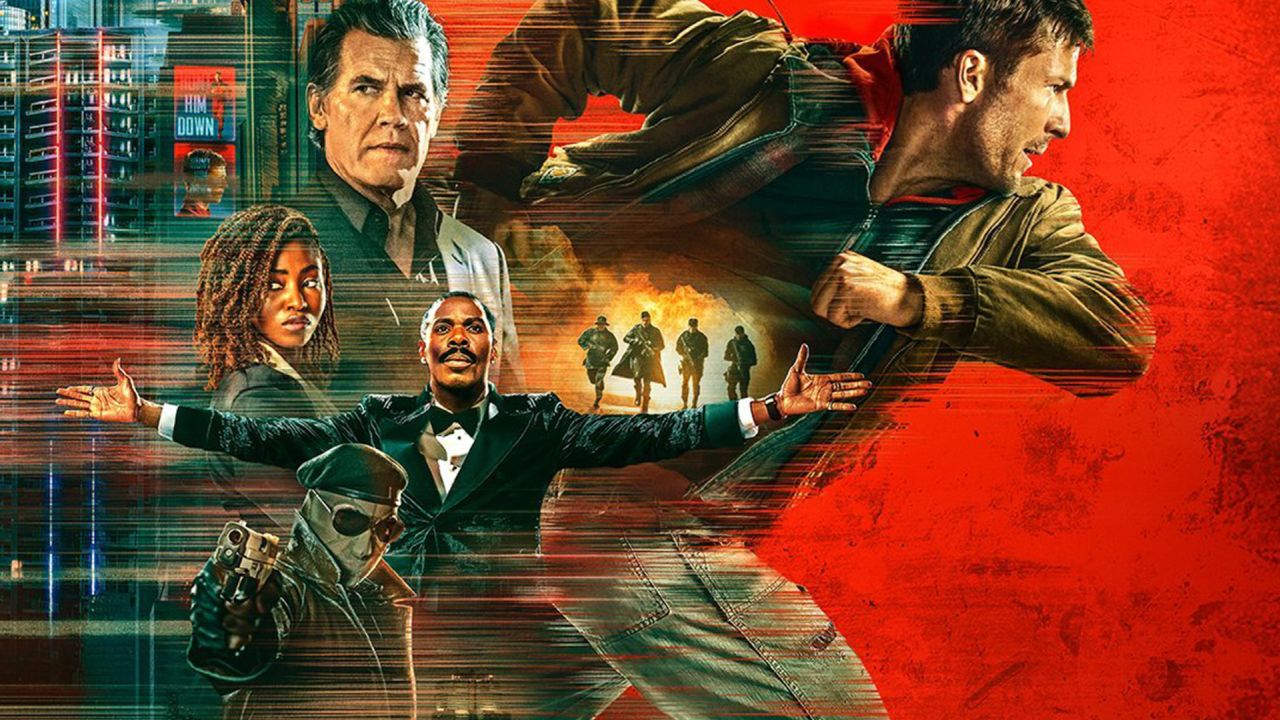
MOVIE REVIEW – Stephen King’s dystopian novel The Running Man imagines a future where a brutal TV game show turns social mobility into a televised bloodsport. Paul Michael Glaser’s 1987 film arrived well before the explosion of reality television, while Edgar Wright’s 2025 adaptation lands in a world where even the so called “leader of the free world” can grow up inside the machinery of reality TV. What once felt like a chilling prophecy now plays more like a familiar warning sign: Wright’s new version rarely challenges the present, it mostly taps into the noise that already surrounds us.
The British filmmaker largely sands down the sharp political edges of King’s story. The movie shouts the rhetoric of revolution, with placards in the air and chants echoing through the streets, but it never convincingly defines who or what the uprising is actually aimed at. When Gil Scott Heron’s legendary track The Revolution Will Not Be Televised drops on the soundtrack, it lands as a wry in-joke rather than a rallying cry, all the more so because it recently closed Paul Thomas Anderson’s One Battle After Another. Wright keeps his satire turned down to a safe level and cycles through buzzwords about surveillance, propaganda, and media control until they merge into a generic, off-the-shelf paranoia cloud.

Revolution Without A Clear Target
In this near future United States, the government, law enforcement and a state run broadcast network lock arms to create a system where power is everywhere and nowhere at once. Glen Powell’s Ben Richards is a working class family man with a born in sense of defiance, someone who feels the system pressing down on him every day but has no obvious point to focus his rage. His path toward radicalization is sketched so loosely that the audience is left in roughly the same fog: you understand that you are supposed to be angry, you just do not get a solid handle on what to direct that anger toward.
Forced into a corner and desperate to secure treatment for his gravely ill baby daughter, Ben volunteers for the title game show. In this world, The Running Man is a true monocultural phenomenon, the last mega show that pulls everyone in and makes today’s fragmented streaming landscape look like faint background static. For thirty days he has to stay alive while professional hunters and fired-up citizens track him, with cameras glued to every move so viewers can follow the hunt in real time. Veteran producer Dan Killian (Josh Brolin) spells out the stakes in brutally simple terms: if Ben survives even a single week on air, his family rockets into the top one percent of society.

A Reality Show That Rewards Not Thinking
King’s central idea is strong enough to support a whole film almost on its own. Wright and his regular co-writer Michael Bacall, who also teamed with him on Scott Pilgrim vs. the World, build out the rules of the show, the lineup of stalkers and the circus atmosphere around them with confident craft. A movie titled The Running Man practically promises relentless, kinetic action, and Wright has been trading on that kind of energy since his early two-thousand indie days. The opening pursuits and first clashes between hunter and quarry deliver on that promise, with tight cutting, clear geography, and a few visual flourishes that briefly recall peak Wright.
The trouble is that the momentum starts to sputter earlier than expected, and the third act ends up feeling smothered by repetition. Ben is written into a series of increasingly contrived dead ends, and the script keeps bailing him out with yet another explosion or a clumsy twist built around deepfake trickery. For every set piece that really connects, there is a story beat that undercuts it and lets the intensity leak away. Wright often seems wary of following through on his own bolder instincts, and instead of pushing the concept into sharper, stranger territory, he defaults to the safest possible detours.

Popcorn Spectacle, Soft Focus Critique
On one level, Wright and his leading man clearly understand what the studio wants from them: a slick, accessible sci fi action ride that nods toward King’s darker themes without turning away anyone looking for an easy night out. The problem is that they deliver that assignment with such disciplined restraint that they dilute the very qualities that set them apart. Both men are acutely aware of their own “brand” and work so hard to fit that brand into a reliable blockbuster template that the movie ends up feeling like a carefully risk managed product, not a personal statement.
For Glen Powell, this should have been the perfect chance to step up from scene stealer to full blown headliner. After making a strong impression as a supporting player in Top Gun: Maverick and sharing the spotlight in Twisters, he now finally gets a studio vehicle built entirely around him. Yet the way Ben Richards is written here feels strangely second hand, like a hand me down role that was tailored for a different kind of performer. At a glance it appears to fit, but the longer you look, the more it seems to pinch in all the wrong places.

Glen Powell Shines Most When He Is Hiding
This version of Ben leans heavily on grim stares, clenched teeth, and bottled up rage, while offering very few moments that play to Powell’s easy, mischievous charm. You can sense the actor trying to dig into the character’s worn down, hardened side, but the performance does not fully snap into focus until the game show truly kicks off and he disappears into the city. Once the rules force him to adopt disguises and melt into different corners of the urban crowd, that chameleon quality we saw in Hit Man finally comes roaring back.
Powell prowls through the streets in playful costumes, cycling through accents, body language, and social types, and you can see how much he enjoys the meta level of performing a performer. Paradoxically, he seems most like himself when the film asks him to pretend he is someone else entirely. That stands in contrast to the classic movie star model, where the appeal is built on delivering small variations of the same persona each time. Here he appears eager to bend and break that mold, but the script only sporadically finds ways to turn that impulse into a compelling character journey.

Edgar Wright As A Reliable, Safe Pair Of Hands
On the action front, Powell has nothing to be ashamed of: he runs, brawls, crashes through glass, and handles the physical choreography with ease, and that inevitable towel-only escape sequence confirms that the gym work has been done. The deeper issue is that the film rarely finds situations where his physical bravado and his sly sense of humor can fire at the same time. Wright and Bacall give him a few sharp one-liners, but the overall rhythm of the dialogue still feels tuned to the clipped, hyper-macho delivery associated with Arnold Schwarzenegger’s original take, which does not sit comfortably on Powell’s shoulders.
Ben’s fury over systemic injustice gradually collapses into a much narrower revenge plot as the story moves along, and Powell struggles to inject that boiling anger with the sort of magnetism that draws an audience to him. Because the character is supposed to serve as a pressure valve for the viewers, someone onto whom they can project their own frustrations with the system, this lack of irresistible presence lowers the emotional stakes. It becomes difficult to believe that this Ben Richards is the kind of lightning rod who would send viewing figures through the roof.
What might be chalked up as growing pains for an emerging star is much harder to overlook in Edgar Wright’s case. Here is a director who once stood out through idiosyncratic cuts, rhythmic visual gags, and an almost musical sense of structure, and yet in this project, he largely parks those strengths at the studio gate. The likely nine-figure budget, which should represent a new peak in his career, ends up feeling like a leash rather than a reward. Wright comes across as a dependable craftsman tasked with delivering clean, brand-safe action scenes instead of an auteur free to push form and tone.
A Film That Is Content To Just Get By
In the end, it is almost only Michael Cera’s brief appearance, a winking echo of those old Scott Pilgrim days, that hints at what The Running Man might have looked like if Wright had allowed himself to be looser and more formally adventurous. He tries to compensate for the missing visual personality with sharp casting and a scattering of small gags, and performers like Colman Domingo, William H. Macy and Lee Pace all make their scenes pop. Still, these turns feel more like colorful fragments than fully developed characters that linger in the memory.
Much like the society inside the story discovers that endless spectacle has a hard ceiling on how much it can numb or satisfy, Wright’s film also runs up against its own limits. It is competent, often entertaining and occasionally incisive, but it rarely taps the full political charge or stylistic potential of King’s material. This Running Man settles for being solid instead of aiming higher, circling the track with confidence but never quite making the daring move that would carry it into the top tier of Stephen King adaptations.
– Gergely Herpai “BadSector” –
The Running Man
Direction
Actors
Story
Visuals/action/music/audio
Ambiance
MEDIOCRE
This new take on The Running Man is flashy and at times genuinely fun, but it treats the social criticism built into Stephen King’s novel with kid gloves. Glen Powell proves he can carry the physical demands of an action lead, yet the darker, more brooding version of Ben Richards he’s given never really lets his natural, playful charisma loose. Edgar Wright, for his part, largely sets aside the visual swagger and personal style of his earlier work, and the result is a solid but far from outstanding spin on a classic piece of material.














Leave a Reply