
MOVIE REVIEW – On paper, Keeper sounds like a can’t-miss, small-scale serial killer horror: a retreat to a cabin in the woods, a relationship quietly cracking, ominous signs piling up, and madness seeping in scene by scene. On screen, though, it plays much more like an overlong nightmare collage, where mood, strange images, and the soundtrack often land harder than the story itself. Some moments genuinely crawl under your skin, yet overall it feels as if the director of Longlegs and The Monkey had simply dumped the horror mixtape from his brain straight onto the screen, then left us to sort through the mess and look for meaning. We watched Keeper at the Puskin cinema in Budapest.
Over the last few years, Osgood Perkins has quietly turned himself into one of the more recognizable voices in modern horror: Longlegs was marketed like an instant cult item, and The Monkey twisted a Stephen King short story into something warped and nasty enough not to feel like a dutiful, by-the-numbers adaptation. His films usually lean on thick, unnerving atmosphere, patient pacing, and a very tangible psychological darkness, with the occasional deliberately theatrical, almost stagey flourish. It is no surprise that the trailers for Keeper promised a “psychedelic” cabin-in-the-woods nightmare trip, the kind where the border between reality and hallucination slowly slides out of place.
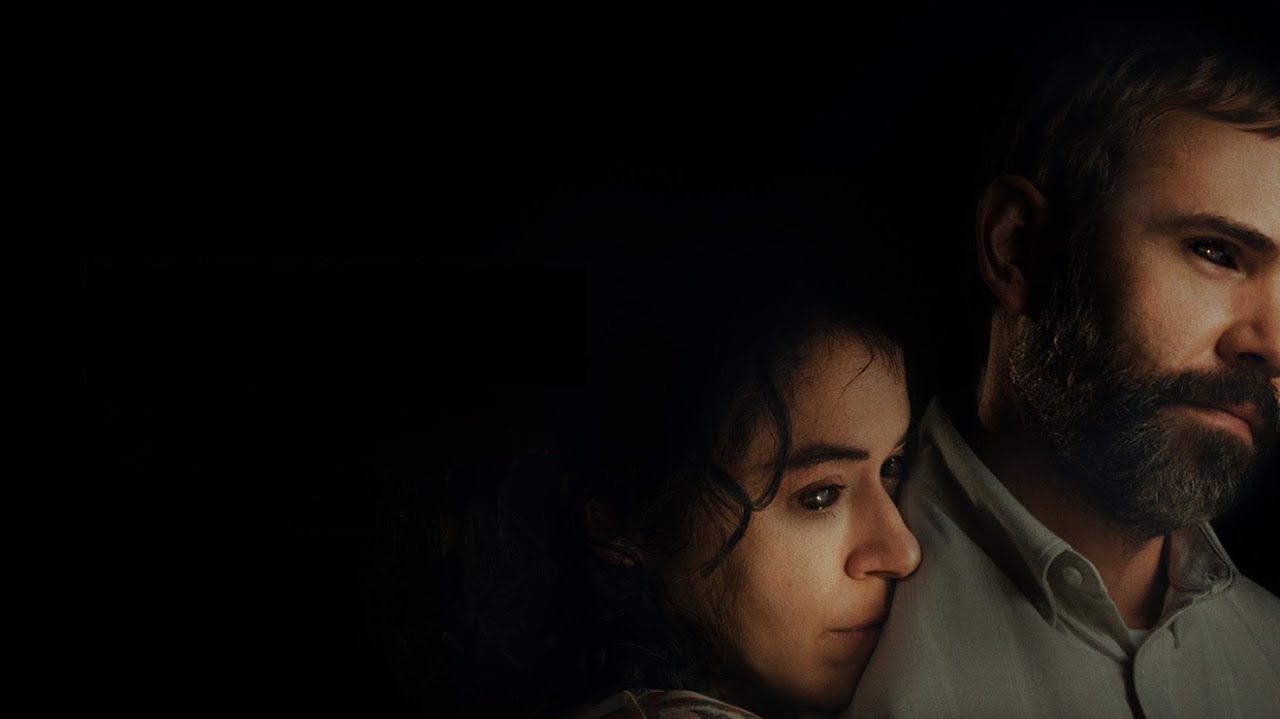
At the center of the story are Liz (Tatiana Maslany) and her boyfriend Malcolm (Rossif Sutherland), who head out of the city to spend their first anniversary at his family’s cabin. The setup rings familiar to any horror fan: a seemingly idyllic house in the middle of nowhere, a relationship with more question marks than either partner wants to admit, and a vague sense of wrongness that slowly seeps into every corner of the place. In the opening stretch, Perkins plays into these expectations with confidence, but as the film goes on, it often feels like he cannot decide whether he wants a tight, nerve-shredding thriller or a drifting, dreamlike tone poem. Keeper wobbles between those two modes for almost its entire running time.
Experimental Horror That Starts Strong, Then Falls To Pieces
Keeper is very clearly designed as an experimental horror film: Perkins does not build around a classic “we track the killer” structure; he leans into formal play, jagged cutting, and fragmented associations. On paper, that is an appealing stance – these are the kinds of films that promise to say something fresh in a genre that has been mined to death. The problem is that most of those experimental ambitions end up feeling more interesting than genuinely effective. Unlike one of the few recent real outliers, Kyle Edward Ball’s Skinamarink, Keeper never quite finds that suffocating, alien strangeness that makes you keep glancing at the dark corner of the room for nights afterward.
At its core, Keeper is a serial killer drama that occasionally delivers some very sharp, chilling beats, yet as a whole it feels oddly muted, almost “normal” in a down-to-earth way. Now and then, this naturalistic tone is punctured by a woozy, trip-like oddness: random visions, jumps in time, and images that feel as if they have wandered in from a completely different movie. The trouble is that these strange intrusions never really click into a coherent whole. You can call it “dream logic” if you like, but that label does not magically make the film better – it just gives you an easier excuse for why so many things fail to add up.

Relationship Horror In A Cabin You May Not Want To Visit
The frustrating part is that the film actually opens on a sequence strong enough to make you believe Perkins is about to deliver something truly memorable. From the main character’s point of view, we see a montage of the women he has dated and then dropped – almost like flipping through a private diary of how the same pattern plays out again and again. As the pieces line up, a very familiar social type comes into focus: a man who is devoted only until the next “love of his life” shows up. The behavior is contradictory in itself, and it dovetails neatly with the language of serial killers: if “serial” is the defining trait in every part of someone’s love life, that is rarely a comforting sign.
Out of this prologue, the film shifts over to Liz. Tatiana Maslany, whom we have every reason to rate highly since her Orphan Black days, plays a smart, urban, slightly adrift woman who is heading into that anniversary trip with more doubts than she admits out loud. Malcolm invites her to what he modestly calls a “cabin,” which in reality turns out to be a renovated, stylish, generously sized house in the woods. The huge windows, open-plan rooms, and surrounding forest make it look like something lifted straight from a horror location scout’s notebook – the perfect hideout for anyone who might want to make someone disappear.
Malcolm himself does little to calm our nerves. He is a doctor, withdrawn, awkward, and rarely smiles, and Rossif Sutherland plays him with a quietly unsettling energy that never quite lets up. Bearded, grumpy, communicating mostly in one-word replies, he is not exactly the picture of effortless romance or emotional transparency. It is only natural that the audience keeps asking what Liz actually sees in him – and the film leans on that doubt. On the surface, everything about him scans as “ordinary,” but there is a trace of suspicion in nearly every gesture. In a culture as sarcastic and joke-hungry as contemporary America, Malcolm’s dour Canadian earnestness practically reads as a red flag all by itself.

One Slice Of Cake, And The Nightmare Kicks In
At one point, Malcolm hits Liz with the most overused line in the book – “you’re not like the other girls” – which is more than enough to put us on alert. You brace yourself for the slow, inevitable descent into his madness, but instead the story veers sideways. Malcolm’s cousin Darren shows up, a deeply sleazy bro type that Birkett Turton plays like a washed-up TV host gone bad. He brings along Minka, an almost entirely silent Eastern European model, who glances at the cake the caretaker has delivered and casually announces that it “tastes like shit.” As a slice of grounded, uncomfortable horror, the whole situation tracks, but Minka’s verdict soon starts to feel suspiciously off.
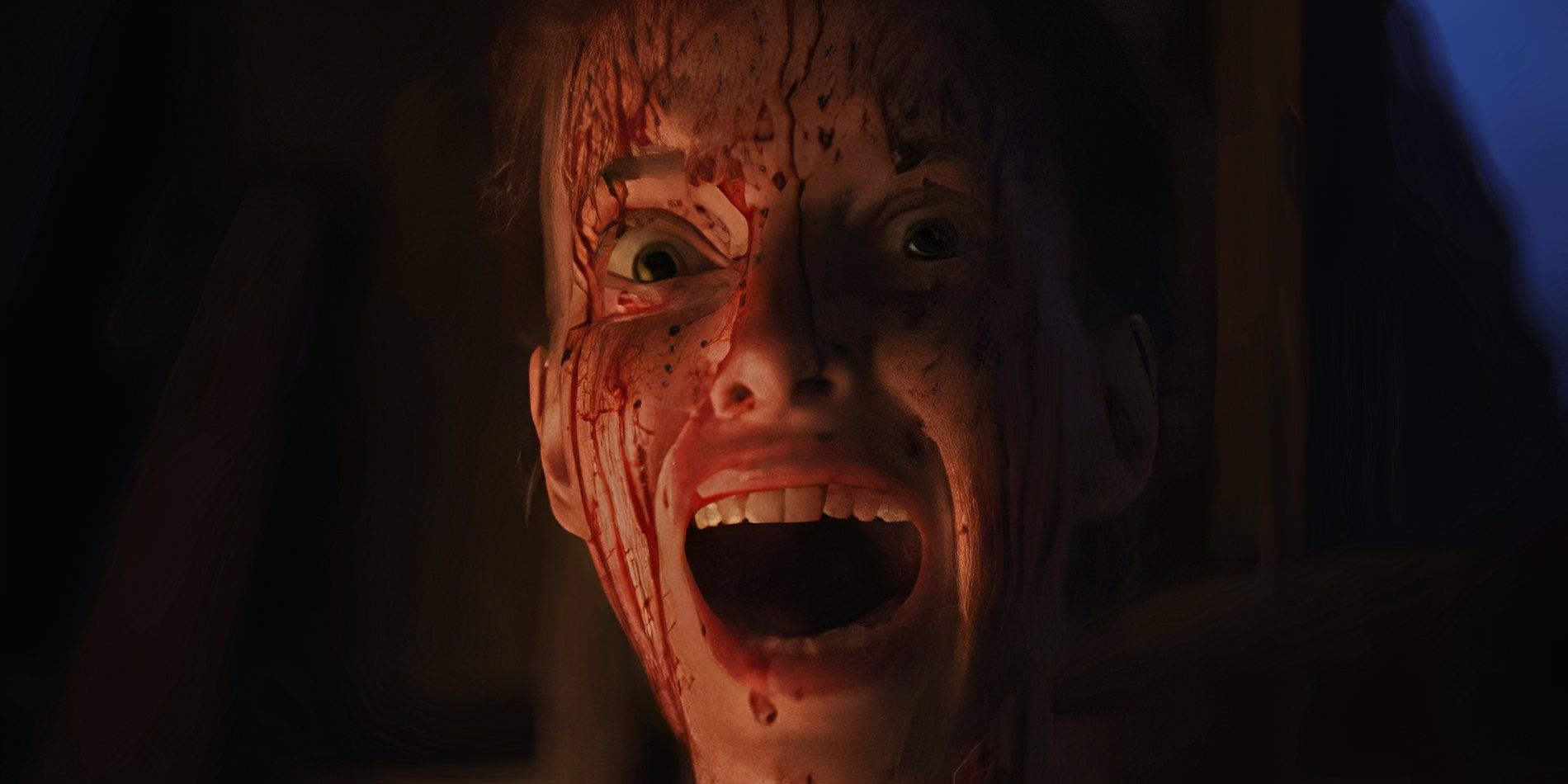
Later, Malcolm offers Liz a piece of that same chocolate cake. She takes a bite – in a nicely staged, drawn-out moment of suspense – and it seems perfectly fine. In the middle of the night, though, she sneaks down to the kitchen and devours the rest in a kind of frenzied binge. From that point on, the visions spill in: washed-out, ghostly figures, the dead-eyed faces of former girlfriends, Minka, and a smaller double of herself framed together like a warped nod to the twin girls from The Shining. The strangest image of all might be a flashback to some bygone century, where the cousins, as boys, stalk through the woods with muskets and shoot a pregnant woman who looks uncannily like Liz.
After this, Malcolm heads back to the city, supposedly to deal with a patient, and Darren returns to the cabin, marching straight into the kitchen to pull a massive butcher knife from its place. Every signal screams that he is the killer we have been waiting for – and then nothing really comes of it. The movie keeps setting up scenes like this, cranking up the tension and then cutting it off without any real payoff or consequence. After a while, you stop feeling scared and start feeling worn out, just waiting for the film to decide what any of this is actually about, finally.
Gorgeous Images In Search Of A Solid Idea
What cannot be denied is that Keeper looks terrific: Jeremy Cox’s cinematography builds a clean, woodsy, sometimes downright elegant visual world that feels far more controlled than the more frantic, overcaffeinated barrage of ideas in Longlegs or The Monkey. From the viewer’s side, though, the experience often boils down to nearly two hours of “trying to figure out what the hell this movie is trying to say.” The usual serial killer trappings are all here – severed heads, bodies soaking in disgusting fluids, foul tanks and tubs – wrapped in a vague, half-sketched mythology that the film wants to sell as a deep commentary on men who are terrified of commitment.
The needle drops push in that direction too: Peggy Lee’s “I Don’t Want To Play In Your Yard,” Mickey & Sylvia’s “Love Is Strange,” and Elvin Bishop’s “Fooled Around And Fell In Love” all suggest Perkins thinks he is mapping the overlap between homicide and emotional cowardice, that space where indecision, fear of responsibility, and the habit of treating partners as disposable collide. The catch is that none of this ever really crystallizes into a clear thought on screen. More than anything, Keeper exposes Perkins as a filmmaker who cannot quite commit to a single, consistent cinematic language – it is like watching him chase the next cool idea, grafting every passing inspiration onto the same story, whether it fits or not.
-Gergely Herpai “BadSector”-
Keeper
Direction - 6.2
Actors - 7.1
Story - 5.3
Horror/visuals - 7.2
Ambiance - 6.4
6.4
FAIR
Keeper is a horror film that starts from a promising idea, with visuals and atmosphere that often hit hard, but a shaky overall concept in which the nightmare images linger while the story itself quickly fades. It is really for viewers who enjoy slow, drifting, experimental mood pieces, and who can live with the fact that logic is only half present in the narrative. Anyone hoping for a tight, well-built, cathartic serial-killer thriller will probably leave after the end credits feeling as if someone stopped making the horror halfway through and only bothered to finish the set dressing.













Leave a Reply