
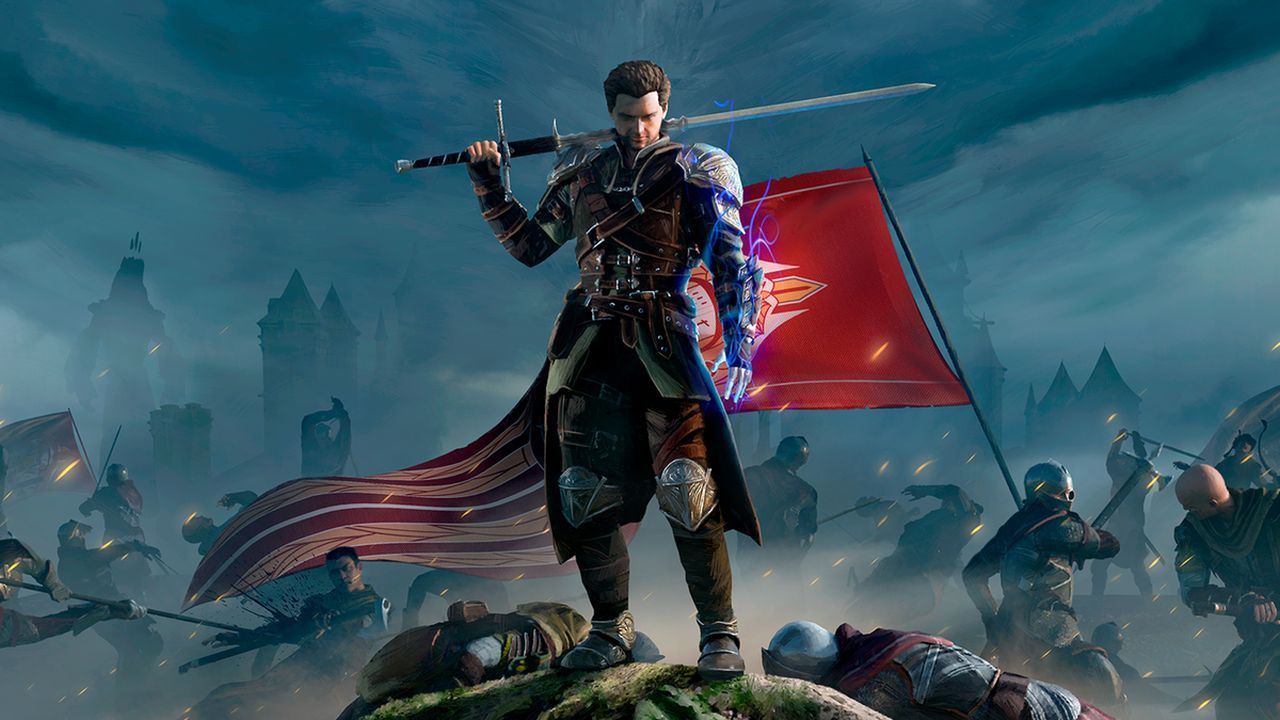
REVIEW – Fire & Frost and tinyBuild’s new role-playing project sounds like the kind of fantasy pitch Gothic fans would scribble in a notebook: a low-fantasy open world, exploration without markers, and a hapless cartographer dropped into a land that seems determined to murder him the moment he steps off the boat. Once you start playing, though, Of Ash and Steel behaves like a rough, unfinished euro-jank relic from 2002 that was hastily wired to run on modern machines with the hope that nostalgia could hide its cracks. Every time the game briefly shows what a moody, atmospheric old-school RPG it *could* have been, another freeze, another glitch, or another baffling design choice smothers that hope instantly.
Of Ash and Steel presents itself as a third-person open-world action RPG inspired by early-2000s classics, bolstered by survival elements. You arrive on Greyshaft, an island that is technically part of the Kingdom of the Seven, yet looks and feels more like an abandoned, lawless frontier where justice ends at the reach of your blade. The intent is clear: no quest markers, no constant direction, no comforting tutorials. Instead, the world pushes back against you, and your curiosity and stubbornness are meant to carry you forward.
The philosophy is admirable, but in practice everything falls apart. Characters feel like cardboard cutouts, and Tristan – your unlucky protagonist – has the charisma of a damp pastry. The world is visually anonymous, the pacing soon turns into a dull grind, and all of it is wrapped in a technical mess that makes you question whether this is really a finished product, or some stray pre-alpha prototype that accidentally escaped onto Steam and GOG.
Retro Vibes, Wax Figures, And A Buckling Engine
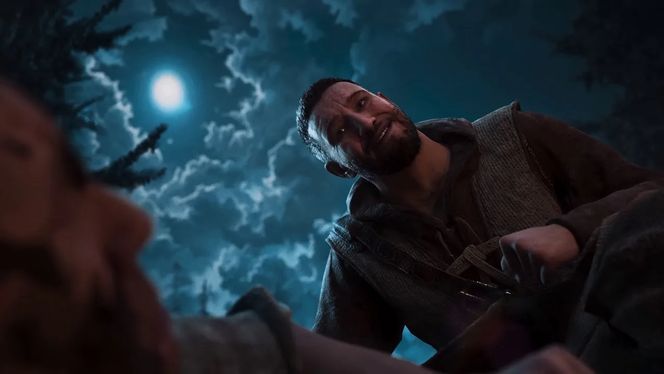
First impressions matter, and here those opening minutes hit like a bucket of cold water. You’re forced through long, awkwardly cut cinematics paired with flat, cliché narration, and then immediately shoved into a series of mind-numbing fetch quests in a camp so forgettable you’d struggle to recall it an hour later. Characters have glossy, mannequin-like skin, glassy eyes, and stiff facial animations that make it clear character modelling was never a priority.
Stylized graphics can absolutely work, but Of Ash and Steel doesn’t land on any real style. The textures look washed-out, the environments feel generic, and outfits barely differ from one character to the next. Maxing out settings on a strong PC won’t fix it – it just makes the shortcomings more obvious. Hair looks like wispy translucent threads, and lighting rarely forms a genuinely dramatic or atmospheric scene.
Things get worse once you start moving. Frame drops are common, dips below 20 FPS aren’t unusual, autosave hitches constantly interrupt flow, and load screens sometimes stretch for minutes. Benchmarks show issues even on an RTX 4080 Super, which says everything about the game’s optimization. And this is only the beginning: playing with menus or aspect ratios can create situations where the cursor simply can’t reach the right side of the screen, locking off entire sections of your settings.

Tristan, The Damp Bread Hero, And The Never-Ending Prologue
The game’s narrative introduction doesn’t fare any better. Long cutscenes padded with loading breaks attempt to outline the political ties between Greyshaft and the Kingdom of the Seven, but the result feels like listening to an overeager yet clumsy Dungeon Master explaining world-building lore while everyone just wants to start playing already. Tristan, a cartographer, arrives with a group of knights to a land where hardship is routine, people are harder still, and authority ends wherever someone’s sword reaches.
The first camp – which should function as an exciting hub – is instead a swamp of dull tutorial tasks. You slog through one uninspired “pick this up, carry that there” quest after another. Tristan gets knocked out and left for dead twice, treated less like a protagonist and more like a disposable background character. The farmer who rescues you buries you under even more tedious errands, padding out time long before the game offers anything resembling momentum.
In theory, this is the classic slow rise of a weak hero learning his place in the world. But the pacing is so sluggish that you’ll be over an hour in before it feels like the story has actually begun. Tristan himself has the personality of soggy cardboard: no memorable dialogue, no real reactions, no visual identity beyond “generic fantasy NPC variant number five.” You can’t choose another hero, nor customize much – you’re stuck with him the entire time.
Worse yet, Tristan starts out almost completely incompetent. Too weak for a decent axe, clumsy with a bow, and unqualified for most weapons. Progression is a slog of stat requirements, trainers, gold, and resources, all combining into an exhausting grind before combat even feels functional. This isn’t rewarding difficulty – it feels deliberately obstructive, as if the game doesn’t want you to enjoy even small victories early on.

A Combat System Working Against You
Once you step beyond the farm area, the game unloads its combat system on you, and the problems become even clearer. Tristan moves as if wading through mud in iron boots: slow, heavy, and drained of stamina after a few swings. Even basic bandits feel like HP sponges, absorbing hit after hit while you desperately chip away at their health bar.
Most alternative weapons might as well be decorations at first, since you can’t meet their stat requirements. More advanced combat stances, skills, and techniques unlock only after you track down specific trainers, complete their often tedious tasks, and pay them. On paper this sounds immersive, but in reality it keeps shoving you back to square one whenever you start to feel any progress.
An early main mission introduces a hunter who offers to accompany you toward the nearest city. It could’ve been a great way to show players a safer route. Instead it becomes a mobile demonstration of poor design. His default pace is a slow walk, forcing you to plod along behind him. During encounters, he shoots faster than you can swing, wiping out enemies before you even reach them, and leaving you with scraps of experience. Wander too far and he stops. Don’t wander far enough and you spend minutes bored out of your mind. Everyone loses.

The City Gate, 300 Gold, And Peak Jank
If you push through and finally reach the city, the first thing you learn is that entering through the main gate costs 300 gold. If you don’t have enough, you need to get creative. There are alternative entry points, but most require stats you don’t yet possess, meaning you’re stuck experimenting with awkward routes – like trying to approach from the water against the outer wall.
The game visually suggests this isn’t a real entrance, but it lets you get close enough that you try anyway. Eventually, the system just… gives up, and suddenly you’re inside the walls. This would be a good exploit story if it didn’t feel like the game simply lost track of you. Once inside, the true chaos begins. Many NPCs share the same voice lines and deliveries, as if the team used a tiny voice-bank duplicated everywhere. Some activities display leftover developer strings or half-translated text. Animations lurch between 10 and 60 FPS as you approach characters.
The city also feels eerily empty. Minimal ambient noise, NPCs milling about with no purpose, and scenes that resemble an unfinished simulation. Walk into a blacksmith shop and you may find him floating slightly above the ground, hammering the air while a ladder behind him leads to geometry that can trap you permanently until you reload. In another shop, selecting an innocent “What would you give me for this?” line instantly sells items from your inventory without confirmation.

A Priest, A Knife, And Completely Broken Systems
One of the strangest moments occurs during a “test” involving a priest, perfectly demonstrating how fragmented the internal logic is. Earlier, a tutorial warns that stealing has consequences. Naturally you wonder: what if you attack a critical NPC in his own temple? The outcome is surreal. A long, messy melee begins, while worshippers slowly gather around to watch. They don’t intervene, don’t defend him, and don’t call guards. They just stare, occasionally looking supportive.
Eventually a guard shows up, and you expect trouble. Instead, he behaves exactly like the others – a passive spectator. Once you finally drop the priest and pick up his knife (the first weapon that actually suits your stats), the guard suddenly accuses you of theft. Moments earlier he watched the entire fight without moving. Now he cares. This isn’t emergent AI. It’s broken scripting where separate systems don’t communicate.
And that is the real tragedy: Of Ash and Steel clearly comes from a passionate team that wanted factions reacting to your choices, decisions echoing through the world, and layered consequences. What they built instead is a tangle of half-functioning mechanics that struggle with even basic cause-and-effect, let alone complex interactions. The game insists your actions matter, but sometimes it can’t even track who attacked whom.
A Good Dream Buried In The Ash
What hurts most is that the passion behind the project does seep through. The developers wanted an old-school, marker-free, low-fantasy RPG where the world isn’t shaped by UI, but by your curiosity and choices. There are brief moments when that dream flickers: a gloomy forest, distant fortress walls emerging through the fog, or a rare piece of music that fits perfectly.
But the overall state is simply too unstable. Bugs, poor performance, an imbalanced combat system, a bland protagonist, and forgettable quests build an enormous wall between the player and the intended experience. Maybe someone with a lucky configuration, infinite patience, and low expectations will find pockets of brilliance. I wasn’t one of them. After the absurd “priest incident,” I quit – and the game greeted me with the same “wishlist the full version” screen used for its old demo, except this time… the full version was already running.
-Gergely Herpai BadSector-
Pro:
+ A heartfelt tribute to early-2000s Gothic-style RPGs
+ Marker-free exploration with a genuinely appealing concept
+ Occasional moments of strong low-fantasy atmosphere, solid voice work, and good music
Con:
– Catastrophically unstable technical state with game-breaking bugs
– Sluggish, frustrating combat, slow progression, and an exceptionally weak main character
– Bland world and quest design wrapped in inconsistent, broken systems
Developer: Fire & Frost
Publisher: tinyBuild Games
Genre: Action RPG, open world, low-fantasy
Release Date: November 24, 2025
Of Ash and Steel
Gameplay - 3.6
Graphics - 4.2
Story - 4.1
Music/Audio - 4.2
Ambience - 3.4
3.9
BAD
Of Ash and Steel is an ambitious, old-school-inspired open-world action RPG that promises everything a Gothic fan could want, but collapses under technical instability and half-working systems. Its marker-free exploration, bleak low-fantasy tone, and unforgiving world occasionally reveal the strong game it wants to be, yet constant bugs, clunky combat, a weak protagonist, and flat quests pull you back to reality. As it stands, it’s only recommended for players who treat jank as a lifestyle and are willing to endure long hours of frustration for a few rare flashes of brilliance.



![Altera: Even Penguin Soldiers Could Be Out to Get Us! [VIDEO]](https://thegeek.games/wp-content/uploads/2026/03/theGeek-Altera-302x180.jpg)
![Lizard State: If There’s No Sam Fisher, Indie Devs Fill the Gap! [VIDEO]](https://thegeek.games/wp-content/uploads/2026/03/theGeek-Lizard-State-302x180.jpg)



Leave a Reply