
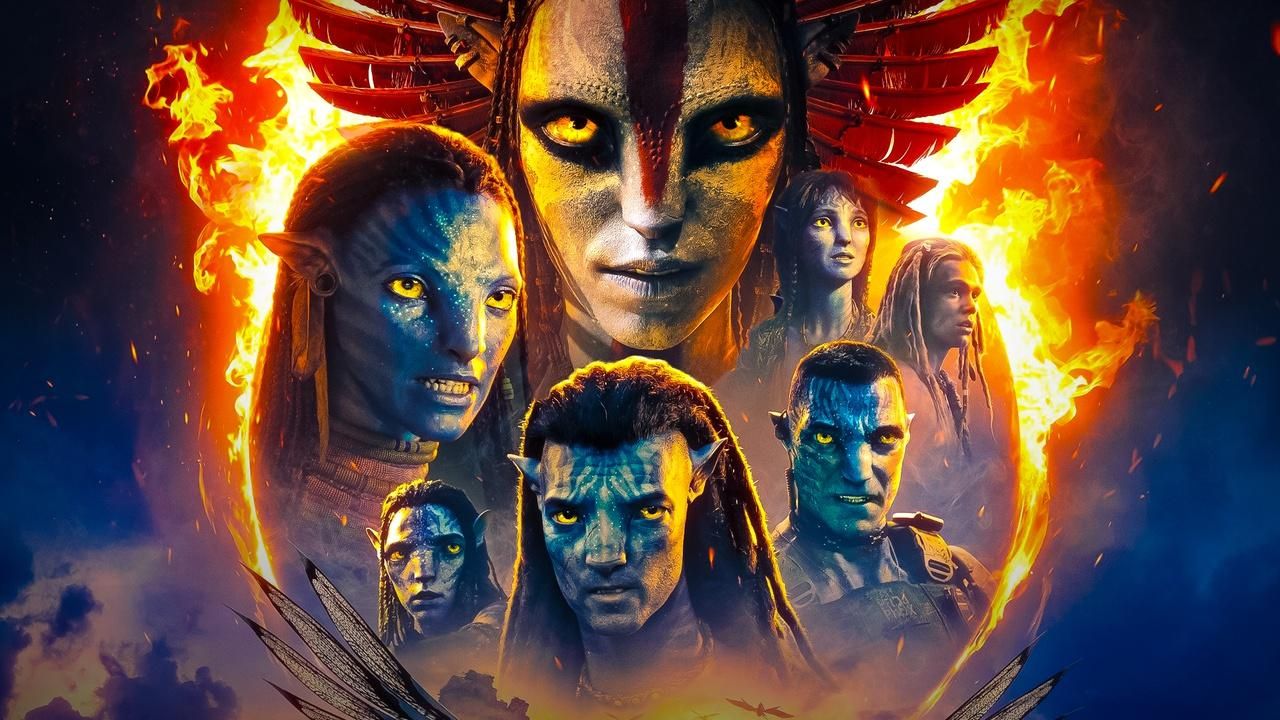
MOVIE REVIEW – Throughout his career, James Cameron has never simply made successful films; he has repeatedly delivered era-defining cinematic milestones. Avatar: Fire and Ash once again arrives as a massive, theater-built experience, but it also marks a point where the franchise’s storytelling begins to feel more cautious, leaning heavily on familiar tropes and emotional excess.
James Cameron’s filmography can almost be read as a timeline of modern blockbuster history. Terminator 2: Judgment Day redefined digital effects, Titanic effectively closed the chapter on traditional Hollywood mega-epics, and Aliens transformed a horror franchise into a full-scale action powerhouse by only its second installment. It is no coincidence that Cameron has repeatedly held the record for the highest-grossing film of all time.
His movies are consistently grand in scale, technologically ambitious, and designed to push the limits of what mainstream cinema can achieve. This philosophy is most clearly embodied in the Avatar franchise, which functions not merely as a series of films, but as a carefully constructed universe built for long-term expansion.

Pandora as a Once-New World
The original 2009 Avatar was a visual shock to the system, creating the genuine illusion that audiences had physically traveled to another planet. Thirteen years later, Avatar: The Way of Water expanded that foundation in nearly every direction, offering stronger emotional arcs, more complex character dynamics, and even more astonishing visuals.
Only three years later, Cameron unveiled Avatar: Fire and Ash, a film shot alongside its predecessor and originally conceived as part of the same story. Cameron himself has acknowledged that these two films were once planned as a single installment, and that shared origin is still evident in the structure of this third chapter.
Unlike many of Cameron’s previous works, however, Fire and Ash does not deliver a dramatic leap in technical or qualitative ambition. That does not diminish its craftsmanship, but it does signal a shift toward safer, more familiar territory, relying heavily on the franchise’s established visual language and narrative rhythms.

The Sully Family, Grief, and Rising Threats
Following the events of The Way of Water, the Sully family remains deeply affected by the death of Neteyam. Jake Sully (Sam Worthington) and Neytiri (Zoe Saldaña) process their grief in fundamentally different ways. Neytiri’s distrust of humans has intensified, and Spider (Jake Champion) living among the family only amplifies existing tensions.
Jake, meanwhile, understands that humanity’s colonial ambitions on Pandora have not ended. The RDA and Colonel Miles Quaritch (Stephen Lang) remain active threats, prompting Jake to recover weapons from the wreckage of previous conflicts in preparation for the violence he knows is coming.
Their children face struggles of their own. Kiri (Sigourney Weaver) feels increasingly disconnected from Eywa, Pandora’s guiding consciousness, while Lo’ak (Britain Dalton) fears that his father silently blames him for Neteyam’s death. These unresolved emotional fractures further strain the family dynamic.
As the Sullys, now aligned with the Metkayina clan, brace for humanity’s next move, a new danger emerges. The Mangkwan clan, also known as the Ash People, is led by Varang (Oona Chaplin), a Na’vi leader who has seen everything she loves destroyed by fire. Now she wields that same destructive force against her enemies, escalating the conflict and placing Pandora’s future in even greater jeopardy.

A Theatrical Experience That Still Matters
In 2025, few films demonstrate the necessity of the theatrical experience as clearly as Avatar: Fire and Ash. Cameron understands how to craft films that demand the scale, sound, and immersion of a cinema screen, and this installment is no exception.
Although 3D has largely fallen out of fashion since the original Avatar, Fire and Ash serves as a reminder of how powerful the format can be when used with precision and intent. The visual immersion of Pandora is breathtaking, while the sound design is so forceful that every splash, explosion, and arrow strike seems to reverberate through the theater itself.
This is not merely a visually impressive film; it is an event. Cameron knows exactly how to draw audiences in and then overwhelm them once they are seated.

A Competent but Trope-Heavy Screenplay
While Cameron wrote the first Avatar alone, the sequels were developed with a team of collaborators. Rick Jaffa and Amanda Silver handled the screenplay, with Josh Friedman and Shane Salerno contributing to the story. As a result, the world of Pandora feels richer and more detailed than ever.
At the same time, Fire and Ash increasingly relies on well-worn narrative conventions. Themes of loss, vengeance, shaken faith, and rebirth are presented in an almost textbook fashion, frequently accompanied by overwrought, overly explicit dialogue that leans heavily into emotional grandstanding.
The film repeatedly underlines its emotional beats with sweeping music and tear-inducing moments that often feel forced rather than earned. Instead of trusting visual storytelling or performance nuance, the screenplay insists on spelling everything out, resulting in scenes that drift into melodrama.
Despite these issues, the story remains functional. The plot threads connect, the structure holds together, but genuine surprise is increasingly rare. From a writing standpoint, Fire and Ash feels more like solid craftsmanship than inspired storytelling.

Repetition and Uneven Focus
Cameron’s action sequences are still expertly staged, but the franchise shows signs of repetition. The central conflict between the Na’vi and humanity once again follows familiar patterns, and several large-scale confrontations echo the structure and rhythm of The Way of Water.
Spider’s role remains contentious. For viewers who felt his presence was excessive in the previous film, this installment offers little relief. The story relies heavily on him as a narrative device, even as he struggles to function as a fully realized character rather than a symbolic concept.

Varang and the Strength of the Performances
The film’s most significant addition is Varang. Oona Chaplin delivers a commanding performance, creating a villain who feels genuinely dangerous and unpredictable. Varang injects new tension into the narrative and serves as a catalyst for both the Sully family and Quaritch.
Zoe Saldaña continues to excel as Neytiri, while Sam Worthington has clearly grown into the role of Jake Sully. Their shared scenes are emotionally compelling and often rival the film’s action sequences in intensity, providing some of the story’s most effective moments.
Momentum Still Remains
Avatar: Fire and Ash does not redefine the franchise the way the original film did, nor does it deliver the leap forward achieved by The Way of Water. Nevertheless, it remains an exceptional cinematic experience and a reminder that the series still has fuel left in the tank.
While the storytelling increasingly circles familiar ground, Cameron and his team continue to open new paths for future installments. Fire and Ash once again proves that no one crafts large-scale action cinema quite like James Cameron.
-Gergely Herpai “BadSector”-
Avatar Fire and Ash
Direction - 7.2
Actors - 6.4
Story - 5.5
Visuals/Music/Sounds - 9.2
Ambience - 7.4
7.1
GOOD
Avatar: Fire and Ash is a visually overwhelming sequel that prioritizes spectacle over narrative risk. While its story remains coherent, it leans heavily on familiar tropes, melodrama, and overt emotional signaling. Essential viewing on the big screen, even if its storytelling no longer breaks new ground.













Leave a Reply