
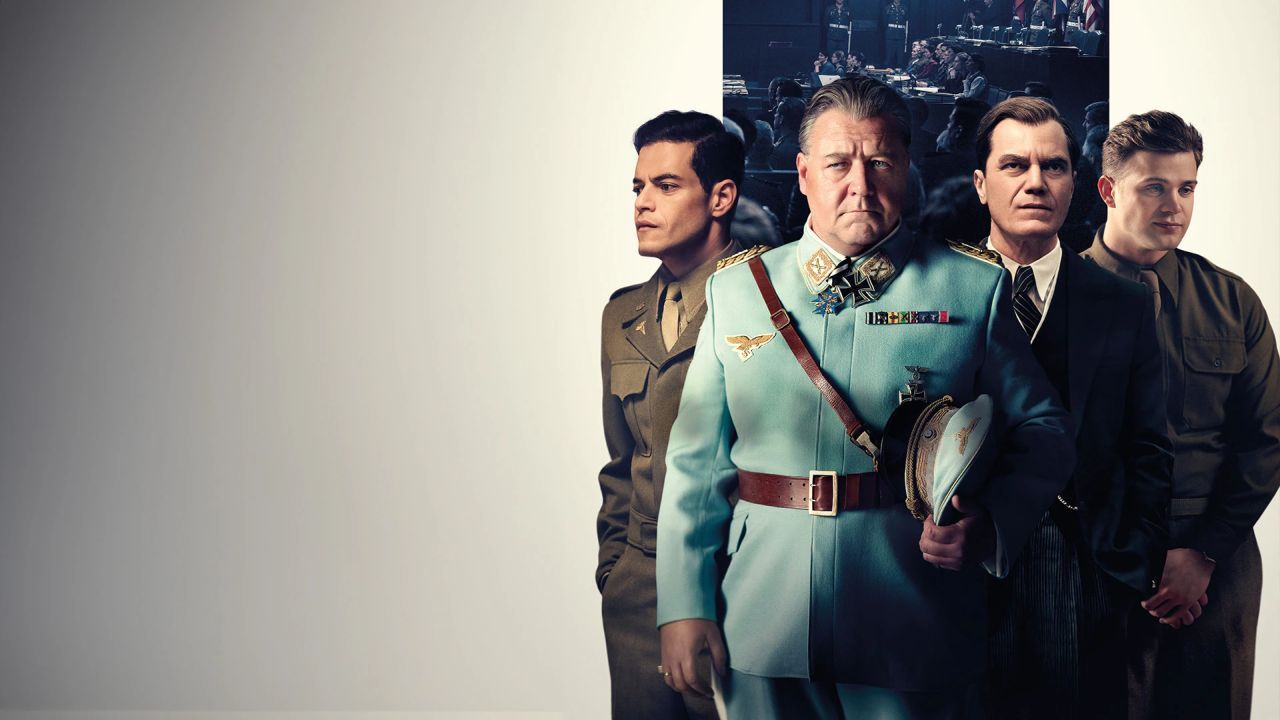
MOVIE REVIEW – The world that emerged after World War II was not only physically devastated, but morally shaken to its core. Nuremberg does not dwell on the horrors of the battlefield; instead, it focuses on the moment when history was forced to pause and confront a far more uncomfortable question: what happens when silence lasts too long. Through a tense narrative built on psychological games and moral confrontation, the film explores the background of the Nuremberg Trials while weaving in timeless reflections on responsibility, all anchored by first-rate performances.
An old idea holds that evil prevails not through action alone, but through inaction by those who know better. In the aftermath of World War II, following Adolf Hitler’s suicide and the deaths of several high-ranking Nazi officials, the United States and its allies were eager to leave the chaos of war behind. Millions had perished in a genocide of unimaginable scale, and the world was desperate to move forward. Yet a handful of governments chose a different path, opting not for erasure or revenge, but for an unprecedented legal process that would stretch the limits of international law as it was then understood.

The Cost of Justice
What later became known as the Nuremberg Trials sought to hold accountable those who survived the war and had actively participated in what we now call the Holocaust. James Vanderbilt’s latest film, Nuremberg, which premiered to resounding acclaim at the Toronto International Film Festival, revisits this period from an unconventional angle. This is neither the first cinematic interpretation of the trials nor likely the last, but its strength lies in how it centers on manipulative human relationships and the internal struggles of men attempting to impose justice on an almost incomprehensible crime.
Based on Jack El-Hai’s book The Nazi and the Psychiatrist, the film follows American psychiatrist Douglas Kelley, tasked with evaluating Nazi prisoners to determine whether they are mentally fit to stand trial. While much of the world would have preferred swift executions, several governments insisted on due process, sending their finest legal minds to Nuremberg to ensure that justice would be more than an empty gesture. Kelley’s primary subject is Hermann Göring, the highest-ranking Nazi official to survive the collapse of the regime.

A Psychological Chess Match
At its core, the film is driven by the confrontation between Kelley and Göring, a clash that often resembles an interrogation lifted from a psychological thriller. The two men engage in an ongoing battle of intellect and will, each attempting to outmaneuver the other. Kelley is assisted by American translator Howie Triest, though he quickly begins to suspect that Göring understands far more English than he ever admits. The prosecution is led by Robert H. Jackson, who relies heavily on Kelley’s instincts to extract admissions and shape the strategy behind Göring’s cross-examination.
Vanderbilt deliberately presents Göring as a deeply contradictory figure. The film portrays him both as a criminal and as a charismatic, almost disarmingly pleasant man, someone who might easily be mistaken for a follower swept up in Hitler’s delusions. Russell Crowe’s performance consistently undermines that illusion, revealing how even warmth and humor can function as tools of manipulation. It is a portrayal marked by a level of intensity rarely seen from the actor in recent years.
Opposite him, Rami Malek’s Douglas Kelley carries the emotional weight of the era. His performance captures a Germany in transition during the mid-1940s, a society still reeling from devastation and moral collapse. Kelley’s perspective adds a new dimension to a story previously explored in classic courtroom dramas such as the 1961 film Judgment at Nuremberg and the 2000 miniseries Nuremberg. This adaptation, however, benefits from historical distance and a psychological lens, examining the mindset of a man determined to reshape how history would judge his actions.
When the Past Issues a Warning
The power of Nuremberg extends beyond Crowe’s imposing performance to the strength of its ensemble cast. In the courtroom scenes, Michael Shannon and Richard E. Grant gradually dismantle Göring’s carefully constructed defenses through meticulously written monologues, pushing the accused into increasingly narrow corners.
One of the film’s most striking and relevant moments comes when the German-born Jewish translator states: “Do you know why it happened here? Because people let it happen.” This line encapsulates the film’s moral and historical thesis: if the lessons of the past are ignored, history is all too willing to repeat itself.
At one point, Göring tells Kelley that history will one day place him alongside figures such as Alexander the Great. Eight decades later, Nuremberg delivers a clear rebuttal to that delusion, underscoring that time does not transform mass murderers into heroes.
-Herpai Gergely “BadSector”-
Nuremberg
Direction - 9.2
Actors - 9.4
Story - 9.2
Visuals/Music/Sounds - 9.1
Ambience - 9.4
9.3
AWESOME
Nuremberg approaches the Nuremberg Trials not as a procedural spectacle, but as a deeply human and psychological drama. Its strength lies in exposing how manipulation, responsibility, and collective silence intersect at a decisive historical moment. More than a reflection on the past, the film stands as a warning about what follows when societies fail to act in time.












Leave a Reply