
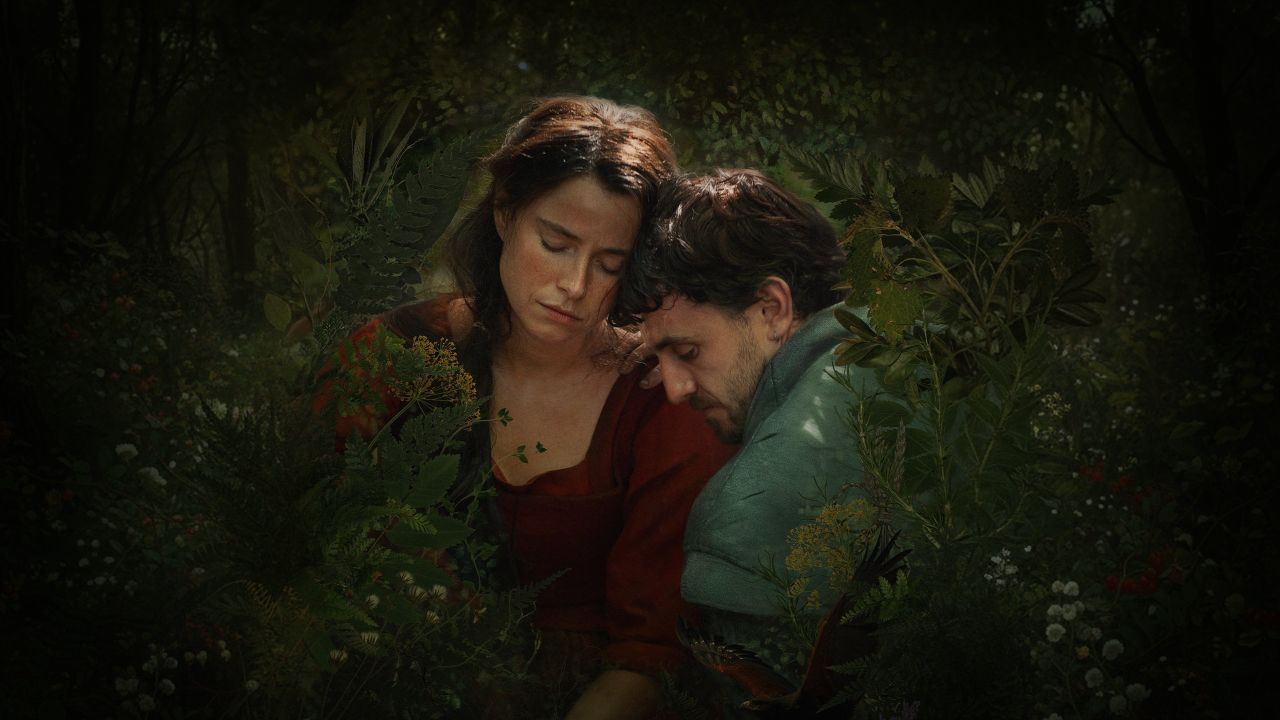
MOVIE REVIEW – Jessie Buckley and Paul Mescal make a devastatingly effective pair in Chloé Zhao’s breathtaking, bruising Shakespeare-adjacent drama. Maggie O’Farrell also worked on the adaptation of her acclaimed novel, and the film follows a story of the Bard and his wife as love turns into marriage, family, and then an unexpected tragedy that rewrites everything.
When we first meet Agnes (Jessie Buckley), she’s asleep, curled against the mossy base of an enormous tree. Dressed in red and purple, she looks like something both delicate and exposed, like a flower and a wound at the same time, an organ set out in the open. It’s hard not to think of a heart left where it can be lifted, held, and broken. Beside her yawns a hollow beneath the roots, so deep and so dark it feels less like a place than the idea of absence.

Joy and Dread, Love and Loss – Stitched Together
Hamnet, the latest film from Oscar-winning Nomadland director Chloé Zhao, refuses to separate opposites. Joy walks beside fear. Love leans into loss. One keeps feeding the other in a cycle that feels as old as breathing, unavoidable and relentless. And just as her William Shakespeare (Paul Mescal) will eventually turn the pain of living between those poles into the work we know as Hamlet, Zhao shapes the same tension into cinema that is both gorgeous and strangely cleansing.
Will first notices Agnes as she returns from the woods, from a world that seems to belong to her long before he does. He’s inside, supposedly tutoring her brothers in Latin, but the glimpse through his window knocks his focus loose. He follows her to the barn and asks her name. She dodges the question with a playful patience, lets him kiss her, and only then answers. Their attraction is so immediate that whatever they are to the rest of the world barely seems to matter.
Before anyone can properly object, they’re stealing time in the forest and in sheds, caught in a whirlwind they both know their families wouldn’t approve of. Will’s mother, Mary (Emily Watson), has heard the rumors that Agnes is the daughter of a forest witch. Agnes’ brother Bartholomew (Joe Alwyn) is more inclined to listen, but still can’t help asking why she would tie herself to “a pasty-faced scholar.” And then Agnes becomes pregnant, and opinions lose their power overnight. The delighted parents-to-be marry, and begin the family that will eventually include three wonderful children.

The Forest as Cathedral, the Everyday as Rhythm
The first act of Hamnet, written by Zhao with Maggie O’Farrell and adapted from O’Farrell’s novel, plays like pure wonder. Zhao’s reverence for natural scale, visible even in her blockbuster detour Eternals, is everywhere here, along with a sharp eye for tactile, lived-in detail. Cinematographer Lukasz Zal opens the landscape in generous wides, sometimes shrinking the couple until they look like creatures native to the trees. Sound designer Johnnie Burn builds the hush of ordinary life, occasionally lifted by Max Richter’s airy score.
Agnes, especially, feels elemental. She is so rooted in the wild that when her water breaks with her first child, she slips into the woods to give birth alone. For the second, Mary insists it happen indoors, and she isn’t wrong to do it. Outside, the rain is not gentle, it is relentless.
But “civilized” life has a way of intruding, even on people who would rather live by weather and soil. Agnes might have wandered those hills forever, but Will is an artist straining against his limits, and even she can see he needs London, other creators, other stages. She urges him toward his ambitions, and as his career gathers momentum, she grows increasingly unwilling to leave Stratford-upon-Avon. Still, when he’s home their household remains warm. Their son Hamnet (Jacobi Jupe) is particularly close to his father, dreaming of working with him in the theater one day, as if the future could be rehearsed into safety.
Then the unthinkable arrives while Will is away, and the Shakespeare idyll cracks beyond repair. A wedge is driven between Agnes and Will that won’t easily shift. Agnes withdraws, unable to move forward, furious that he wasn’t there when she needed him most. Will, meanwhile, seems desperate to outrun the pain, returning to London while grief is still raw, burying himself deeper and deeper in work as if momentum could substitute for breathing.

Mescal’s Restraint, Buckley’s Raw Force
Mescal is superb as the Bard, and the role may draw even more tears than his grieving musicologist in The History of Sound. He keeps emotion small when a bigger performance would be the obvious move, which makes the rare eruptions land like blows. Among the supporting cast, Watson deserves special mention for a crushing mid-film monologue that distills one of the story’s core truths into a single line: “What is given may be taken away at any time.”
But it’s Buckley who truly stuns. She carries Agnes from a grass-stained free spirit to a loving wife and mother, and then into something brittle with mourning, as if grief dries you out from the inside. She anchors a character that could have floated away, filling her with raw, unshielded feeling. There’s a moment when she screams until sound itself leaves her. It’s difficult to shake. It doesn’t end neatly. It just stops, because the body runs out.
Buckley can map an entire inner journey just by the way she looks at someone. She does it early on, when Will tells her the story of Orpheus and Eurydice, another tale of love and a hungry void. And she does it with even more force in the third act, when Agnes finally understands what Will has been doing during his long absence, what he has been building out of pain.
At first she’s shattered to learn her husband has named his new tragedy after their boy. (As a caption at the beginning notes, “Hamlet” and “Hamnet” were treated as the same name in that era.) Gradually, though, she recognizes how Will has poured grief into the play, and how that act transforms an absurd loss into something that can move hundreds, thousands, millions. Not because it explains anything, but because it refuses to lie about what it costs.
When the Elements Become Art
Exactly how Will makes that transformation is not something Hamnet spells out. Zhao only glances at his process, and the film is better for it. The splendor and the menace of the elements, introduced in those first images of Agnes in the forest, become, almost like a sleight of hand, the durable power of art.
Hamnet doesn’t solve grief; it gives it a shape you can live with.
-Gergely Herpai “BadSector”-
Hamnet
Direction - 9.2
Actors - 9.4
Story - 9.2
Visuals/Music/Sounds - 9.2
Ambience - 9.4
9.3
AWESOME
Hamnet is both sweeping romance and intensely intimate mourning, with Zhao using the grandeur of nature to frame a deeply human collapse. Mescal brings a restrained, quietly devastating Shakespeare, while Buckley pulls you so close to Agnes that it can feel hard to breathe. It’s a film that doesn’t offer comfort so much as clarity: grief remains, but art can make it bearable.














Leave a Reply