

MOVIE NEWS – Fight Club was released on streaming platforms in China with a drastically altered ending so that David Fincher’s film could even be shown. Ironically, the censored conclusion ended up being closer to Chuck Palahniuk’s original novel than the version audiences around the world had known for years.
China has long been known in the film industry for the exceptionally strict requirements imposed by its authorities on Hollywood productions. Before a movie can be released in the country, the government may demand changes it considers necessary for local audiences, and not even domestic stars are exempt from these controls. If the rights holders refuse to comply, the film is simply barred from reaching viewers in the Asian market.
One of the most striking examples of this practice involves Fight Club, David Fincher’s cult classic, whose original ending had to be altered in order to secure a streaming premiere in China.

The Censored Ending
Fight Club was added to the Chinese streaming platform Tencent Video, where viewers quickly noticed that the film’s conclusion differed significantly from the original version. Out of the 137-minute adaptation of Chuck Palahniuk’s novel, a total of twelve minutes were missing, but the most dramatic change clearly concerned the ending.
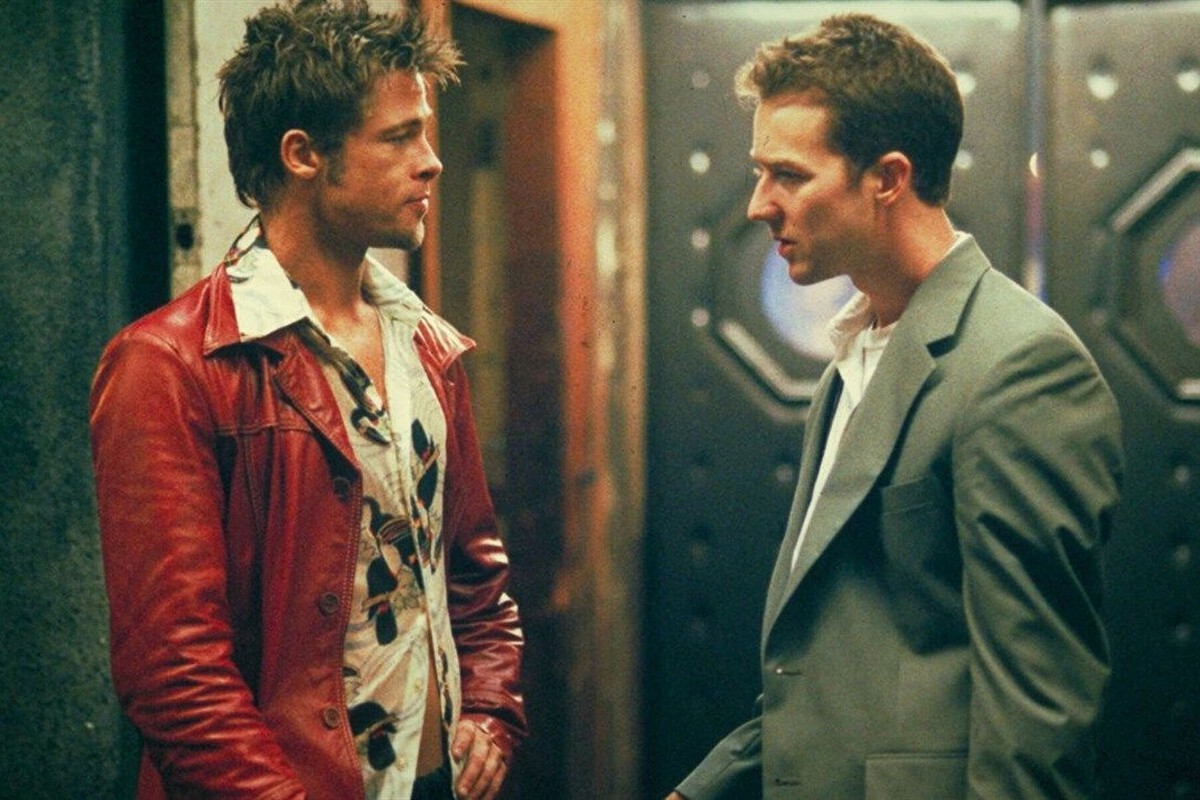
In the original story, the Narrator, played by Edward Norton, kills his alter ego Tyler Durden, portrayed by Brad Pitt. He then reunites with Marla, played by Helena Bonham Carter, and together they watch several buildings collapse, implying that Tyler’s plan to dismantle modern civilization ultimately succeeds.
This finale appears to have deeply unsettled Chinese authorities, because in the version released there, the film ends immediately after the Narrator defeats his alter ego. Everything that followed, including the explosions, was removed, and a text screen appeared explaining the outcome to the audience. The approach closely resembled the famous joke in The Simpsons about how the character Poochie is written out of a story.
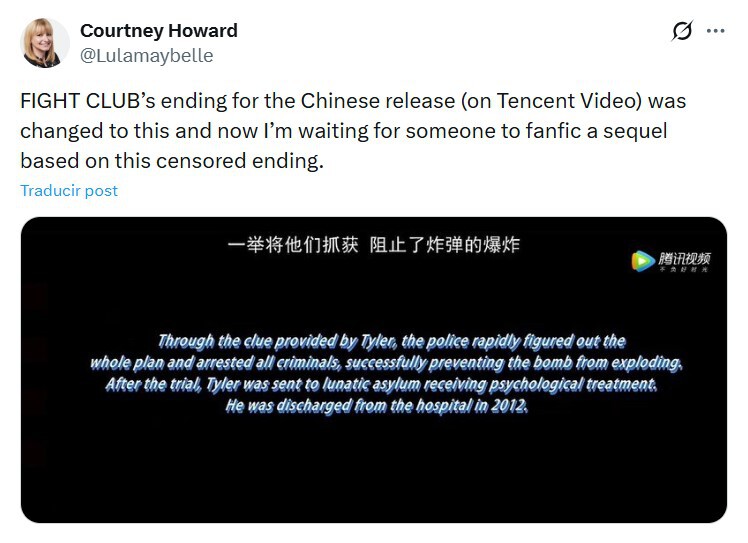
The message did not recount Fincher’s shocking conclusion but instead introduced a new, censored version in which the police prevent the catastrophe. The text shown at the end of Fight Club in China read:
“Thanks to the tip provided by Tyler, the police quickly uncovered the entire plan and arrested the criminals, successfully preventing the bomb from exploding. After the trial, Tyler was sent to a psychiatric hospital for psychological treatment. He was released in 2012.”
The exact reason behind the change was never officially disclosed, but Vice confirmed through a source familiar with the matter that the copyright holders themselves implemented the alteration, with approval from Chinese authorities, before selling the streaming rights in the country. In short, the studio accepted the change as a condition for releasing the film in China.
The news quickly went viral, sparking global debate, and eventually Fight Club regained its original ending in China along with most of the removed footage. Eleven of the twelve missing minutes were restored, with only nude scenes remaining absent, as Chinese authorities did not request their reinstatement.
The most unexpected aspect of the entire episode was Chuck Palahniuk’s reaction. Rather than expressing dissatisfaction, he stated that the censored ending was, ironically, more faithful to his novel. David Fincher, however, took a far more critical stance and said:
“I find it curious that the people who wrote that ending had actually read the book, because it fits quite well with the last pages of Chuck Palahniuk’s novel.”
“A company licensed the New Regency film for screening in China with a standard contract that says cuts can be made for censorship. Nobody asked, ‘If we don’t like the ending, can we change it?’ Now there’s a debate about what ‘cuts’ even means. If they don’t like this story, why would they license this movie? I don’t understand wanting the work but as a different film. The damn movie is 20 years old. It was never known for being cute.”
Source: Espinof














Leave a Reply