
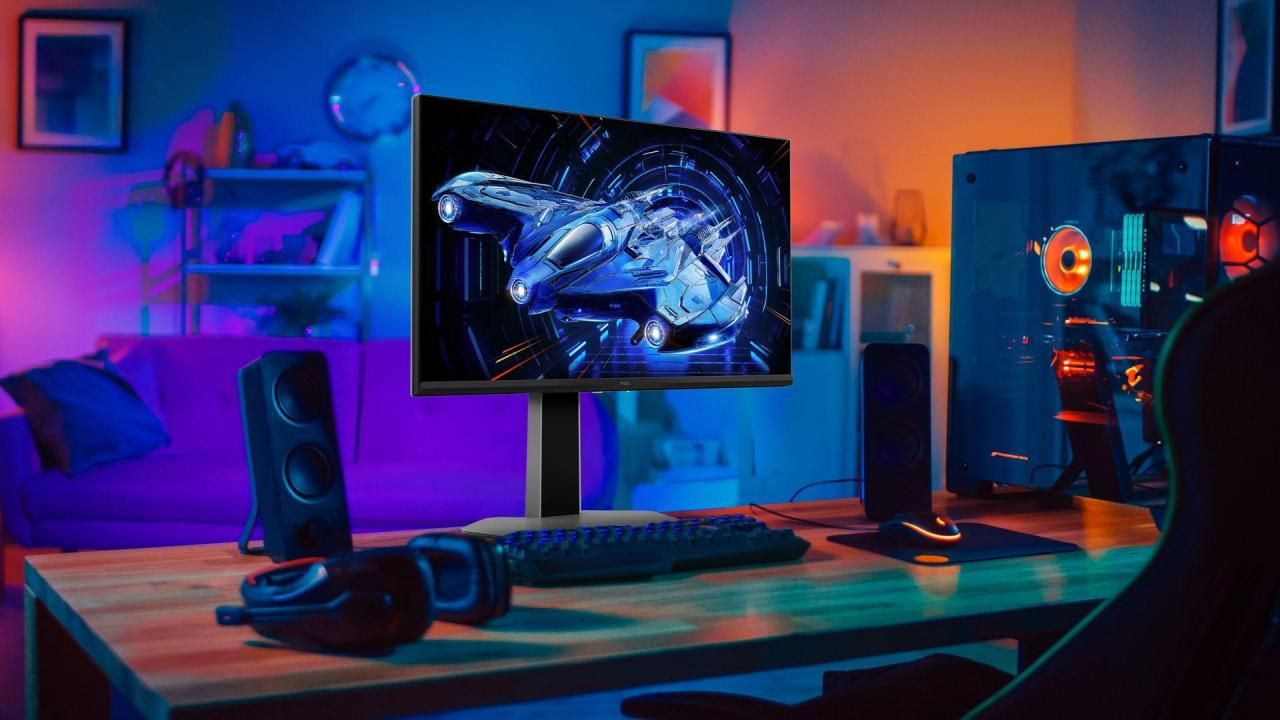
TECH REVIEW – The TCL 27G64 is a QHD gaming monitor with fairly restrained specs, but the price aims to stay grounded. Its QD MiniLED backlight is the one feature meant to separate it from the pack. In Hungary, TCL is mostly associated with TVs, yet the company has been building monitors too, and the 27G64 is a newer model built around a MiniLED backlight.
TCL is one of the few major TV players with deep control over the LCD supply chain, and years of MiniLED know-how from its television lineup. Bringing that into monitors makes strategic sense, but the gaming monitor market is far more crowded and unforgiving than the TV space. A logo alone does not move units here – you need a concrete advantage. The 27G64 tries to deliver that advantage with QD MiniLED, QHD resolution, and a 180 Hz refresh rate in a segment where value still matters.

MiniLED in a Knife Fight – Not OLED, and Not Pretending to Be
At the high end, OLED is the easy headline: spectacular contrast and fast pixel response, with a price tag to match. MiniLED takes a different route. It cannot dim per pixel, but a zone-based backlight can push blacks and HDR dynamics much further than typical edge-lit LCDs. The TCL 27G64 sits in that gap: it is not selling “infinite contrast,” it is selling a visibly stronger HDR and dark-scene experience than a standard QHD gaming monitor can deliver.
In practice, that usually means black levels and perceived contrast that beat the IPS baseline, with MiniLED adding another layer of pop in highlights. The trade-off is also built in: zone count and control precision determine how much blooming you will see around bright objects on dark backgrounds. The 27G64 tends to land in the “clearly better than typical LCD HDR, but not flawless” zone – meaningful improvement, not a no-compromise reference.

Specs That Matter in Real Use – QHD, 180 Hz, HDR600
The TCL 27G64 targets 2560×1440 QHD at 180 Hz, a strong sweet spot on PC: sharper than 1080p without the GPU tax of 4K. On the HDR side, a 600-nit peak and DisplayHDR 600 signal that this is more than a sticker. The VA/HVA foundation brings high native contrast, which pays off in darker games and movie viewing.
Refresh rate and variable refresh are tangible in motion. The good news is that 180 Hz is already enough to make camera pans and mouse tracking feel light, while VRR helps smooth frame-time swings. The classic VA risk is slower dark transitions that can smear in shadowy motion; pushing overdrive too hard can introduce inverse ghosting. The practical approach is usually to avoid the most aggressive mode and stick with a balanced setting where motion stays clean without breaking the image.
Connectivity on Hungarian listings points to DisplayPort and HDMI 2.1, plus a 3.5 mm audio jack. You also get height adjustment and VESA mounting – both essential if you actually care about ergonomics on a gaming desk.

Pricing and Reality – Value Lives or Dies on the Receipt
The TCL 27G64 tends to land in the mid-range: it appears across multiple retailers and price trackers at several price points depending on stock and promotions, spanning from “entry MiniLED” territory to more expensive, deal-dependent listings. The key context is that QHD OLED monitors in the same size typically start noticeably higher, offering higher refresh ceilings and faster response in return. The 27G64 pushes back with strengths LCD still owns: higher sustained brightness over larger areas and a contrast experience shaped by the VA plus MiniLED combination.
If your only goal is pure competitive FPS, OLED and 240 Hz class panels remain the benchmark – at a higher cost. If you want mixed use (gaming, video, work), and you want HDR you can actually see without blowing the budget, the TCL 27G64 is positioned right where the compromises stay acceptable and the picture stops being average.
-Gergely Herpai “BadSector”-
Pros:
+ QHD plus 180 Hz delivers genuinely smooth motion, and VRR helps stabilize frame-rate swings
+ VA/HVA contrast paired with a MiniLED backlight gives a stronger HDR punch and darker-scene depth than typical LCD gaming monitors
+ Practical ergonomics and hookups: height adjustment, VESA support, and modern inputs for the price tier
Cons:
– Zone-based dimming can produce blooming in challenging dark scenes, and HDR is not “reference” in every scenario
– VA dark-transition behavior can smear if you push the wrong overdrive mode, so settings matter
– Versus higher-end OLED options: slower response and a lower refresh ceiling for esports-first buyers
TCL 27G64
Design - 7.8
Picture quality (gaming) - 8.3
Picture quality (office work) - 8.4
Hardware - 7.6
Price/value - 8
8
EXCELLENT
The TCL 27G64 stands out by pairing VA/HVA contrast with a MiniLED backlight for noticeably stronger HDR impact than typical QHD LCD gaming monitors. At 180 Hz with VRR, it hits a practical performance sweet spot while usually staying far below QHD OLED pricing in Hungary. Blooming and VA dark-transition behavior are still part of the deal, but for mixed-use gaming it remains a highly rational buy.











Leave a Reply