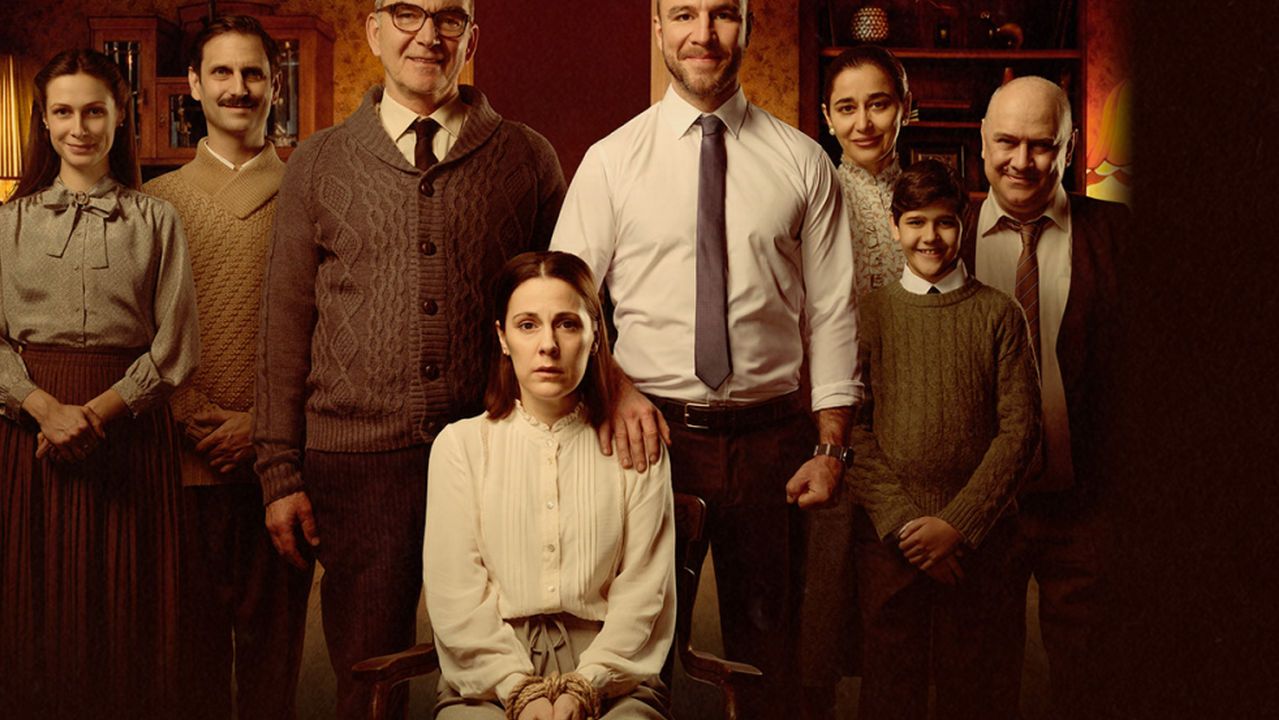
MOVIE REVIEW – Feels Like Home is both a surreal thriller and a viciously familiar Hungarian nightmare: after Rita (Rozi Lovas) is abducted, she wakes up in an apartment where a “family” insists – with absolute certainty – that she is Szilvi (Rozi Lovas), their daughter who vanished years ago. Director Gábor Holtai plays smart games with identity, loyalty, and that suffocating, velvet-glove coercion that can make you shiver in real life, too. The film occasionally lets the leash run too long, but it packs in enough potent set pieces, images, and acting fireworks that what lingers isn’t “sure, another middling Hungarian movie”, but “finally, an intelligent allegory that needles the system in power” – assuming you want to read it that way.
On its surface, Feels Like Home is an unusual, surreal thriller: Rita (Rozi Lovas) disappears, then comes to in a stranger’s apartment – the carefully arranged, sterile “home” of the Árpád family (Árpád – Tibor Szervét; Nóri – Dorka Gryllus; Gergő – Kornél Simon; Marci – Áron Molnár; Brúnó – Soma Simon). There’s no tentative probing, no careful questioning, no doubt – they know Rita (Rozi Lovas) is really Szilvi (Rozi Lovas), and that’s that. Rita (Rozi Lovas) is just as certain of her own identity, except her survival instinct spins faster than her rational arguments: if she wants to make it out alive, she has to step into Szilvi’s (Rozi Lovas) role, while the question tears at her from the inside – who are these people, what do they want, and when did reality slip off its own tracks?
The setup gives a subtle nod to Alain Delon’s 1967 film Ördögien öné (Diaboliquement vôtre): there, too, the engine is an identity forced onto someone, and the claustrophobic game begins with waking up to other people telling you who you are. But Feels Like Home pushes it further: here it isn’t one clever con tightening the vise, but an entire, in-house “reality” swallowing the protagonist whole. The film doesn’t just ask whether you believe what they’re saying; it asks how long you can take it before your own memories – your own sentences – start sounding strange as they come back out of your mouth.
And that’s the layer that makes Feels Like Home more than “just” a thriller – it’s a very Hungarian, very current allegory: this “family” (Árpád – Tibor Szervét; Nóri – Dorka Gryllus; Gergő – Kornél Simon; Marci – Áron Molnár; Brúnó – Soma Simon) isn’t merely odd, it’s a miniature of a system. Belonging is an order, affection is conditional, faith is mandatory – and if you don’t believe, they’ll help you believe. Not necessarily because they’re “evil,” but because to them, this is order, and order isn’t debated here: it’s repeated as ritual.

A Fake Home Where Even a Smile Is an Order
Holtai’s direction is at its strongest when it isn’t chasing the classic “who jumps out of the dark” kind of tension, but the everyday horror of perfect politeness while the air slowly disappears. Rita’s (Rozi Lovas) captivity isn’t always measured in chains or slaps – it’s measured in routines, rules, enforced gestures. The film understands that manipulation is rarely flashy, but it is always repetitive: the same line, the same “my dear girl”, the same manufactured intimacy, until you catch yourself answering on reflex because it’s easier than pushing back.
Árpád (Tibor Szervét) isn’t “just” the patriarch in this space; he’s the apartment’s gravity: everything bends toward him, everything gets its meaning from him, and everything is judged by his gaze. Marci (Áron Molnár) is the believer-enforcer – the kind of man who craves love, and for that reason can sell any cruelty to himself as a “holy cause,” while his methods are unmistakably hard, manipulative, and steeped in secret-police logic. Nóri (Dorka Gryllus) is the regime’s soft face: she wraps horror in a napkin, hands it over with a smile, and talks about “family” as if it were a cure-all. Gergő (Kornél Simon) is the one who doesn’t go mad from the absurdity, but slides into it – because it’s more comfortable than asking questions. A detail worth noting: Soma Simon, who plays Brúnó, is Dorka Gryllus and Kornél Simon’s real-life son – and his presence isn’t “cute” so much as queasy: the future learning, in this room, what counts as normal.
What’s most frightening is that the film never circles anything in red marker with “you’re monsters” scrawled across it. The Árpád family (Árpád – Tibor Szervét; Nóri – Dorka Gryllus; Gergő – Kornél Simon; Marci – Áron Molnár; Brúnó – Soma Simon) isn’t a caricature – it’s a warped mirror. And that’s what makes the thriller truly surreal: not that “strange things” happen, but that far too much of it feels painfully familiar.

Orwell in the Living Room, a Personality Cult at the Dinner Table
Feels Like Home’s political reading doesn’t feel imposed – it feels unavoidable. The “pseudo-family” (Árpád – Tibor Szervét; Nóri – Dorka Gryllus; Gergő – Kornél Simon; Marci – Áron Molnár; Brúnó – Soma Simon) functions like a dictatorial micro-system: there’s a “leader,” there’s faith, there’s sin, there’s re-education, and there’s the logic threaded through everything that if the story doesn’t fit, you fix the story – not reality. In that frame, Rita’s (Rozi Lovas) identity isn’t private, it’s a project: rewriteable, assignable, eventually sealable with an “official” stamp. The Orwellian chill works precisely because it isn’t poster art: it doesn’t scream “dictatorship!”, it whispers “relax, we know who you are”.
The ’80s-inflected visual world adds another dark layer. Árpád (Tibor Szervét) uses an archaic camera, developing photos becomes ritual, and the apartment’s design evokes the era as if someone deliberately cranked the clock backward – so the “safety” of the past can serve as the handcuffs of the present. And when Árpád (Tibor Szervét) practically bathes in the carefully manufactured, family-branded personality cult built around him, it isn’t just chilling, it’s painfully legible: sequences with pure party-boss energy, where affection isn’t a feeling, it’s propaganda.
If you want, you can read this as a war between “family” and individual freedom – and you can read it more literally, too, because in Hungary the two rarely sit far apart. Áron Molnár’s public activism makes Marci (Áron Molnár) especially charged: the character embodies the psychology of loyalty and belief, the kind of person who isn’t necessarily “bad,” just desperate to belong somewhere – and so chooses the “leader’s” logic over his own conscience. He’s playing the exact type he most often tears into in his Facebook videos, which makes the performance especially intriguing and unexpectedly fresh.

Razor-Sharp Performances
One of the film’s strongest weapons is its cast. Rita’s (Rozi Lovas) role is pure survival parkour: she has to be terrified, perform, improvise, and still protect that stubborn inner core that keeps saying “this isn’t me”. Rozi Lovas doesn’t play her as a hysterical victim; she plays a woman who steadily maps the terrain for survival, and when she has to, she plays along with the lie – so she can strike back later.
Marci (Áron Molnár) is a thankless part in the sense that it would be easy to turn him into a one-note “cultist” puppet. Molnár instead shows the inner emptiness that feeds fanaticism: the hunger for love, the need to be approved of, the stubbornly childlike belief that if you want it badly enough, “family” will become family. That doesn’t absolve Marci (Áron Molnár) – it makes him scarier, because he’s comprehensible, and in some corners even likable, while we still recoil from what he does.
Árpád (Tibor Szervét) is flat-out chilling. Tibor Szervét doesn’t yell or slam doors: he smiles, speaks slowly, and what freezes your blood is exactly how much he enjoys how “natural” power feels to him. Dorka Gryllus, as Nóri (Dorka Gryllus), nails the kindly-cruel register – the emotional blackmail that’s always smooth, always soft, and therefore so hard to defend against. Kornél Simon, as Gergő (Kornél Simon), finds the right shape for normalized absurdity: the state where you stop asking questions, shrug, and comply. Their real-life child, Brúnó (Soma Simon), adds a quietly uncanny edge: not the stock “creepy kid” from horror movies, but a real little boy who feels far too at home in this ecosystem of lies.
Not Flawless, but Rarely This Necessary
One of Feels Like Home’s best qualities is that it’s both intelligent and genuinely important. Not because it has a “message,” but because the story works, the humor is dark, the satire lands, and as a thriller it can still keep its hooks in you. The political layer isn’t there instead of the plot; it grows out of the plot. Yes, you can figure out pretty quickly what it’s doing, and once the picture clicks into place, the second half can feel a touch too explicit – especially if you’ve consumed a lot of politically sardonic work. But Feels Like Home stays acceptably taut even then: it doesn’t want to “make art” by fogging things up, it adds another layer to make sure it hurts.
The biggest substantive negative is that the film is too long. There’s a stretch in the middle where the pace sags, the loops start to repeat, and you can easily imagine shaving 10 to 15 minutes to keep the squeeze consistent throughout. The peaks still work – they just arrive a little later than they should. In return, the ending doesn’t land like “okay, it’s over”, it lands like “okay, we’re going to talk about this” – and for a Hungarian film, that alone is a rare and very good sign.
And maybe most importantly: this isn’t the kind of movie that nods along to the NER while claiming it’s “just entertainment.” If you catch what it’s doing, Feels Like Home is, in an allegorical sense, pointedly attacking the NER – precisely because the logic of power here isn’t an external enemy, it’s a family default setting. It’s not like certain recent productions where you mostly just squirm in your seat – see the case of Magyar menyegző. Feels Like Home, by contrast, does what a good thriller and a good surreal satire can do at the same time: it entertains, it tightens, and it leaves you with deeply uncomfortable questions – right where the word “family” usually promises safety.
-Herpai Gergely „BadSector”-
Feels Like Home
Direction - 8.2
Actors - 8.6
Story - 8
Visuals/Music/Sounds/ - 8.5
Ambience - 7.7
8.2
EXCELLENT
Feels Like Home works as a surreal thriller, and as an allegory it hits with unsettling precision: a system wearing the label “family” tries to overwrite reality while the protagonist fights for her life, forced to survive inside this bizarre domestic regime. Rozi Lovas (Rita/Szilvi) and Áron Molnár (Marci) are excellent, and Tibor Szervét (Árpád) rules the space with such icy authority that even his smile seems to chill the tea in the samovar. It’s a bit long and the middle section sags, but the experience still lands hard - sharply funny, bitterly cutting, and rare in how it refuses to serve you comfort while it’s looking you straight in the eye.