
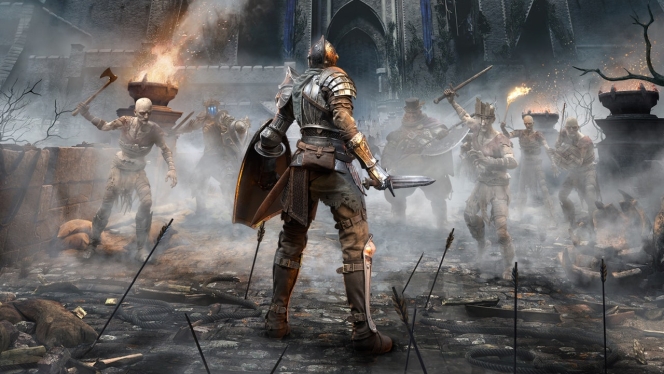
They made the Demon’s Souls remake, PlayStation acquired them, and now their studio is being shut down. The bleakest part is that their fate looked effectively sealed years ago. Bluepoint Games‘ 2021 acquisition was built on a very obvious break from reality. What we are seeing now is the bill coming due.
PlayStation has announced that Bluepoint Games will be closed. It is the most painful and most unfair decision Sony has made within its current video game strategy. Painful, because this means the disappearance of one of the strongest teams in the entire Japanese conglomerate, one of its crown jewels, and the studio behind outstanding releases such as the remakes of Demon’s Souls and Shadow of the Colossus. Unfair, because the outcome stems from a firm, silent sentence handed down on September 30, 2021, a day that looked celebratory on the surface, when it was confirmed that the developers were joining the PlayStation Studios family. This was not a sad decline caused by employees growing complacent inside one of the industry’s most important parent companies. The reality, and one players around the world know well, is that Bluepoint Games‘ collapse comes from a business strategy that puts profitability ahead of what actually moves players emotionally.
To summarize the Bloomberg report that revealed PlayStation‘s plan for the Demon’s Souls Remake studio, Sony agreed to shut the team down “following a recent business review.” Until a few months ago, the developers were working on a God of War game-as-a-service project, intended to be another pillar in the company’s strategy of dedicating time and resources to multiple GaaS titles based on its major IP. That project was canceled in 2025, and the Japanese company said at the time it would work closely with Bluepoint Games and Bend Studio – which also had another project with the same approach put on hold – to find new directions for both teams. Now, however, we know those discussions never produced a concrete outcome, and that Bluepoint‘s path inside PlayStation Studios was always shaped by a plain disconnect from reality.
The outcome of being disconnected from reality
When PlayStation bought Bluepoint Games in 2021, the move initially seemed perfectly logical for the company. Bluepoint Games was a studio with a proven ability to deliver exceptional results when reworking Sony IP, having done superb work on the 2020 Demon’s Souls Remake, and it looked like an obvious candidate to revive other major Japanese classics. It is no surprise that many fans started dreaming about a return for Bloodborne under Bluepoint Games‘ direction. However, content creator Kyle Bosman made a sharp point in a video about the studio’s newly announced closure, arguing that PlayStation‘s plans were never really aligned with what players wanted. In that context, the YouTuber noticed that the Sony-written announcement of the Bluepoint Games acquisition highlighted the developer’s “world-building and character creation” capabilities.
That claim does not accurately reflect reality, because while the remakes of Demon’s Souls and Shadow of the Colossus, along with the collections the studio released over the last two decades, earned widespread community praise, those projects were built with pre-existing characters and, fundamentally, pre-designed worlds. As a result, PlayStation‘s acquisition announcement reads much more like the original plan was to buy Bluepoint Games – a studio experienced with PlayStation IP – and then have the team build a game-as-a-service title based on one of its flagship franchises, something later confirmed when it became known that the developers were making a God of War GaaS.
In the end, PlayStation‘s whole concept rests on a total disconnect from reality. This strategy is basically on the same level as its stubborn push for games as a service, driven by the hope of creating a “golden goose” capable of competing with giants like Fortnite and Roblox. The problem, as players have repeatedly tried to make clear in a broad effort to communicate with executives who ignore their own community, is that PlayStation fans do not want GaaS.
A basic problem PlayStation does not want to confront
PlayStation‘s games-as-a-service strategy crashes head-on into a fundamental dilemma that applies to launching any product, whether it is a video game or anything else. The company is not offering a superior innovation or entertainment model that would justify leaving another GaaS such as Fortnite. Concord was a total failure. Marathon has already triggered broad rejection through its early showings. And Fairgames has been quiet for so long that nobody would be shocked if it were suddenly canceled.
The single-player identity of PlayStation IP, which is exactly what captivated fans, is not compatible with the core experience of games as a service.
Fans do not tune into PlayStation Showcases hoping to see a new game as a service. Players fell in love with Horizon because of its lush world and untamed sense of freedom. They felt powerful through Kratos, controlling a furious god whose journey led him into direct conflict with the Olympian and Norse pantheons. They traveled with Joel and Ellie to experience a raw story that leaves you setting the controller down and watching the credits with a heavy chest. And they swung across the New York of Marvel’s Spider-Man to forget the daily grind and feel like a superhero, even if only for a while.
The basic logic of games as a service undermines the very feelings that created such a deep bond between fans and PlayStation IP. Add matches against other users, constant updates, and notifications pushing you to spend more money, and the appeal of Horizon, God of War, The Last of Us, and any other iconic Sony franchise gets lost along the way. Sony‘s single-player foundation is incompatible with the central experience of games as a service. And yes, we have seen projects such as the Legends mode in Ghost of Tsushima / Ghost of Yotei and the online mode in the first The Last of Us. None of those extras, however, were designed to push players into spending money.
The closure of Bluepoint Games is more bad news for PlayStation’s strategy
The fact that PlayStation failed to understand something this basic – or that its executives refused to understand it – has been the company’s biggest mistake of this console generation. It pressured its best studios to build games-as-a-service versions of its most important IP, hoping that simply launching a “new game as a service based on [insert famous Sony franchise here]” would be enough to lure in huge fan communities. And Bluepoint Games, unfortunately, was acquired with that strategy in mind.
The corporate logic, which completely ignores what fans actually want, is simple: build a long-term IP-based plan to compete with Fortnite and Roblox, buy a studio experienced with your franchises, and force it to adapt to the new strategy. What could possibly go wrong? In the end, this is where that cold, detached mindset appears in full: “anyone can make a Game as a Service like Fortnite if you throw enough money at it.”
And the result has been as disastrous as possible. Canceled games – including projects tied to franchises like Marvel’s Spider-Man, God of War, and The Last of Us – and studio closures, including one that had earned players’ affection (and their money). It is obvious there is no way to reverse this strategy without a meaningful sacrifice in profitability and sales. But given the direction PlayStation has taken in recent years, and the decision to shut down Bluepoint Games, everything suggests its executives are not prepared to take the hard, decisive steps needed to correct course, which is exactly what players are desperate to see. We will probably only see a real shift when the company’s finances hit truly alarming levels. Because here, as always, the numbers are what matter.
Source: 3djuegos














Leave a Reply