
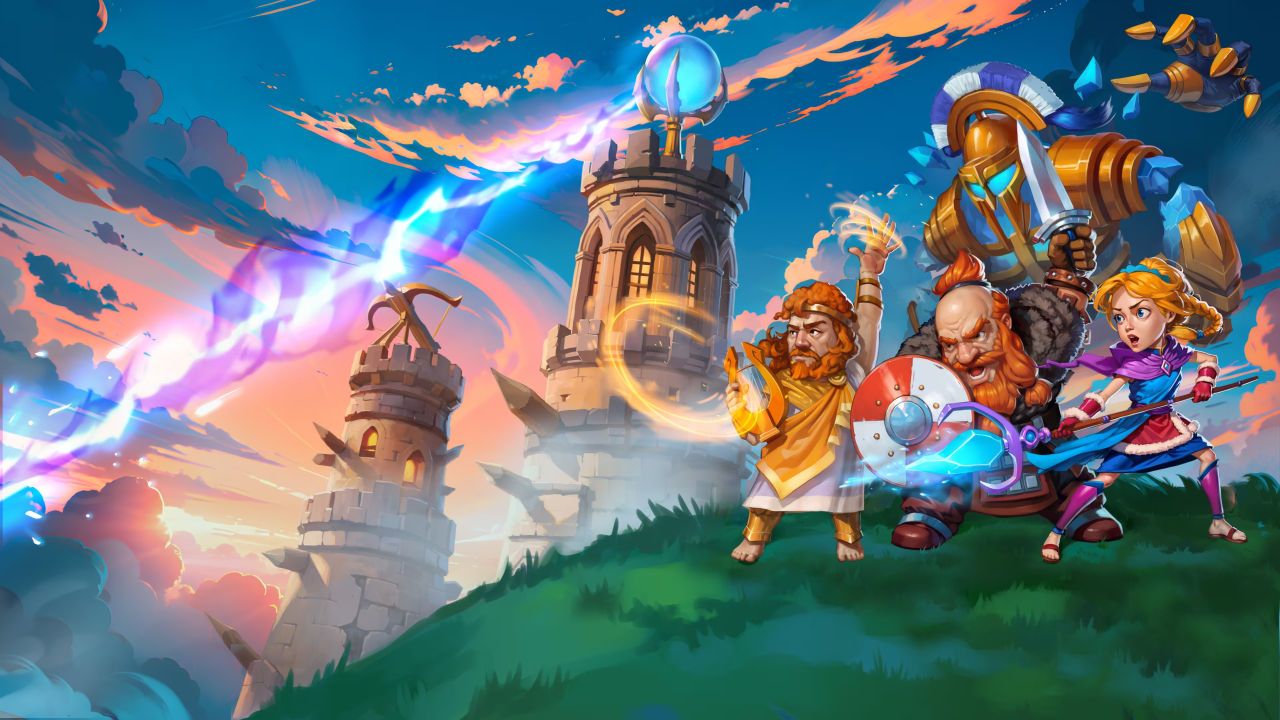
REVIEW – At first glance, Towers and Powers looks like a charming myth-themed VR tower defense game, but after a few stages it becomes clear there is far more tactical thinking under the hood than its visuals suggest. Its resident-based, stackable tower system is genuinely creative, and the VR handling is not just decoration here – it actively shapes your decisions. We tested Towers and Powers on PSVR2.
Towers and Powers is a VR tower defense game, but thankfully it does not stop at “drop tower, survive wave, done”. You oversee the battlefield from a godlike vantage point, building towers by buying tiny citizens and placing them onto predefined platforms. Each character has a profession, which means each one creates a different kind of tower with different strengths and weaknesses – so far, standard genre DNA, nothing unusual.
The twist is that towers can rise up to three floors, and each added level gives them a new function or bonus. Stack three basic villagers and you get an archer tower with a noticeably faster fire rate. Put a Monk on top and it turns into a barrel-lobbing tower that deals area damage while also lowering enemy defense – just at a different pace. As you progress across the 15 levels, you unlock new “jobs”, and with them the game’s tactical toolbox opens up dramatically.

Towers Built From Villagers, Backed by Serious Tactical Math
This is where the game really starts showing its strength. Every new unit is not just another tower variant – it also means new floor combinations, new traps, and trap upgrades. Two professions can even operate special buildings of their own. Mixing these elements creates a level of tactical variety that is rare in tower defense. Of course, you will still develop favorites – for me, an Engineer on the first floor for chain lightning, a Viking axe-thrower above for extra damage, and a Monk on top for defense-shredding barrels turned out to be a particularly effective setup.
The system throws meaningful choices at you early: do you build one powerful three-floor tower, or three separate single-floor towers? On top of that, you can pick up and relocate your people mid-wave, letting you shift your defenses to wherever trouble is brewing. That matters because stages feature multiple enemy gates, and each one spits out different enemy counts, types, and strengths from wave to wave. We have played plenty of tower defense games – but this kind of flexibility and creativity is still rare.
The campaign is not very long, which makes that tactical freedom especially important: it gives you a reason to test new strategies on harder maps or replay stages for a full three-star clear. There is one frustrating limitation, though: you cannot return to earlier levels with items and options unlocked later in the game. Some trophies also ask for more than simply finishing the campaign, but during the review period two of them appeared to be bugged and did not register properly, and there is no platinum trophy.

Strong Systems, Formulaic Surface
Visually and sonically, the game is solid, but never spectacular. The sound effects for both your units and enemy troops do the job, and the music works well enough – not especially memorable, but at least it is not annoying, intrusive, or repetitive over longer sessions. In VR, that is a bigger strength than it may sound.
The graphics are clean and readable, though distant details can sometimes be hard to make out. My bigger issue was the overall look and feel: everything seems a little too familiar, a little too broad. Islands, temples, trees, villagers – it all feels like it was assembled from the leftover art direction of several loosely mythological mobile games. The gameplay has more depth than the visuals suggest, but it is hard to completely shake that “mobile game” vibe.
The pointer beams extending from your virtual hands are useful because they clearly show what you are about to pick up and where you can place it, but they are always visible and can feel almost comically thick. It would have been nice to have settings for beam thickness or fade-out behavior, or a smarter solution that better uses PSVR2 features such as eye tracking. Even with them, it can still be tricky to grab the exact object you want when something sits in front of it or behind it.
The “story” does not add much either, and honestly, the game probably does not need it. 2D images of gods and monsters slide in with narration explaining that the major gods are busy, some dark threat is approaching, and you need to help. You also get a satyr guide who comments on your progress and introduces new mechanics, but as a character he is fairly bland. He serves a purpose, but he has very little personality.
The tutorials, however, are mostly well paced, and if you replay stages you can quickly skip through the dialogue. A genuinely welcome feature is that after failing or quitting, the game usually lets you continue from the most recent wave instead of kicking you back to the very start. That is more generous than many tower defense games. Granted, sometimes the issue is that your run was already in bad shape during the previous wave, and the next one merely puts the lid on it – in those cases, wave restarts feel like a partial fix rather than a full one, but it is still better than starting from scratch.
Two Hands, Plenty of Options, Occasionally Stubborn Controls
The tooltips are useful: point with your left hand at a monster, one of your units, or any floor of a tower, and the game pops up the key information. Independent two-hand use also works – at least most of the time. You can hold a trap in one hand and another trap in the other, or a villager in one hand and a spell in the other, but you cannot hold two villagers at once. You can learn the rules, but the system’s internal logic is not always consistent.
There is also an in-game guidebook that is supposed to explain what every unit, trap, and monster does. On paper, that is a great idea. The problem is that in my playthrough, it only showed the first few discovered entries and then stopped updating properly, so it failed right when it should have become most useful.
And yes, there are spells – in fact, two separate spell systems. The first type consists of magical orbs generated by a specific building roughly every 30 seconds, or falling from the sky for you to catch. You then physically throw them at enemies. At first, this can feel a little clunky and inaccurate – and I hate to say it, but that is partly a skill issue. Once your hands adjust to the game’s slightly odd physics, it can feel great to freeze a larger group or snipe that last sneaky goblin with a fireball just before it slips into your base.
The second spell type charges over time and is activated with hand motions and gestures. These are stronger, flashier, and they bring back a pleasant hint of classic god-sim energy. There is one strange omission, though: I could not really find a place in-game where all gestures are listed for later reference – unless you replay the stages where each spell is first unlocked. That is an entirely unnecessary inconvenience.
Towers and Powers still has a strong gameplay core. The VR mechanics – even when they initially feel a little “gimmicky”, like the throwable spell orbs – do add to the experience and create a genuinely immersive sense of presence while defending your base. What drags the package down is the formulaic visual presentation, the relatively short runtime, and replay value that, despite the excellent mechanics, is not quite strong enough to make it a long-term must-have VR favorite.
-Gergely Herpai “BadSector”-
Pros:
+ Genuinely creative three-floor tower building with lots of combinations and real tactical freedom
+ VR handling meaningfully adds to the game – repositioning, throwing, and two-handed multitasking make it come alive
+ Well-paced tutorials, useful wave restarts, and a strong “one more try” pull
Cons:
– Formulaic visuals with a slight “mobile game” feel that does not reflect the depth of the systems
– Short campaign and limited replayability (for example, no return to early stages with later unlocks)
– Several small technical and quality-of-life issues: imprecise object pickup, buggy guidebook, miscounted trophies, no platinum
Publisher: VRKiwi
Developer: Jetdogs Studios
Genre: VR Tower Defense Strategy Game
Release Date: December 14, 2023
Towers and Powers
Gameplay - 8.2
Graphics - 6.8
VR Experience - 8.1
Music/audio - 7
Ambience - 6.9
7.4
GOOD
Towers and Powers delivers one of the smartest VR tower defense concepts around by building its tactics around stackable resident-made towers and constant repositioning. The VR mechanics are more than gimmicks: two-handed control, hand-placed traps, and manually cast spells all make the experience better. Its shorter runtime, formulaic visuals, and a handful of technical and usability issues keep it from all-time status, but it is very easy to get hooked on.









Leave a Reply