
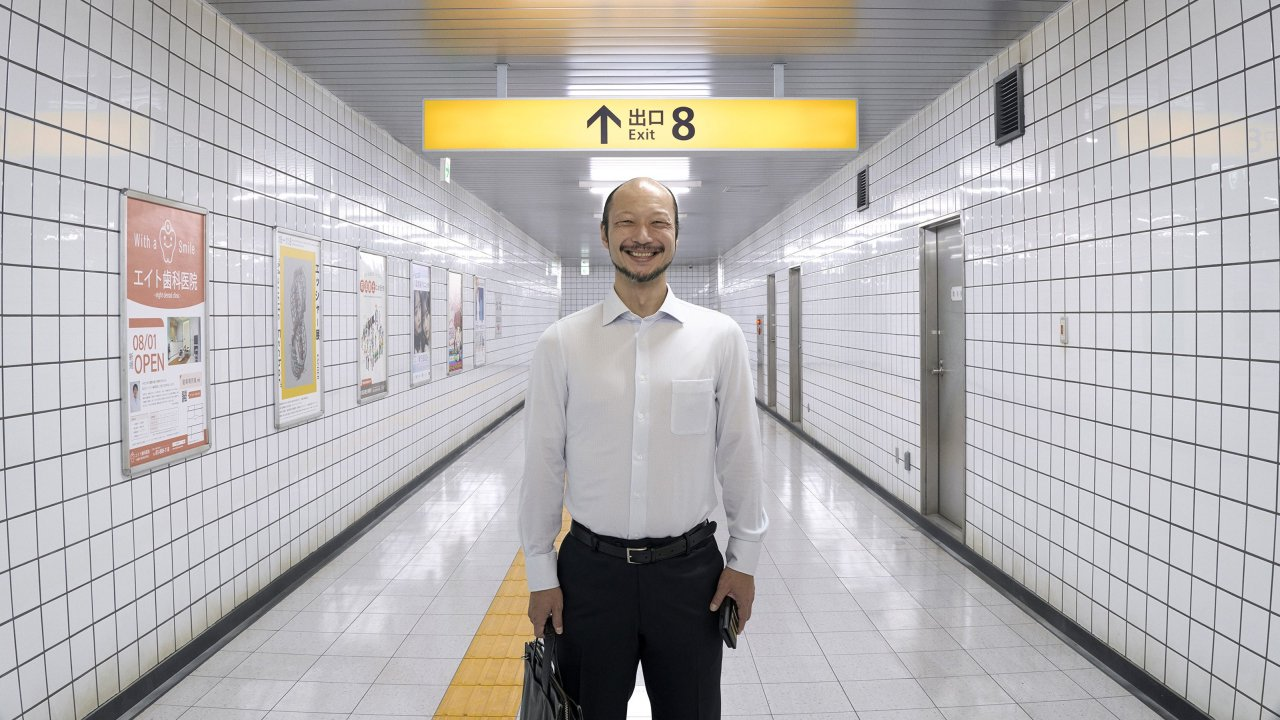
MOVIE REVIEW – Exit 8 turns a Tokyo subway corridor into a trap built from guilt, repetition, and the kind of dread that creeps up on you one detail at a time. Genki Kawamura’s film does something game adaptations almost never manage: it actually thinks like a game without feeling like a cutscene stitched into a feature. It is not flawless, but when it locks into its own unnerving rhythm, it becomes a sharp, claustrophobic head-trip with real staying power.
Ravel’s Bolero pulses through Genki Kawamura’s cerebral chiller Exit 8, although you could just as easily imagine it opening with a voice pleading for a route out of this maze. Adapted from the influential game of the same name, the film feels like a cursed variation on that famous Seinfeld parking-garage nightmare – only here the setting is a Tokyo subway station, and the endless corridor ahead gradually starts to resemble purgatory, or else the darker switchbacks of the mind itself.

Loop logic with a pulse
Kawamura, both a filmmaker and an acclaimed novelist, previously used similar manipulations of image and time in 2022’s A Hundred Flowers, where they served to evoke the lived confusion of dementia. In Exit 8, he redirects those techniques toward an entirely different end. The result is an ingenious brain-teaser that transforms the source material’s built-in repetition into something consistently entertaining, even if the mechanism occasionally shows through the gears, while also bringing to mind high-concept works such as Vincenzo Natali’s Cube and Hitoshi Matsumoto’s stranger, more aggressively bizarre 2009 puzzle-box oddity Symbol. Genuine game adaptations that preserve the sensation of play are still remarkably uncommon, and Exit 8, with its maddeningly exact rules and escalating uncertainty, looks well placed to secure a healthy cult following outside Japan too.

A corridor that studies you back
The unnamed central character, played by Kazunari Ninomiya, is on his way to work on the Tokyo subway, surrounded by commuters buried in their phones while one agitated man loudly berates the mother of a crying baby. He keeps his distance, gets off the train, and answers a call from his ex, who tells him something that could alter the course of his life, though he is clearly in no state to confront it. Shot in a long POV take, or at least in an exceptionally convincing imitation of one, this opening lays the groundwork for the ordeal ahead, in which the hero, identified by an on-screen caption as the Lost Man, cannot find his way out of a crooked passage supposedly leading to the elusive Exit 8.
No one else seems to be there, apart from an older man who repeatedly marches past him with robotic regularity, the so-called Walking Man, played by Yamato Kochi. A noticeboard sets out the rules for escape: watch for anomalies, and ignore them at your own risk. Yet as more figures begin to appear inside this sealed-off world, the Lost Man has to work out whether they are fellow unfortunates trapped like him, or anomalies in human form.
He keeps moving forward, sometimes doubling back, and the film’s deftly assembled long-take progression makes the harshly lit tiled corridor feel infinite, while the circling camera intensifies the sense that orientation itself is slipping away. Kawamura exploits the suspense of repetition with real cunning – every turn brings the hope of discovery and the fear that something is subtly, crucially wrong. Just when the film appears to be approaching a dead end of its own, it swerves into an unexpectedly bracing new direction, and it does not stop there.
Conscience as the hidden exit
No tidy explanation is offered for what is happening, even if one figure arrives with a few speculative theories, but the film gradually, if not always elegantly, reveals that the hero’s ordeal is inseparable from the shape of his present life and from an ethical lapse that has set the whole process in motion. That thread of social and personal conscience gives Exit 8 more weight than the more mechanical side of its gaming DNA might suggest, even if Kawamura cannot entirely avoid moments of softness that edge a little too close to sentimentality.
At its strongest, the film’s reversals wrongfoot both the audience and the characters with admirable precision, although one grotesque stretch stuffed with jump scares lands as a rather abrasive detour. Elsewhere, visual and compositional nods to The Shining, coupled with imagery recalling the looping impossibilities of M. C. Escher, lend the film a cohesive and properly unsettling design. Ryo Sugimoto’s production work infuses what should be an ordinary everyday space with the texture of a waking dream. The performances help keep the concept grounded as well, with Ninomiya shifting persuasively between panic and grim resolve, while Kochi adds an eccentric and faintly dangerous unpredictability.
-Herpai Gergely “BadSector”-
Exit 8
Direction - 7.2
Actors - 7.4
Story - 6.6
Visuals/Music/Sounds/ - 7.4
Ambience - 7.6
7.2
GOOD
Exit 8 is a clever, unnerving adaptation that understands how to turn repetition into tension rather than monotony. It occasionally leans too hard on its mechanics or its symbolism, but when its images, rhythm, and ideas click together, it becomes genuinely absorbing. For viewers with a taste for cerebral, claustrophobic Japanese genre cinema, this is an easy film to get lost in.














Leave a Reply