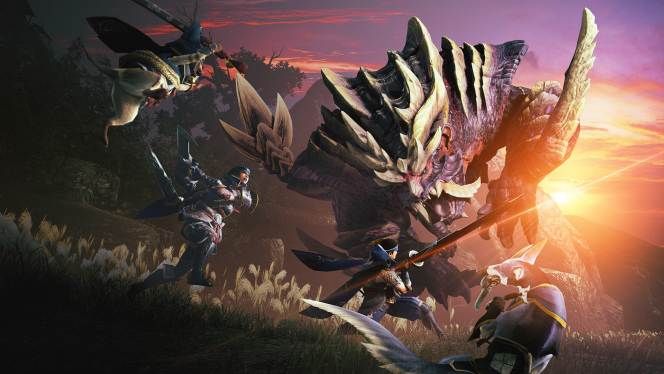
REVIEW – There are games you download from PlayStation Plus because they look worth a quick look, and then there are games that quietly hijack your evening and keep you hunting the same beast at two in the morning for one stubborn material drop. Monster Hunter Rise is very much the latter. Now that it is part of March’s PS Plus Essential lineup, Capcom’s relentlessly moreish action RPG has become even easier to fall into. This is not just another catalogue filler – it is a slick, fast, dangerously addictive monster-slaying machine that knows exactly how to get its claws into you.
When Monster Hunter Rise first launched as a Nintendo Switch exclusive, some players assumed it would be a smaller, lighter side entry – a streamlined spin on the series rather than a fully blooded instalment. That assumption did not last long. What Capcom actually delivered was a sharper, faster and more immediately playable take on the familiar formula, one that trims away some of the drag without sacrificing the obsessive rhythm that has defined Monster Hunter at its best. Playing it now on PlayStation, it still feels fresh in all the right places. The core loop remains brutally effective, but the pace and mobility give it a snap that makes it easier to sink into and much harder to put down.
The basic idea will be familiar to anyone who has ever touched the series. You head out into the wild, track down some gigantic nightmare with claws the size of a hatchback, learn its tells, get knocked around a bit, adapt, survive, carve it up and take its remains back home to forge something nastier for the next hunt. On paper, that loop sounds like pure repetition. In practice, Monster Hunter Rise is built with the kind of mechanical precision that turns repetition into compulsion. Every hunt feeds the next one. Every new weapon tree dangles another goal in front of you. Every monster kill feels like progress, even when what you are really doing is signing yourself up for ten more rounds of the same glorious punishment.
For newcomers, this is also one of the better entry points the series has produced. Not because it is shallow – it absolutely is not – but because it is better at getting players up to speed. The systems are still dense, the weapon classes still feel like entirely different games in disguise, and the menus are hardly a masterclass in clean design. But Rise does a better job than some of its predecessors of pulling players into its logic. The first few hours can still feel like being handed a manual, a toolkit and a warning at the same time, yet once the structure clicks into place, the hook becomes obvious. It stops feeling intimidating and starts feeling deliciously absorbing.
Gameplay that moves faster and hits harder
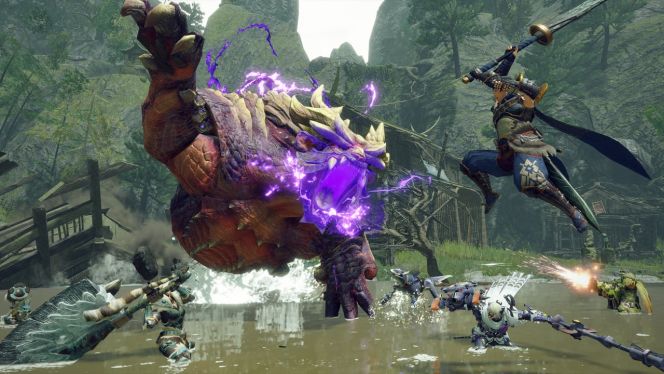
The biggest change in Rise is the Wirebug, and it is not some minor gimmick designed to dress up the marketing bullet points. It fundamentally changes the way the game feels. Movement is quicker, more flexible and far more vertical than before, which gives both exploration and combat a very different cadence. Instead of trudging through fights with deliberate heft, you are constantly repositioning, launching yourself back into the action or escaping disaster at the last possible second. It injects a level of speed and agility that makes the whole experience feel more playful and more aggressive without robbing the monsters of their threat.
That extra mobility also makes the maps more enjoyable to navigate. Monster Hunter has often asked players to put up with a fair amount of friction between the good bits. Rise reduces that friction. You spend less time being mildly annoyed on the way to the fun and more time actually engaging with the fun. The result is a game that feels more immediate than some previous entries, and that immediacy matters. It gives the hunts momentum. It keeps the energy high. It encourages that dangerous thought of doing just one more quest before bed, which is usually where the trouble starts.
The weapon design remains one of the series’ greatest strengths. Whether you favour the elegant reach of the Long Sword, the weighty brutality of the Hammer or something more technical and eccentric, every weapon category feels distinct enough to reshape the entire experience. Rise does not just ask what you want to fight – it asks how you want to fight it. That makes the game feel strangely personal once you settle into a style that suits you. The hunt stops being abstract and starts becoming yours, full of your own timing, habits, mistakes and small moments of brilliance.
A world with character, even when the story is not the main event
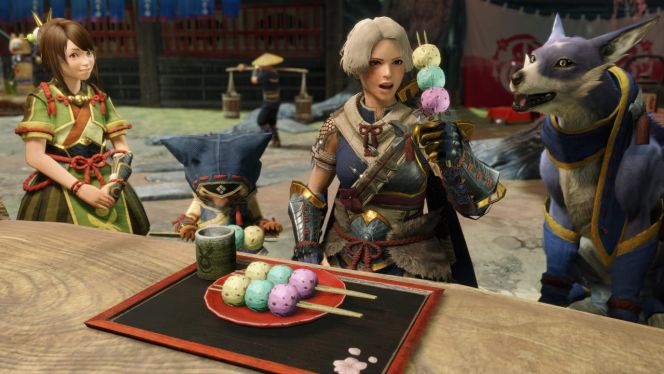
It would be generous to claim that Monster Hunter Rise is driven by its narrative. Like much of the series, it treats story more as framing than as a genuine centrepiece. But that is perfectly fine, because the atmosphere does most of the heavy lifting. Kamura Village has a strong sense of place, the Japanese folklore influence gives the world its own flavour, and the monsters themselves carry enough personality to make the setting memorable. You are not here for a grand dramatic revelation. You are here because the world has identity, and because Capcom knows how to make that identity readable in every menu, village interaction and battlefield encounter.
The supporting cast does its job without trying too hard to become the focus. The villagers are warm, recognisable and functional in the way a hub cast should be. They help anchor the game, provide context and keep the village from feeling like a static vending machine between missions. There is enough charm here to make the world feel inhabited, but not so much narrative sprawl that it gets in the way of the action. That balance suits Rise. It knows where its strengths lie, and it does not pretend to be something it is not.
More importantly, the monsters themselves feel alive in the ways that matter. These are not just health bars with teeth. They move with intent, react with personality and demand that you pay attention. The best hunts are not about hacking away until something collapses. They are about reading behaviour, adjusting your approach and learning the creature in front of you. When a fight really clicks, it stops feeling like a grind and starts feeling like a deadly conversation where one wrong answer means getting flattened into the dirt.
A Switch-born game that still looks the part
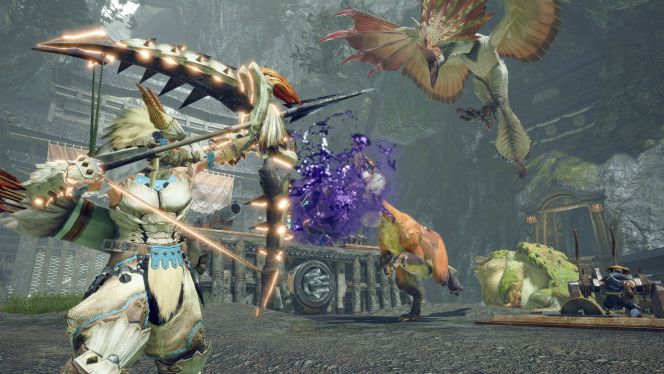
You can tell that Monster Hunter Rise was not originally built to show off the most advanced hardware on the market, but that does not prevent it from looking good. Quite the opposite. Its visual strength lies in clarity, consistency and strong art direction rather than in brute-force technical showmanship. The environments are readable, the creature design is excellent, and the overall presentation supports the pace of the game rather than smothering it in excess detail. In a game this dependent on movement and reaction, that matters far more than flashy clutter.
On PlayStation, that design philosophy pays off nicely. The cleaner performance and bigger screen help the game’s strengths come through without exposing too many weaknesses. The locations may not have the same oppressive density as some of the most intricate areas in Monster Hunter World, but they serve a different purpose. They are built for momentum, for traversal and for keeping the player engaged in motion. That makes them fun spaces to fight in, which is ultimately far more important than photorealistic shrubbery.
The sound design helps sell the scale as well. Weapons land with satisfying weight, monsters roar with real menace and the music does a solid job of escalating tension without becoming overbearing. Rise does not aim for cinematic prestige. Instead, it succeeds by giving its combat, creatures and environments a strong sensory identity. The result is a game that may not be visually groundbreaking, but is often visually memorable, and that is the better outcome.
Combat that rewards commitment and co-op that adds chaos
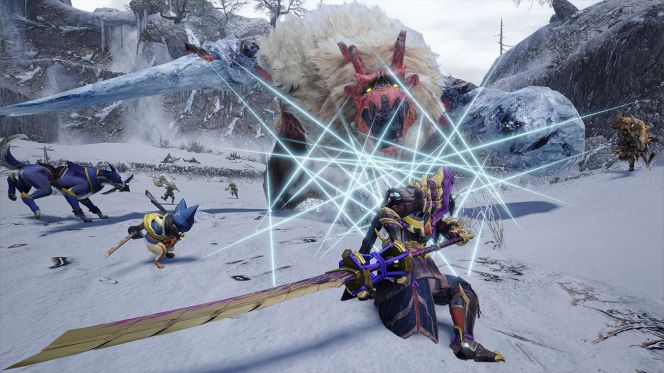
The combat in Monster Hunter Rise has the kind of design that looks accessible on the surface and then slowly reveals how much depth is hiding underneath. You can learn the basics relatively quickly, but true mastery takes patience, timing and a willingness to understand your weapon rather than merely use it. That learning curve is part of the appeal. Winning a difficult hunt does not feel like a routine success. It feels earned. You survived because you adapted, improved and stopped panicking just long enough to do something clever.
The Palamute is another smart addition. It is not merely a cosmetic companion or a cute mascot built to generate fan art. It meaningfully changes the flow of the game, especially when combined with the Wirebug. Riding across maps, repositioning more efficiently and using your companion as part of the overall rhythm gives the experience a more fluid, dynamic feel. It all contributes to that sense that Rise wants to remove dead air and get players into the interesting part faster.
Multiplayer, meanwhile, remains one of the best ways to experience the game, even if it is not flawless. Hunting alone can be rewarding and often makes your personal growth easier to feel, but co-op is where the natural drama of Monster Hunter really takes shape. A group of players with different weapons, different instincts and varying levels of competence can create the kind of emergent chaos that makes every successful hunt memorable. Someone overcommits, someone saves the run, someone gets flattened at exactly the wrong moment, and somehow it all turns into a story worth retelling.
That said, the online side can be uneven. Matchmaking is not always as smooth as you would want, and the broader structure around multiplayer can occasionally feel clunkier than the combat itself. New players may also find that the combination of layered systems and co-op expectations adds to the initial feeling of overload. Still, these issues rarely overshadow the joy of actually playing together. Once a hunt begins and everyone is focused on bringing down the same colossal target, the friction in the menu system matters a lot less than the thrill of the fight.
The best part is that co-op in Rise creates genuine shared memories without leaning on hollow live-service tricks. It does not need a circus of artificial urgency to make players care. The mechanics do the work. The monsters do the work. The unexpected moments do the work. Few action games are this good at generating stories that belong to the players rather than to the script, and that remains one of the series’ most durable strengths.
PS Plus gives one of Capcom’s best hooks an easy way in
Monster Hunter Rise works because it understands exactly what needs changing and what needs preserving. It is faster, more flexible and more welcoming than some earlier entries, yet it never loses the series’ fundamental obsession with preparation, mastery and the steady satisfaction of becoming better at something difficult. It can still be intimidating at first, and it occasionally shows the rougher edges of its systems, but when everything locks together it becomes absurdly hard to resist.
That makes its arrival in March’s PS Plus Essential lineup especially significant. This is not the sort of game people add to their library and forget about. It is the sort of game that quietly becomes the thing they are still playing long after they meant to move on. For veterans, it remains a smart, energetic variation on a formula Capcom already understands better than almost anyone. For newcomers, it is an excellent place to discover why Monster Hunter inspires this level of obsession in the first place. Just do not expect to dip in casually and stay that way for long.
-BadSector-
Pro:
+ Fast, technical and deeply addictive combat
+ Wirebug and Palamute genuinely refresh the formula
+ Great entry point for newcomers without losing depth
Contra:
– The number of systems can still overwhelm new players early on
– Matchmaking and online structure are not always smooth
– The story works as flavour, but never becomes a real highlight
Publisher: Capcom
Developer: Capcom
Style: Action RPG
Release: Nintendo Switch, Windows: March 26, 2021. PS4, PS5, Xbox One, Xbox Series X/S: January 20, 2023.
Monster Hunter Rise
Gameplay - 9.2
Graphics - 8.6
Story - 8.5
Music/Audio - 8.5
Ambience - 8.6
8.7
EXCELLENT
Monster Hunter Rise is a thrilling adventure that offers a lot of new features and improvements over the previous games. The game's gameplay is fun and challenging, the graphics are stunning and detailed, and the story is intriguing and engaging. The game also features a new feature called the "Wirebug" and "Palamute" which adds a new level of exploration and combat.