
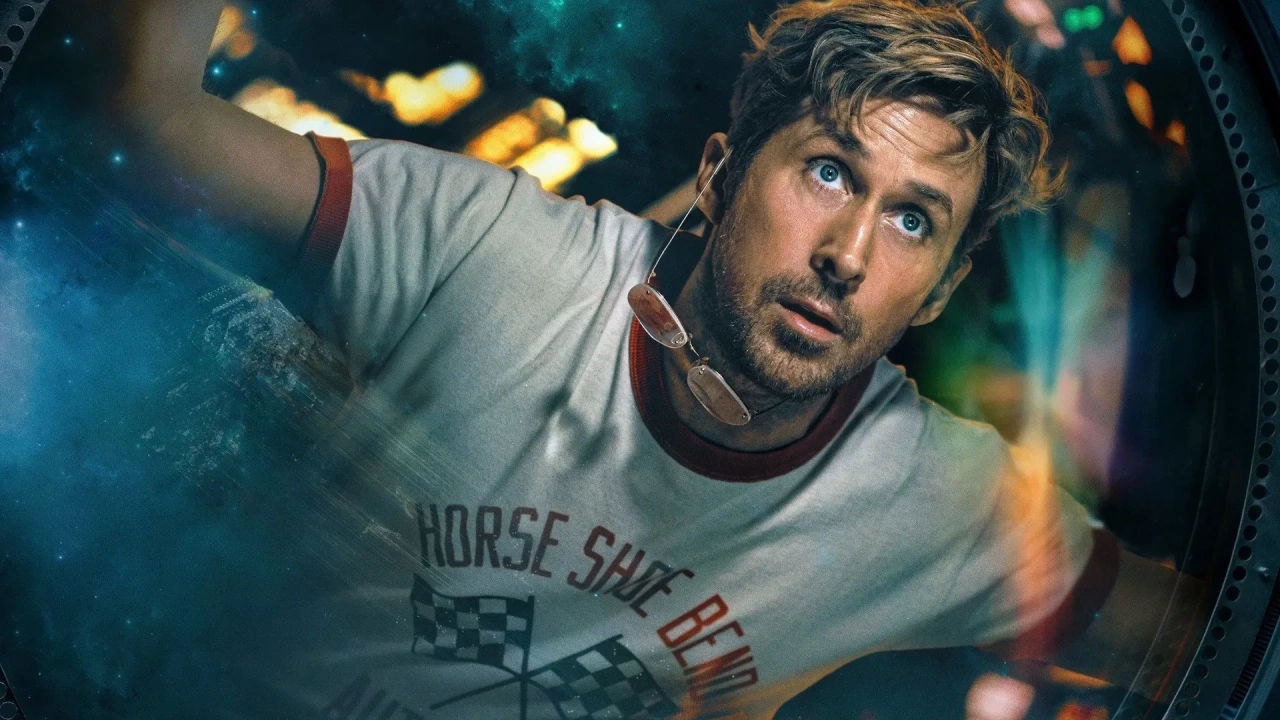
MOVIE REVIEW – Project Hail Mary belongs to that rare class of big studio sci-fi movies that refuses to choose between brains, heart, and humor, then somehow manages to make all three work at once. Phil Lord and Christopher Miller are not trying to clone The Martian; they are building something stranger, warmer, and a lot more playful. Ryan Gosling is terrific at finding the fragile midpoint between brilliance and full-body panic, and the movie turns what might have been a quirky side note in someone else’s hands into its emotional center of gravity. It is a long, generously scaled, occasionally offbeat crowd-pleaser that knows exactly when to be smart, when to be funny, and when to just let itself be human.
The Martian‘s runaway success almost certainly amplified that mix of excitement and dread for this movie. Ridley Scott’s 2015 take on Andy Weir’s work earned $630 million worldwide, became one of the year’s biggest commercial hits, and picked up seven Oscar nominations, including Best Picture and Best Director. It still lands near the top of all-time sci-fi rankings with impressive regularity. That film trimmed back Weir’s lengthy, carefully detailed scientific passages, pushed the central adventure to the foreground, and turned the whole thing into a propulsive, likable space thriller that managed not to irritate actual scientists in the process. Expecting Project Hail Mary to pull off the same trick all over again is a bit like hoping to hit the Powerball jackpot twice in one year.
And yet Lord and Miller, who made The Lego Movie and Cloudy With a Chance of Meatballs, and who later left their fingerprints all over the Spider-Man: Into the Spider-Verse films as producers, know exactly how to balance action and comedy without letting either one flatten the other. Drew Goddard, who adapted The Martian, came back to translate Weir’s novel for the screen. Andy Weir himself was clearly close to the project throughout. Ryan Gosling, playing the science-obsessed and deeply reluctant astronaut Ryland Grace, gives this movie a very different flavor from The Martian, but the same easy charm, vulnerability, and stubborn resolve are very much present. For this material, it turns out, that team was exactly what the movie needed, and when it came time to bring the emotional core of Weir’s book to the screen, they hit the target dead center.
Project Hail Mary begins with Ryland waking up alone aboard a spacecraft after a long medically induced coma, his memory in fragments. Through a chain of flashbacks, he gradually pieces together the mission that put him there. Earth’s sun has been infected by a microscopic life-form later named astrophage, which feeds on stellar radiation so aggressively that the consequences for our planet have become catastrophic. Observations of nearby stars revealed that, within humanity’s reachable range, Tau Ceti’s sun was the only one left untouched. Ryland, one of the lead researchers studying astrophage, was therefore sent to the Tau Ceti system to find out why.

The Point Is Not the Reveal, but What Happens When Two Minds Start Working Together
Weir’s novel throws several major turns into the mix as it unfolds, and the film’s trailers reveal two of the biggest ones immediately. That annoyed some fans, but Weir told Polygon the choice was considered necessary if the movie was going to sell itself effectively to a wide audience. Still, Project Hail Mary is not really a twist-driven movie at heart. Like The Martian, it is more of a problem-solving thriller, built around a scientist trying to bring astrophysics, biology, thermodynamics, and a stack of other disciplines to bear on an escalating chain of urgent crises. Only this time, he is not merely fighting to stay alive himself; he is trying to save Earth, and eventually far more than that.
Much like the film version of The Martian, Lord and Miller’s Project Hail Mary cuts back a great deal of the novel’s extended scientific explanation, relying instead on shorter bursts of exposition and a strong overall impression that its protagonist is frighteningly smart. That, in turn, makes room for the movie’s lively emotional side, which depends heavily on Ryland’s strange mix of wit, self-deprecation, sensitivity, flashes of insight, and plain old fear. He is the kind of person who already seemed to struggle with human connection back on Earth, which makes him an especially unlikely space hero. But when he encounters an alien astronaut he names Rocky, voiced by James Ortiz, Ryland stumbles into something his life back home was obviously missing.
In its own odd way, Project Hail Mary is also a movie about friendship. It is a meeting-of-the-minds story in which a man who could not quite connect with people like himself finally finds real companionship beside someone radically unlike him. Much of The Martian‘s warmth came from watching a whole network of capable people pool their expertise and ingenuity to rescue Mark Watney, Matt Damon’s stranded astronaut on Mars. Project Hail Mary raises the stakes, simplifies the central relationship, and still taps into that same deep satisfaction that comes from watching a shared problem create an emotional bond.
Lord and Miller also understand the same tonal seesaw that made the book work. At times the film is remarkably relaxed, almost as if it has tuned its rhythm to Ryland’s own casual, slightly chaotic way of doing science. The directors leave room for a shopping montage where Ryland cheerfully goofs off while gathering supplies for a cobbled-together lab experiment, and for another gag-driven stretch in which he tests different voice settings for the translator he builds to communicate with Rocky. As dry, character-based, and gently snarky as those scenes can be, the movie keeps swinging back into more recognizable space-adventure mode, where danger closes in, the clock starts ticking, and answers have to be found fast.
Without Rocky, This Would Merely Be Clever. With Him, It Comes Alive
Lord and Miller have not co-directed a movie since 2014’s 22 Jump Street, having spent most of the years since then writing and producing projects ranging from The Lego Batman Movie to The Last Man on Earth. With Project Hail Mary, they return in style, and they do so as producers as well, alongside Gosling and Weir. That may help explain how they secured the freedom to make a science-fiction movie this unapologetically unusual, one that never dumbs Weir’s book down but also refuses to inflate it into a more generic, action-driven blockbuster. The film carries a clear faith in the material, and a matching confidence that audiences will not grow restless over a 156-minute runtime as long as Ryland remains compelling, the push-and-pull with Stratt stays sharp, the problem-solving remains absorbing, and Rocky is as lovable as the movie needs him to be.
It is difficult not to warm to Rocky, who can collaborate on complex astrophysics with one of Earth’s best scientists and, in the next breath, land innocent little-alien bits that sit somewhere between BB-8 and Baby Yoda on the scale of engineered audience affection. The scene where he experiments with Ryland’s retractable tape measure is basically begging to be turned into a thousand GIFs. He was always the trickiest element in the entire production: a nearly featureless puppet character who had to feel relatable, soulful, and funny all at once. Rocky has to register as a mystery, a survivor, a balm for Ryland’s loneliness, a pioneer among his own kind, and a steady source of endearing jokes and reactions. Building an entire movie’s emotional center around a dancing rock with halting English sounds like an absurdly reckless idea on paper.
That may be exactly why Project Hail Mary works as well as it does. Anyone capable of seeing charm, heart, and real emotional pull in an alien rock is already operating with a radical amount of imagination, empathy, and nerve. The fact that these filmmakers pushed even further, and recognized the appeal of an E.T. the Extra-Terrestrial variation where Elliott is not just E.T.’s friend but also his lab partner and co-worker, tells you a lot about the particular sensibilities required to get this adaptation made. The film is better for having passed through minds this peculiar.
This is one of those rare cases where the anxious fan question – “Did they do the book justice?” – turns out to be unnecessary from the start. The movie version of Project Hail Mary is funny, strange, uplifting, and fully satisfying.
-Gergely Herpai “BadSector”-
Project Hail Mary
Direction - 8.4
Actors - 8.6
Story - 8.6
Visuals/Music/Sounds/ - 8.8
Ambience - 8.8
8.6
EXCELLENT
Project Hail Mary delivers large-scale science fiction without forgetting that the best space adventures are memorable not because things explode, but because people connect. Ryan Gosling, Rocky, and Lord and Miller’s surprisingly assured tonal control combine into something genuinely rare: a smart, funny, sincerely moving crowd-pleaser. This will feel like an event for fans of the book, but it also works beautifully for anyone just looking for a science-fiction movie with brains, heart, and real charm.












Leave a Reply