OPINION – Yesterday, a long-form interview detonated a scandal, and what Szilveszter Pálinkás said about Gáspár Orbán, the Chad mission and “divine guidance” now makes an eight-year-old video game trailer feel like an eerie, accidental paraphrase.
The scandal did not erupt from a vague leak or an anonymous rumor. It came from a long interview given openly and on the record. Captain Szilveszter Pálinkás said the Hungarian military is at a moral low point, and he also claimed that Gáspár Orbán had pushed the Chad mission while invoking “divine guidance.” According to Pálinkás, Orbán spoke about the mission in terms of a fifty-percent combat loss rate, which Pálinkás understood as meaning that half of the Hungarian soldiers sent there could die. That is already a staggering allegation on its own, but it becomes even graver because Pálinkás says he did not hear it from a drunken fantasist. He heard it from the son of the prime minister, a military officer who by then was no longer moving through the system as a private individual in any meaningful sense.
The same interview also included another explosive claim: that after Sandhurst, Gáspár Orbán was placed in the Carmelite, given an office as a first lieutenant, and started planning his African mission from there. That did not come out of nowhere either. Earlier reports had already said that he had been given an office in the Carmelite Monastery and had become involved around a new national security structure. Official reactions never really dispelled those reports. If anything, they merely suggested that the prime minister’s son had an unusual, informal passage into the innermost spaces of state power. That fits with the earlier reporting by Direkt36 and Le Monde, which showed that Gáspár Orbán played a visible role in preparing the Chad mission and appeared repeatedly at meetings connected to it. In other words, this was not some incidental bystander hovering near policy. It was someone with no transparent public mandate walking deeper and deeper into military and foreign policy terrain.
And this is where the story becomes genuinely sickening. Because Gáspár Orbán’s public profile has long been inseparable from the charismatic religious environment in which he became known. Around the Felház movement, the dominant language for years was that of ecstatic faith, conversion, divine calling and spiritual chosenness, and Gáspár Orbán himself made statements presenting Jesus Christ as the only chance for the Hungarian nation. Religion in itself is not the issue. Fanatical religiosity that mutates into political and military influence very much is. Especially when a former comrade is now alleging that this same man invoked “divine guidance” while pushing Hungarian soldiers toward an African mission, and the surrounding system apparently did not stop him in time.

An Eight-Year-Old Trailer Suddenly Feels Disturbingly Familiar
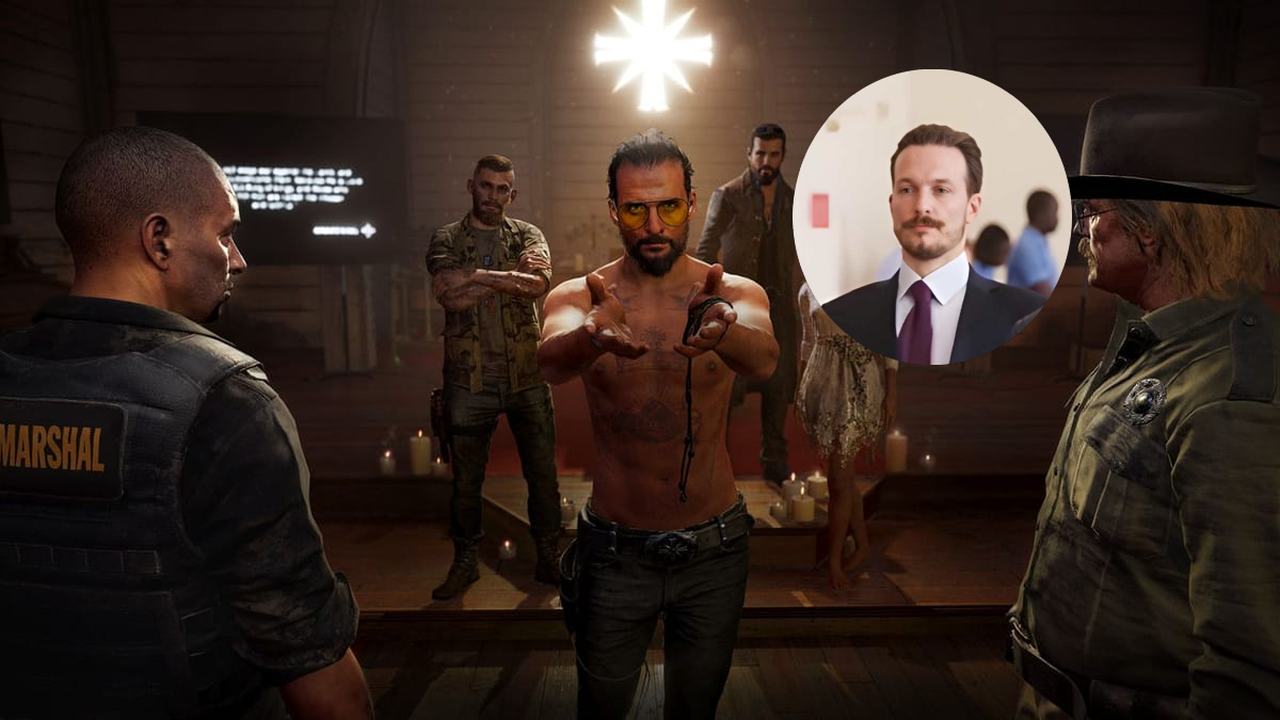
That is why it is now impossible to rewatch that 2018 trailer as if it were just another piece of game marketing. The video belongs to Far Cry 5, a game built around a fanatical religious cult led by Joseph Seed, a man who sees himself as a prophet, the chosen one, the instrument of God. In the trailer, what you get is not a cartoon villain but a cold, charismatic religious obsessive who uses the language of faith for domination, fear, surrender and eventually violence. Far Cry 5 as a whole runs on that logic too: a self-anointed savior builds a cult, captures a region and turns belief into a technology of power.
That is why the trailer now lands with such chilling force. Not because Gáspár Orbán and Joseph Seed can be mechanically equated, but because the same dangerous pattern flashes through both images. Religious certainty that is no longer private conviction but command. Charisma that is no longer a spiritual phenomenon but hardened influence. A sense of mission that no longer concerns one’s own life but starts deciding over other people’s lives. At that point, it becomes striking that Greg Bryk’s performance even produces a visual resemblance unsettling enough to amplify the effect: gaunt, intense, inwardly burning, projecting the aura of someone who believes he carries a cause greater than himself.
The trailer works as such an unnerving accidental paraphrase precisely because it is not loud or comic-book insane. It presents the quieter, more insidious form of fanaticism, the kind that first sells itself as moral clarity, purification, mission and obedience to a higher truth. By the time everyone realizes what is happening, people, institutions and armed structures have already started adjusting themselves to that self-image. That is exactly what makes the Hungarian story so disturbing now. What is emerging is not the private drama of an eccentric believer, but the possibility that a religiously charged, mission-driven mindset was being taken seriously around a military project with real human stakes.

The Game Itself Is a Warning, Not Just the Trailer
Far Cry 5 therefore feels like more than a neat pop-cultural comparison. It is a warning about what happens when a sect-leader type is no longer contained by sober institutions, rules and counterweights, but instead is treated as exceptional, chosen, somehow above the normal order. The trailer compresses that into a few minutes. The game plays it out in full, showing how religious obsession turns into hierarchy, obedience, fear and eventually armed control.
And if, in a real country, the prime minister’s son appears around an African mission carrying religious mission-talk, informal access to power and military ambition, while the surrounding apparatus fails to shut it down, then an old video game trailer stops being just a clever analogy. It starts to look like a dark premonition of what happens when people make too much room for a figure like that.
Source: Telex, 444, Telex – VSquare, Direkt36, HVG, Ubisoft