
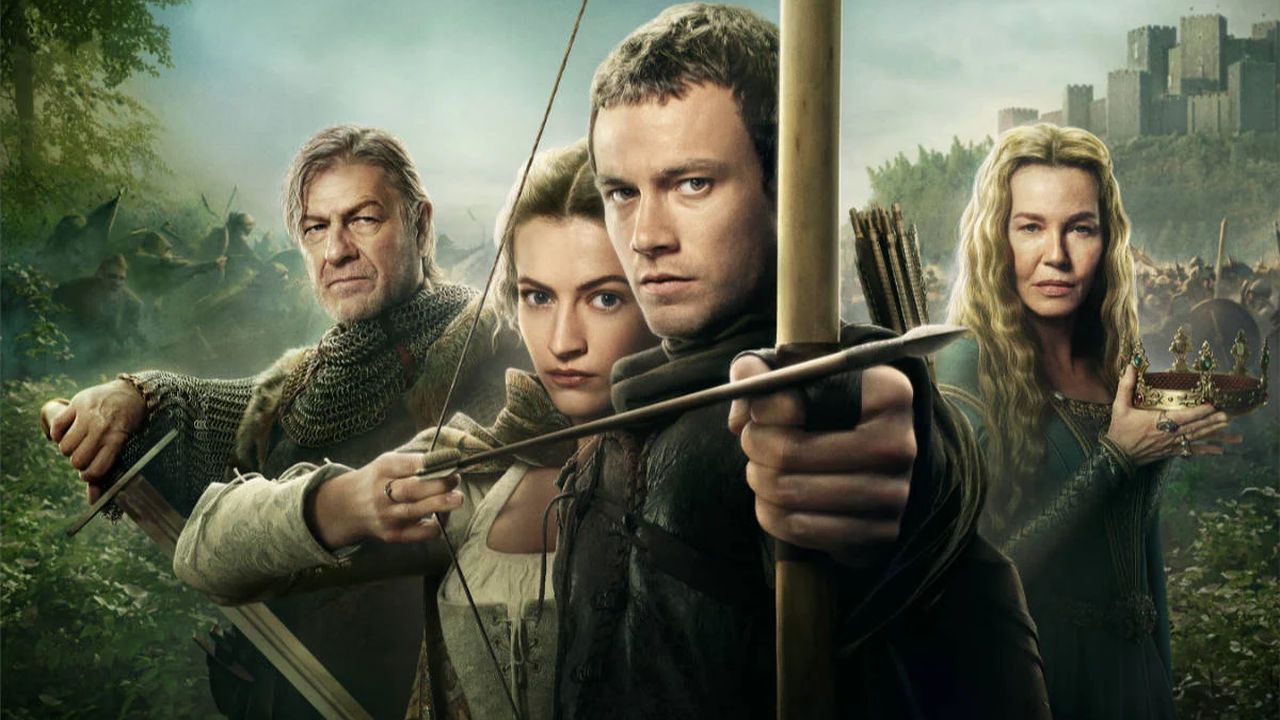
SERIES REVIEW – The Robin Hood legend has been dragged back onto screens so many times that skepticism feels like the only reasonable reaction whenever yet another version appears. This series, though, does not simply put on the hood and march through the usual checklist of familiar iconography. It places an actual human being inside the myth, one with flaws, temper, scars, and a sense of genuine weight. That is what gives the whole thing a pulse. Instead of feeling like recycled folklore, it feels like a story that is finally alive again.
Making a truly good Robin Hood adaptation should be easier than it is, and yet it almost never is. That might sound odd, given how completely the legend has soaked into pop culture and how nearly everyone can recite the basics from memory. A man lives in the woods, shoots with ridiculous precision, steals from the rich, and helps the poor. Simple enough. On paper, at least. In practice, both film and television versions keep tripping over the same problem: they rarely understand Robert of Locksley as a real person with dimension, contradictions, and inner life. Too often, he is flattened into a symbol, while goodness itself gets treated like a neat personality trait instead of something proven through difficult, lived choices. The same problem ruins most King Arthur adaptations too, but that particular rant can stay sheathed for another day.

When the Legend Finally Finds a Heartbeat
Maybe that is why it feels oddly fitting that the first genuinely worthwhile Robin Hood to arrive in a very long time did not come packaged as a flashy prestige event or a big-screen spectacle, but instead landed on a streaming service most people still overlook. MGM+ has already been home to some very strong work, from Steven Knight’s war drama Rogue Heroes to the twisty genre series From, but it still spends most of its time in the shadow of Prime Video. Robin Hood could easily be the show that pushes it a little further into wider attention, because this is a thoughtful, disciplined, and often impressively textured take on a classic story. It strengthens familiar beats with historical framing, layers in nuance, and gives several women in the story something much more interesting to do than simply circle around the men.
The series is currently being marketed as a more contemporary interpretation of the legend, but fuller is probably the more accurate word. This version is just as interested in the world Rob inhabits as it is in the hero he will eventually become, and that makes it an origin story willing to sit with awkwardness, pain, and the rougher edges of growing into oneself. At the same time, it allows its characters enough agency to make meaningful choices rather than simply nudging them from one preordained mythic beat to the next. Set in 12th-century England during the reign of Henry II, the show reframes the legend through the social and cultural tension between the Norman ruling class and the Saxons, who have effectively become second-class citizens in their own land. If we want to be strict about the history, the series definitely plays a little loosely with the details – Hastings still cast a long shadow by this point, but a more blended English identity had already begun to take shape – so yes, it is a little messy, though that very messiness might give Season 2 something more interesting to grapple with.

There Is Finally a Human Being Behind the Bow
In this version, Robert of Locksley (Jack Patten) is reimagined as the son of Hugh (Tom Mison), a former Saxon lord whose land was seized by the Normans before he was reduced to the status of a royal forester, while the family seat was handed over to the odious Earl of Huntingdon (Steve Waddingham). Rob grows up in a much poorer village, but one that also feels warmer, closer, and more recognizably human. He comes of age learning to master the bow, bristling at his mother’s (Anastasia Griffith) attempts to teach him Norman French, and listening to stories about the forest goddess Godda, who sometimes watches over Saxon warriors. He also sneaks back to the grounds of his old home from time to time, and it is there that he meets Marian (Lauren McQueen), Huntingdon’s daughter, who turns out to be far kinder and far less imprisoned by class than her father.
The star-crossed romance practically writes itself, but Robin Hood makes the smart decision to build Rob and Marian’s connection slowly, letting them first exist as two young people tentatively discovering each other rather than forcing epic destiny on them from the start. That gives the relationship a natural charm and an ease that is genuinely appealing. Patten and McQueen work very well together, and they are easy to root for even when the old divide between their worlds keeps rubbing painfully against whatever is growing between them. Things darken when Rob’s father Hugh comes into conflict with the Sheriff of Nottingham (Sean Bean), who is reimagined here as Henry II’s cousin, and the Locksleys suddenly find themselves exposed beyond the protection of Norman law. As Rob is pushed into choices that are harsher, riskier, and far more defining than anything he expected, he is steadily pulled away from the future he once assumed would be his and set on the road that will eventually turn him into a legend.
There Is Life Beyond Sherwood Too
Much of the first ten-episode season plays as a slow-building origin story, introducing a number of familiar names with patience while still managing to make their individual paths feel fresher than expected. Little John (Marcus Fraser), Friar Tuck (Angus Castle-Doughty), and Will [Scarlet] (Henry Rowley) all appear, but not in the dusty, overly familiar ways many viewers will assume. The show’s measured pace gives the story room to breathe, which keeps it from collapsing into nothing more than a straightforward tale about a band of outlaws hiding in Sherwood Forest.
Marian is sent to the king’s court to serve Queen Eleanor of Aquitaine (Connie Nielsen), where the world opens up into something much larger and more dangerous, filled with politics, power, and intrigue. The Sheriff also becomes more than a stock villain through the addition of his fiery daughter Priscilla (Lydia Peckham), whom he not only clearly loves but has also, perhaps a little anachronistically, raised to think for herself. And in one of the series’ most pleasant surprises, all three of these women are given real depth, agency, and interior life in ways that this legend’s adaptations almost never allow. Part historical adventure, part sincerely effective romance, and part political drama, MGM+’s Robin Hood is an unexpectedly rewarding series, far stronger than this overworked myth has any right to inspire at this point, and a welcome reminder that even the oldest stories can still feel alive when someone approaches them with care, attention, and taste.
.
-Gergely Herpai “BadSector”-
Robin Hood
Direction - 7.2
Actors - 7.4
Story - 7.1
Visuals/Music/Sounds/Action - 6.8
Ambience - 7.2
7.1
GOOD
This Robin Hood does not try to reinvent the legend. It simply tells it properly for once. Instead of treating the material like a museum relic, it gives it flesh, texture, and emotional weight, where so many earlier versions settled for poses, costumes, and empty gestures. Not every moment lands perfectly, but this one actually knows how to aim.




Leave a Reply