
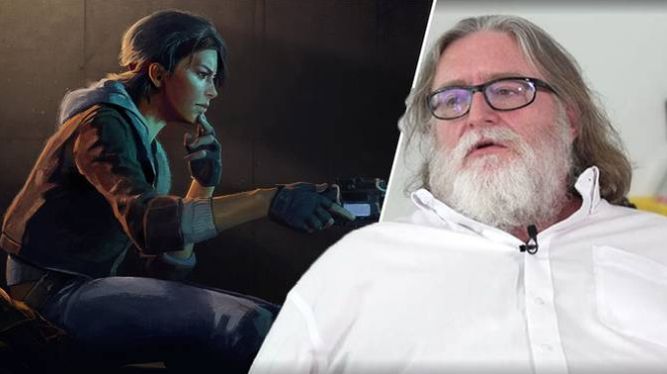
During the development of Portal 2, the founder of Valve came to a blunt realization: his own authority had started to get in the way of creative work instead of helping it. Gabe Newell gradually stepped back from direct game development, and it ended up being one of the smartest decisions he could have made.
There is something deeply paradoxical about Gabe Newell. The president and founder of Valve is one of the most successful people in the video game industry, both creatively and commercially. That long run of major wins turned him into a towering authority figure for fans and developers alike. That is exactly where the problem begins, because no matter how good a leader is, they still need people willing to challenge them – and how exactly do you push back against someone with as much experience and stature as Gabe Newell?
The Day Gabe Newell Stopped Making Video Games
Gabe Newell started to realize his time as a hands-on developer was nearing its end during the making of Half-Life 2. Even though many still consider it one of the greatest games ever made, he admitted in a Q&A almost ten years ago that, looking back, it was hard not to see a number of things to regret in the shooter. He never fully unpacked that remark, but he did leave a few clues. If you’re involved in developing a game, it all becomes a series of trade-offs. Anything that’s in the game comes at the cost of something that isn’t. I just feel this more personally with Half-Life for a number of reasons. And with Xen, of course.
During Valve‘s early years, when Gabe Newell was much more directly involved in the creative process, he began to understand that developers were finding it harder and harder to tell him no. Joshua Weier, lead designer on Portal 2, explained it this way in an interview with Kiwi Talkz: I think he always wanted to be part of the team, but being Gabe Newell and in that position… it just didn’t work. People would be like, We’ll do what you say, while he just wanted to be part of the team and contribute ideas. Weier said that created serious difficulty for the developers. That’s why there was a period where he took a step back and realized he wasn’t going to be able to interact with people in that way.
A lot of that can be blamed on a phenomenon long studied in aviation: the authority gradient. The theory says that people find it difficult to speak up when their opinion contradicts someone they see as more experienced and more authoritative. That is why airline captains are trained to create environments where first officers feel comfortable voicing disagreement. Those first officers also go through regular drills designed to help them overcome the fear of speaking up when they think something is wrong. But for that to work, it takes dozens of hours of training and an entire work culture built around it.
So it is not surprising that things often played out the way Erik Wolpaw, writer on Portal 2 and Half-Life: Alyx, described in another conversation with Kiwi Talkz: Everyone’s a little afraid of him. At the same time, employees also agreed that, in reality, Gabe was a pretty normal and reasonable person. Joshua Weier said there were even moments when he worried about him personally. Chet Faliszek, writer and developer on both Left 4 Dead games, added that Gabe Newell had always respected differing views on game design. He would tell me how we could make a game without a story and that it was going to be a disaster… He was always pushing, but a week later he’d repeat my words in an interview for German TV. He accepted that we didn’t agree.
That is why Gabe Newell stopped focusing on game development, and honestly, it may not have been a bad thing at all. Not only did it free up more time for him to manage Steam and Valve‘s live-service ambitions, but he also seemed personally happier stepping away from the creative side. It’s much easier to be a fan of things I’ve had less control over, he explained in that earlier Q&A. It is no coincidence that his favorite single-player game at Valve is Portal 2, the very project where he chose to take on a much more secondary role. Part of leadership is knowing when to let the talented people you hired do their work freely.
Over time, Valve‘s CEO also stepped back in other parts of the company. These days he works a reduced schedule, contributes to several different projects at once, and mostly focuses on the things he actually enjoys. It is hard to argue that he has not earned that freedom. After all, if you helped build the company best positioned for the future of the video game industry, you are probably allowed a few luxuries.
Forrás: 3DJuegos














Leave a Reply