
After Doom, another PC classic has now crossed into territory that used to feel almost exclusive to id Software’s shooter: running on a portable device that was never meant for gaming in the first place. This time the chosen game is the original Prince of Persia, or more precisely a version called Prince of Arabia, and the hardware in question is the Flipper Zero.
Over the years, it has practically become its own subculture to find increasingly absurd devices capable of running some version of Doom. The technical skill behind those experiments is still impressive, but the sheer number of them has made the idea feel a little less surprising than it once did. That is exactly why this new feat stands out. Instead of dragging id Software’s classic onto another unlikely gadget, developers have done it with Jordan Mechner’s original Prince of Persia. And instead of using some improvised handheld console, they chose the Flipper Zero, a portable device better known for interacting with digital and radio systems than for playing games.
The project comes from Flipper Devices, the company behind the hardware itself. Rather than porting the original game code directly, the team worked from Prince of Arabia, an existing version based on Arduino foundations, and adapted that into a dedicated Flipper Zero release. The result, however, still amounts to the same thing in practical terms: the first Prince of Persia can now be played in a portable format on a device most people associate more with security tinkering than with gaming.
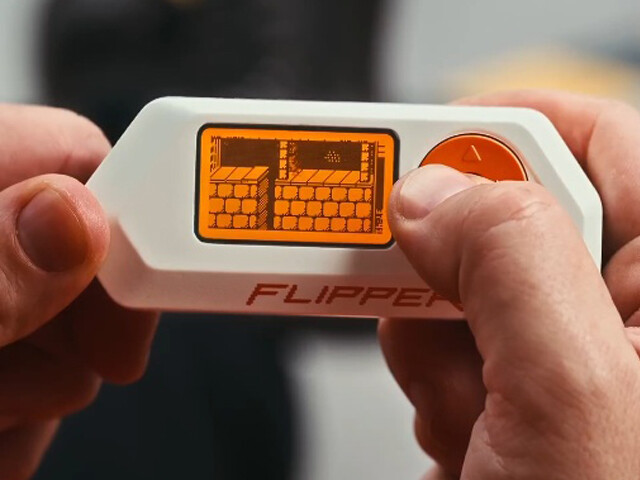
A Prince of Persia on a Hacker’s Tamagotchi
What makes the whole thing especially interesting is how little the hardware was designed for this kind of task. One of the biggest limitations of the Flipper Zero is memory. The device only offers 256 KB of shared SRAM, which is extremely restrictive even for a project that looks deceptively simple on the surface. To work around that problem, the developers used a microSD card to store the game data, allowing the processor to load screens and required assets as needed instead of trying to keep everything in memory at once. In other words, this is less about brute force and more about clever engineering.
The screen was the next major obstacle. The Flipper Zero uses a tiny 128×64 monochrome display, which by modern standards is almost absurdly limited for a game like this. In order to make Prince of Arabia readable and playable on that screen, the developers had to modify the code and simplify the presentation. Characters were stripped of some visual detail, especially color information and finer graphical touches, but the team still tried to preserve the core quality that made the original Prince of Persia so memorable: the remarkable fluidity of its rotoscoped animation. So the goal was not simply to make a crude approximation run, but to retain at least some of the feel that defined the classic in the first place.
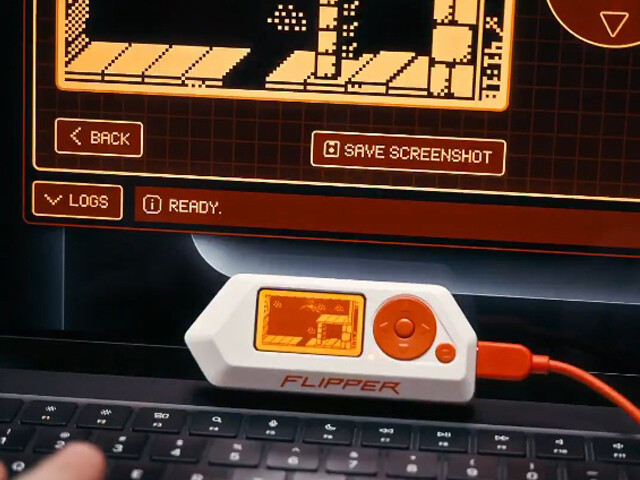
They Adapted the Entire Game Because They Could
Perhaps the most striking part of the experiment is that this is not just a partial demo or a few proof-of-concept levels. According to the reports around the project, the version of Prince of Arabia running on the Flipper Zero includes the full program, complete with levels, cutscenes, enemies, ending, and even credits. That matters because many similar experiments on non-gaming hardware – even with Doom – often stop at incomplete or heavily reduced versions. Here, the point seems to have been to go all the way.
The reason behind it is also part of the charm. This was not presented as some grand technological manifesto or a massive commercial play. It was done, apparently, because the developers liked the game and because they were able to make it work. That gives the whole project an oddly endearing quality. It also helps that the port is not limited to the tiny built-in screen: with the right cables and the optional video module, the Flipper Zero can output to an external display, while the player still controls the game with the device’s own directional pad and buttons. And for anyone curious enough to dig deeper, the source code and a ready-to-run version have also been published on GitHub, turning this from a neat stunt into something people can actually test for themselves.
Source: 3DJuegos





![Koshmar: The Last Reverie Looks Like an Action Adventure Trapped Between Dreams and Madness on PC and Consoles [VIDEO]](https://thegeek.games/wp-content/uploads/2026/04/theGeek-Koshmar-The-Last-Reverie-302x180.jpg)