
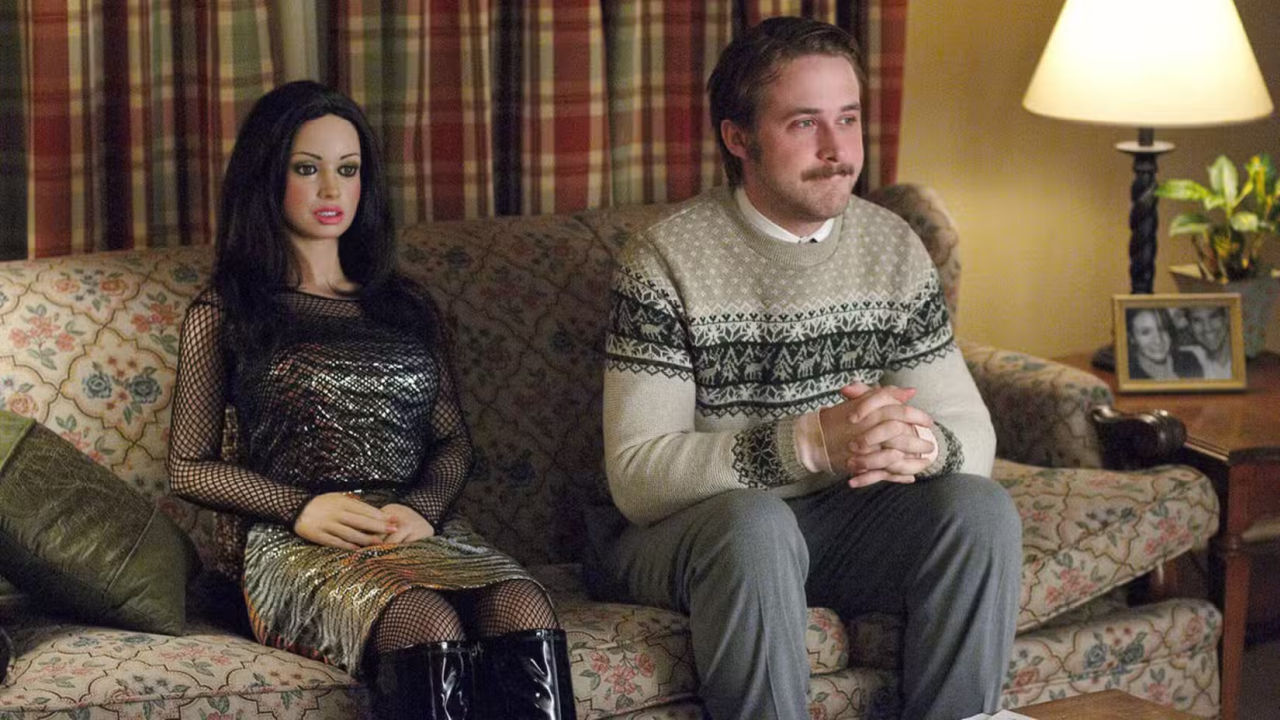
MOVIE NEWS – Long before Ryan Gosling returns as the lonely astronaut of Project Hail Mary, he had already delivered one of the strangest and most deeply human performances of his career. Lars and the Real Girl, released in 2007, remains one of his boldest turns, and it was exactly the kind of risky, quietly affecting film that Roger Ebert admired enough to call deeply satisfying.
Directed by Craig Gillespie from Nancy Oliver’s Oscar-nominated screenplay, Lars and the Real Girl begins with a premise that could easily have collapsed under its own awkwardness. Gosling plays Lars Lindstrom, a painfully shy and socially inept young man who becomes emotionally attached to a lifelike sex doll he orders online and then introduces to the people around him as though she were a real person. On paper, that sounds like the kind of setup built for cheap laughs or bad taste. The remarkable thing about the film is that it refuses both. Rather than mocking Lars or turning his delusion into an easy joke, it treats his loneliness with total seriousness and builds the entire story around that decision.
Lars is still marked by the early death of his mother and the emotional distance of his father, and his fear of physical touch has left him almost incapable of functioning in ordinary relationships. The only real comfort in his life comes from his older brother Gus and Gus’ wife Karin, but when Karin tries to coax him out of his shell, Lars responds by bringing home Bianca and presenting her as his partner. The more earnestly he commits to that fantasy, the more alarmed his family becomes. But this is where the film makes the choice that defines everything. Instead of humiliating Lars, the small town around him decides to play along, including his therapist, who understands that what he needs first is not ridicule, but compassion.
Lars and the Real Girl Is a High-Wire Act That Gosling Walks With Remarkable Control
That is what makes Lars and the Real Girl one of the sweetest and most sincere independent romantic dramas of the last twenty years. Beneath the odd setup, this is really a film about loneliness, grief, shame, and the possibility that a community can respond to suffering with patience instead of cruelty. Gosling’s performance works because he never plays Lars as a punchline. He plays him as a wounded person whose every hesitation, glance, and awkward silence come from somewhere painful and real. That approach does not simply make Lars understandable, it makes him impossible not to care about.
The performance also stands out because it arrived just one year after Half Nelson, which makes the breadth of Gosling’s range even more striking. In Lars, he combines innocence, fragility, and emotional damage without ever letting the character tip too far into caricature. He is not too morose, not too bizarre, and not too studied in his oddness. That fragile balance is what keeps the film alive. If Gosling had pushed too hard in any direction, the whole thing could have collapsed. Instead, he holds the tone steady and humane from beginning to end.
Roger Ebert Heaped Praise on Gosling in Lars and the Real Girl
That is exactly why Roger Ebert responded so strongly to the film. In his review, he stressed that Lars and the Real Girl never becomes smutty, mocking, or condescending, even for a moment, and he argued that one of the film’s greatest achievements lies in how skillfully it sidesteps all the obvious ways such a premise could have gone wrong. For Ebert, the movie’s strongest weapon was its complete sincerity, and he described it as having a kind of purity that carried the entire story. That is especially meaningful praise for a film that could so easily have become embarrassing in lesser hands.
Ebert also singled out Gosling’s work with unusual admiration. He wrote that nine actors out of ten would probably have turned down the role, correctly suspecting it to be a minefield of bad laughs, while Gosling instead delivered a performance built on extraordinary tonal control. In Ebert’s view, Lars never became too mournful, too strange, too opaque, or too earnest. He remained serene and unexpectedly human. Although Lars and the Real Girl did not become a box office hit, it was embraced critically and has endured as one of those Ryan Gosling performances people mention less often than they should. And yet films like this are often where an actor reveals the most, not through grandstanding, but through quiet risk and exact control.
Source: MovieWeb



![A God of War-Style Game With a Ballerina Fighting Slavic Gods Actually Exists, and Tsarevna: Age of Tales Already Looks Wild Enough to Stand Out [VIDEO]](https://thegeek.games/wp-content/uploads/2026/04/theGeek-Tsarevna-Age-of-Tales-302x180.jpg)








![A God of War-Style Game With a Ballerina Fighting Slavic Gods Actually Exists, and Tsarevna: Age of Tales Already Looks Wild Enough to Stand Out [VIDEO]](https://thegeek.games/wp-content/uploads/2026/04/theGeek-Tsarevna-Age-of-Tales-300x365.jpg)