
MOVIE REVIEW – Captain America: Brave New World promised to pull the Marvel Cinematic Universe out of the post-Endgame haze that’s plagued the franchise—but instead, it arrived as a muddled compromise. Enter Thunderbolts*, a film that kickstarts the system like an old-fashioned set of jumper cables. Directed by Jake Schreier, one of the minds behind Beef, this brisker, more engaging installment—Marvel’s 36th—may hit some familiar notes (picture a thinner cocktail of Guardians of the Galaxy mixed with The Winter Soldier), but it’s just different enough from the formula to feel—if not original—at least invigorating. It’s a rowdy, underground-club kind of chaos that clears up lingering continuity bits while laying down new tracks, just ahead of this summer’s Fantastic Four, which seems poised to take over a franchise increasingly drifting without a captain. Thunderbolts* won’t rescue Marvel—but it firmly reminds us why we ever gave a damn.
The premise here isn’t new—in fact, it closely mirrors one of Marvel’s own rival’s well-known films. Think back to David Ayer’s Suicide Squad, where a government agent (ironically, Thunderbolts* star David Harbour) voiced the central concern: “What if Superman decided to fly down, rip off the roof of the White House and grab the president right out of the Oval Office? Who would’ve stopped him?” That sparked another question in viewers: what could a bunch of misfits with little more than handguns and sass really do against a godlike threat? Thunderbolts* offers a surprisingly satisfying answer by sending its team of half-heroes after the ultra-powerful Sentry—aka Bob (Lewis Pullman)—in a battle that intentionally breaks from Marvel’s usual, over-planned demolition style. But more on Bob later.

The Calm of the Underdogs: A Superteam Made of Rejects
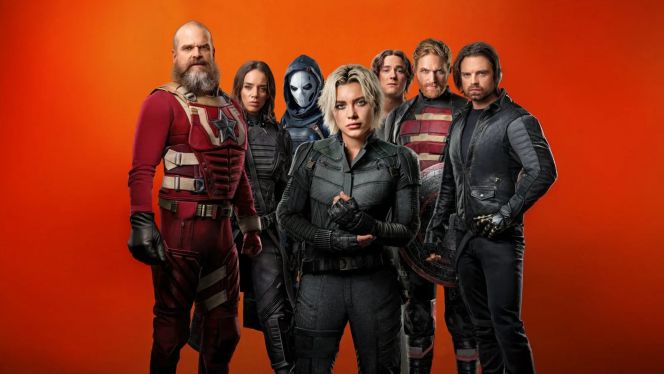
The name Thunderbolts* actually traces back to a preschool softball team—which makes perfect sense for this oddball crew, assembled from sidelined sidekicks, forgotten characters, and former villains. There’s Yelena Belova (Florence Pugh), cracking sarcastic one-liners to mask the grief of Endgame’s losses; her vodka-soaked, limping father figure, the Red Guardian (Harbour); disgraced Cap replacement John Walker (Wyatt Russell), still as smug and abrasive as ever; and two practically invisible figures—Ghost (Hannah John-Kamen) and Taskmaster (Olga Kurylenko)—whose generic helmets render them as forgettable as wallpaper. The squad is rounded out by none other than the Winter Soldier himself, Bucky Barnes (Sebastian Stan), who’s somehow gone from Hydra assassin to U.S. congressman—because MCU geopolitics are still an absurd joke. What you get is the familiar “found family” trope, but Schreier and screenwriters Eric Pearson (Black Widow) and Joanna Calo (The Bear) inject enough friction and contrast to keep it from getting stale.
The plot kicks off when the team is sent to eliminate one another by their refined but shady CIA handler, Valentina Allegra de Fontaine (Julia Louis-Dreyfus, in unexpectedly sharp form). Their showdown unfolds in a secret lab hiding another one of Val’s pet projects: Bob, a being with terrifying powers and a darkness inside him known only as “The Void.” Once Bob enters the fray, Yelena, John, Ghost, and Taskmaster quickly realize Val herself is the real threat—her aim is to engineer a remote-controlled superhero fit for a post-Avengers world. That’s not strategic planning—it’s textbook megalomania. “Justice without power is just an opinion,” she tells her subordinate Mel (Geraldine Viswanathan, Drive-Away Dolls). If Veep had a Marvel-sized budget, this would be the result.

They’re Not Fueled by Revenge—They’re Haunted by Failure
Revenge is often enough to bind a ragtag crew together—but not here. What really unites this dysfunctional gang is that they’ve all failed: spiritually, narratively, and on a franchise level. These are Marvel’s leftover side characters—drifting without purpose after films like Black Widow, Ant-Man and the Wasp, and The Falcon and the Winter Soldier. They carry wounds, loose ends, and awkward abandonments. “Have you found fulfillment?” Yelena asks the Red Guardian early on. “Oh, absolutely. Totally,” he replies, forcing a frozen grin. But Harbour’s eyes say otherwise.
Thunderbolts* doesn’t shy away from heavy themes—grappling with depression, trauma, and self-worth. At first, the characters suppress their shame with cold efficiency, repeating one line over and over: “I’m fine.” But the film won’t settle for that. It peels back the armor and digs into what lurks behind the phrase. Bob’s spiral into darkness, and the emergence of the Void, becomes a symbolic enemy—one that embodies the characters’ inner demons. As the madness escalates, the people of Manhattan blur into shadows, while the finale—surprisingly—doesn’t erupt into CGI carnage, but opts instead for something more contemplative and human.
This Time, the Algorithm Didn’t Direct—And It Shows
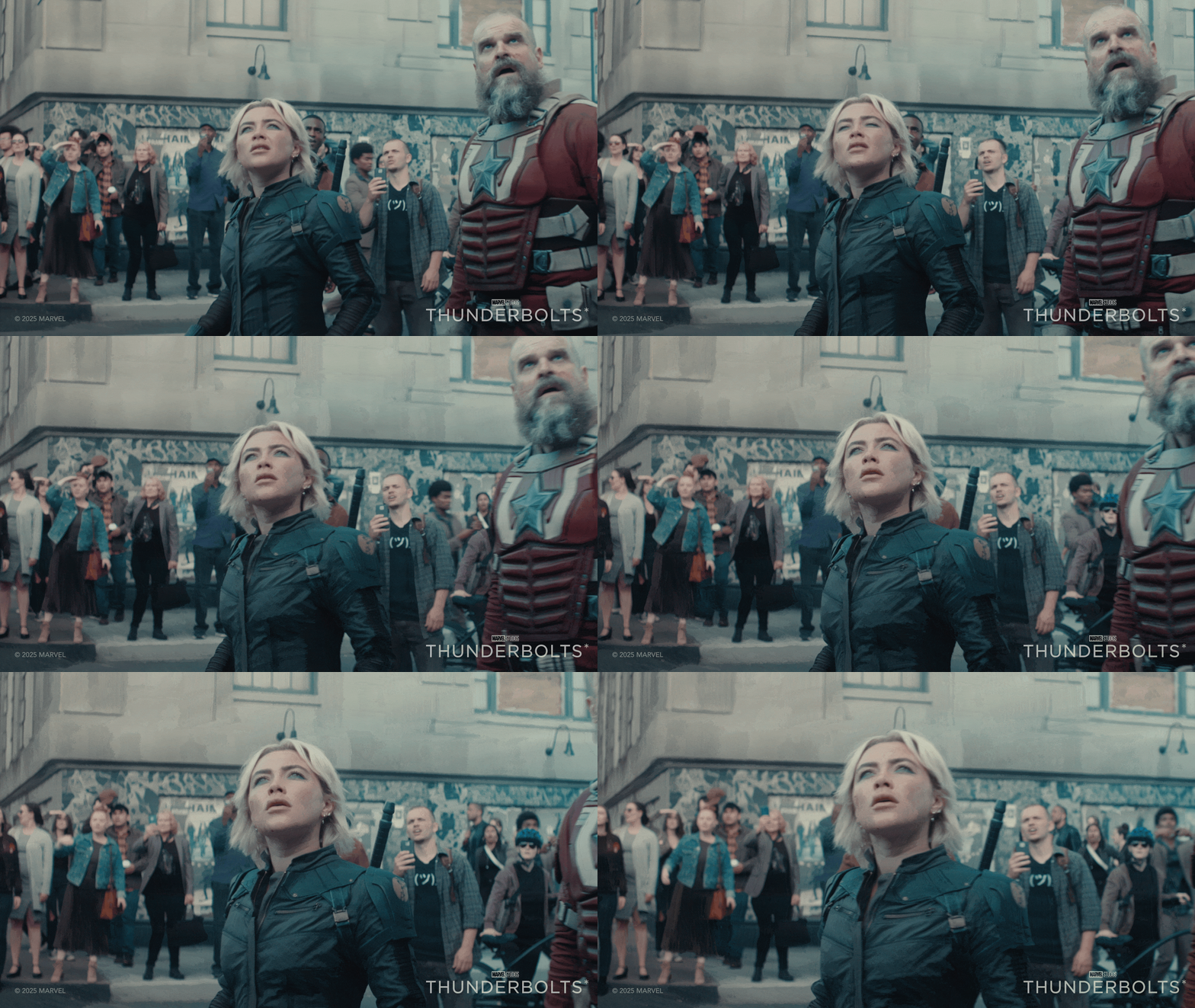
Luckily, the cast clearly enjoys the chaos. Florence Pugh—arguably the MCU’s most emotionally attuned actor—infuses Yelena with heartbreak beneath her meme-worthy gaze, and leaps off Malaysia’s Merdeka 118 (the world’s second-tallest building) like a depressed female Tom Cruise. Wyatt Russell cracks John Walker’s rigid shell just enough to reveal flashes of desperation that make both the character and actor more compelling. But the compressed timeline—most events unfold within a single day—limits the emotional space to let these arcs breathe. John-Kamen and Kurylenko nearly vanish into the background, their stories left hanging, which is a shame given the film’s thematic focus on brokenness.
David Harbour swings between boisterous and exhausting, delivering both the worst jokes and the umpteenth overwrought “parent-child reconciliation” monologue in a misguided attempt to mend Yelena’s rift with Red Guardian. Sebastian Stan charges in like a scruffier, sexier Terminator and pretty much stays at that speed the whole time.
Maybe the film bites off more than it can chew, occasionally tripping over its own momentum—but Thunderbolts* still finds something Marvel has recently lost: real people behind the masks. It’s easy to overpraise Jake Schreier’s work just because it feels like humans wrote it instead of AI—but in the wake of multiversal dead ends, this character-driven, emotionally honest story actually works. It doesn’t just hint at depth—it plunges into it. Within the boundaries of PG-13, it delivers as much psychological bruising and internal bleeding as it can. It’s not a revolution. It’s not Marvel’s salvation. But Thunderbolts* proves these characters still matter. And for the first time in a while, the audience might actually feel the same.
– Gergely Herpai “BadSector” –
Thunderbolts*
Direction - 0.76
Actors - 0.82
Histoire - 0.78
Visuals/action/music/audio - 0.72
Ambiance - 0.78
0.8
GOOD
A heartfelt, character-driven Marvel film where people finally matter again. It's not perfect, but at least it doesn't feel plastic. And right now, that means more than you'd expect.



Leave a Reply