
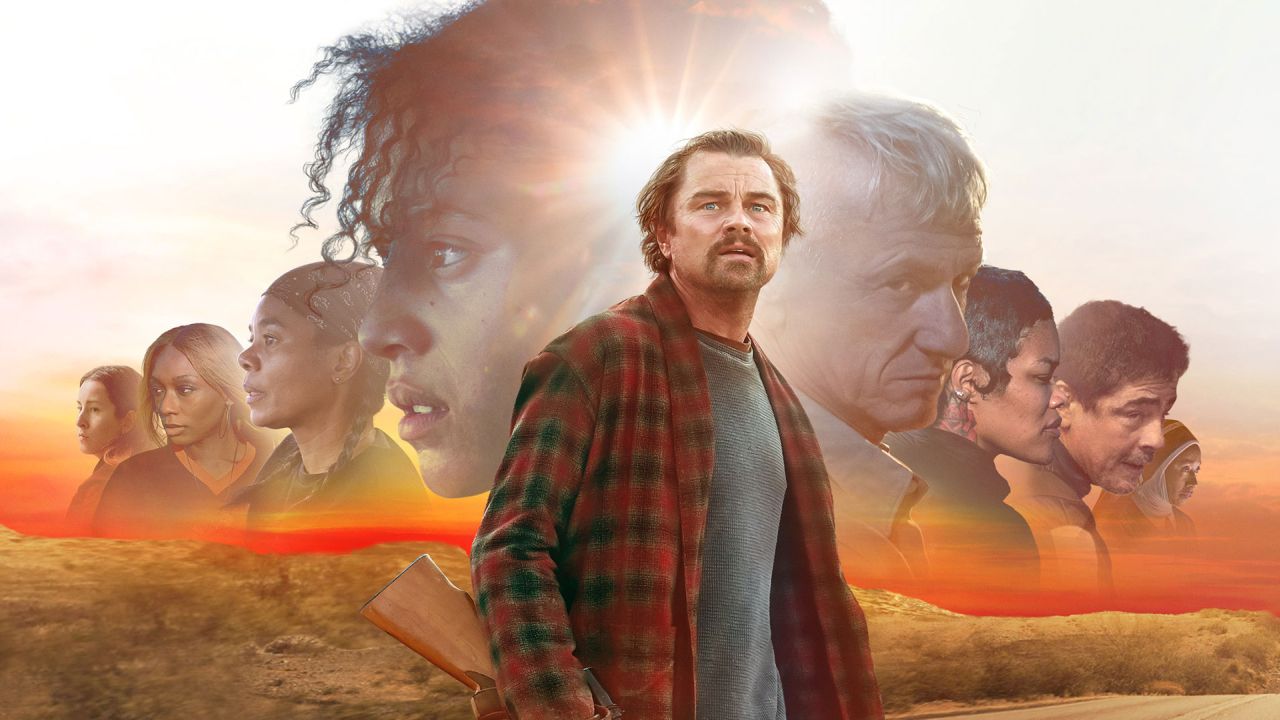
MOVIE REVIEW – Paul Thomas Anderson’s latest feature is unapologetically political, laced with dark comedy, and driven by raw, explosive action. The film hurls viewers into a barrage of scenes rarely greenlit by major studios: chaotic car chases, deafening gunfights, and brutal clashes. That a production with a major star, a hefty budget, and the full weight of Hollywood backing could come together in this form feels nothing short of miraculous in today’s industry. Shot in VistaVision, the imagery burns itself into memory: children trapped in cages under foil blankets, a border wall glowing like an alien monument, riot police in military armor beating down protesters.
Anderson holds nothing back, avoiding soapboxing or lecturing while crafting a film that feels straight out of the freewheeling studio era of the ’60s and ’70s, when directors still had the latitude to pour their own obsessions onto the screen. With blockbusters now ruling and box office math dictating every move, it’s fair to wonder whether such a film can find an audience trained on polished, risk-free entertainment. For me, there’s no question: One Battle After Another is the year’s most powerful cinematic experience.
The story loosely echoes elements of Thomas Pynchon’s Vineland, though Anderson admits he cherry-picked only what resonated with him – with Pynchon’s blessing. At the heart are revolutionaries who feel time slipping through their fingers, their dreams of a better tomorrow trampled into the dirt. Leonard Cohen’s refrain says it best: “Everybody knows the war is over, everybody knows the good guys lost.” One of these burned-out rebels drifts through old movies about more successful uprisings, until something jolts him awake.

Laughing Through The Darkness
What makes One Battle After Another so striking is Anderson’s ability to show a world that’s simultaneously crushingly bleak and absurdly hilarious. It mirrors our own reality: oppression and doom everywhere, yet moments arrive that provoke laughter through tears. Consider the film’s reveal that a white supremacist cult secretly runs the country – terrifying enough. And yet, they’ve named themselves the “Christmas Adventurers Club,” chanting “Hail Saint Nick!” at their gatherings. It’s both chilling and ridiculous, and that contradiction is where Anderson thrives.
The film introduces Pat (Leonardo DiCaprio), an explosives expert working with the underground group known as the French 75. Pat is hopelessly enamored with fellow radical Perfidia Beverly Hills (Teyana Taylor), whose ferocity on screen is nothing short of electrifying. Together they commit acts of domestic terrorism aimed at tearing down a corrupt system. But Perfidia draws the twisted desire of Col. Steven J. Lockjaw, a racist military officer played by a bronzed, ripped Sean Penn. Lockjaw is a vile creation: seething, hateful, and reptilian in his instincts. Penn hasn’t been this despicable on screen in years.
Tensions rise when Perfidia becomes pregnant and gives birth to a daughter. While Pat dotes on the child, Perfidia resents the baby and wants no part of motherhood. After a disastrous bank heist, the French 75 disbands; Perfidia vanishes, while Pat reinvents himself as Bob Ferguson, raising his daughter Willa alone.

Chaos, Smoke, and Broken Dreams
The opening act thrums with nervous energy, propelled by Jonny Greenwood’s metallic, clanging score that leaves the viewer squirming. Anderson caps it with a blistering car chase – only a taste of what’s ahead. Like Mad Max: Fury Road, the film morphs into a near feature-length pursuit that barrels through its 162 minutes without ever taking a breath.
Sixteen years later, Willa is a teenager, portrayed by newcomer Chase Infiniti in a breakout performance. Much of the film sees her in constant peril, a demanding role requiring perpetual fear and confusion. She handles it with such natural ease that when Willa finally fights back, the transformation feels triumphant.
By this point, Bob is a washed-up burnout. DiCaprio has always shined when playing characters who are pathetic and funny in equal measure (The Wolf of Wall Street, Once Upon a Time in Hollywood), and here he’s hilarious as a former revolutionary shuffling around in a bathrobe, perpetually stoned and half-drunk. He’s pitiful yet riotously funny, until Lockjaw reemerges, putting Willa in grave danger.
Desperate, Bob seeks out his old underground contacts, but he’s so fried he can’t even recall the passwords. Enter Sergio, a karate instructor played with effortless cool by Benicio del Toro. Sergio has his own secrets and gladly aids Bob, especially if it means striking back at a government staging fake protests to incite violence.
Anderson stands among today’s greatest directors, his work steeped in the influence of Robert Altman and Martin Scorsese. He makes challenging, adult-oriented films that feel out of place in the current multiplex landscape. Hollywood output has rarely looked so uninspired, and Anderson’s swing here is massive. Maybe it isn’t his ultimate masterpiece, but it’s bold, political, and wildly entertaining all at once – two qualities that seem incompatible, yet he fuses them seamlessly.
The Revolution, Stoned And Loaded
One Battle After Another doesn’t hesitate to suggest that the U.S. government has slid into authoritarianism. The script openly raises the idea that sometimes political violence is unavoidable when every other route is closed. It constantly crackles with the sense that unseen forces are pulling strings from the shadows, leaving the story feeling like a powder keg ready to blow.
And still, Anderson keeps things riotously funny. DiCaprio is consistently hilarious, particularly in a phone argument with a fellow radical that escalates into side-splitting comedy. And the action delivers: Anderson may not be thought of as an action director, but the shootouts and extended car chase finale are so relentless and exhilarating that I nearly jumped out of my seat. Hollywood may shy away from such audacious risks today, but Anderson proves bold vision can still thrive. The film is at once outrageous, entertaining, and deeply unsettling. Above all, One Battle After Another stands as living proof of cinema’s raw power.
– Gergely Herpai “BadSector” –
One Battle After Another
Direction - 9.6
Actors - 9.6
Story - 9.6
Music/Audio - 9.4
Ambience - 9.6
9.6
MASTERPIECE
Paul Thomas Anderson’s One Battle After Another is fearless and uncompromising, mixing sharp political bite with outrageous comedy and breathless action. Teyana Taylor and Sean Penn deliver unforgettable turns, while Leonardo DiCaprio proves once more he can be both pathetic and hilarious. The result is provocative, energetic, and one of the year’s essential theatrical experiences.








Leave a Reply