
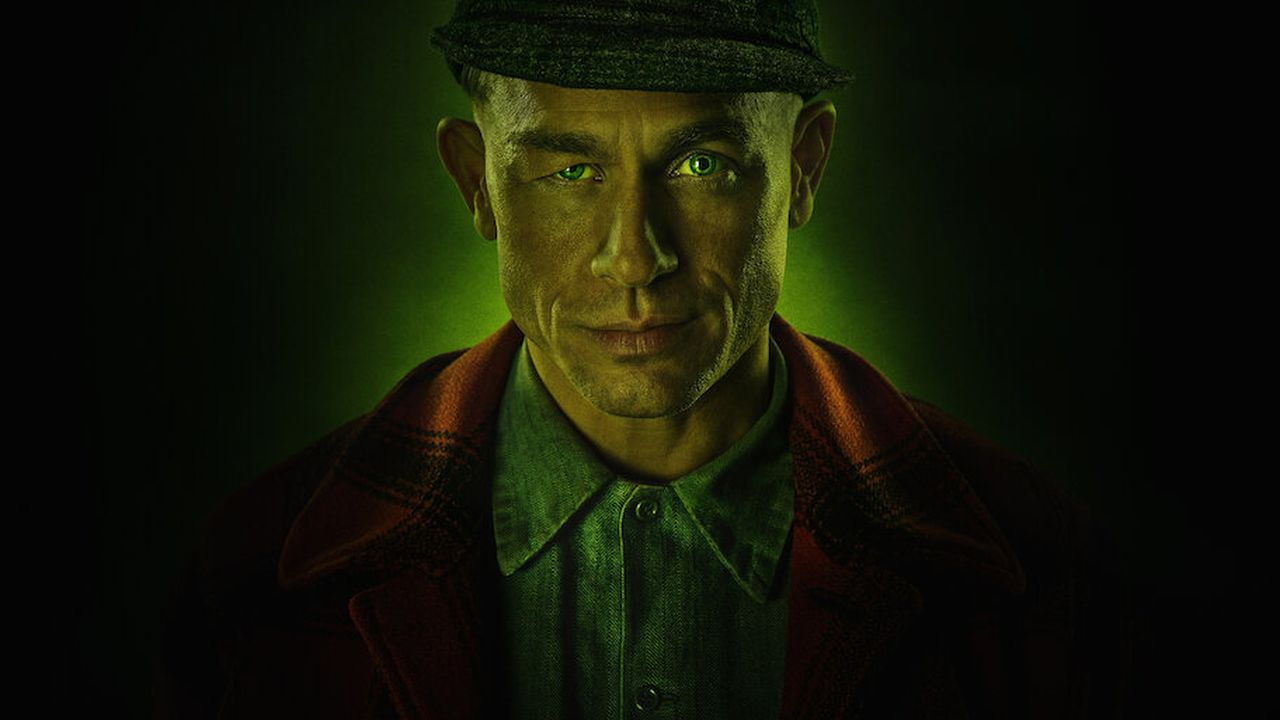
SERIES REVIEW – Charlie Hunnam prowls around in frilly lingerie and grotesque masks sewn from human skin in Netflix’s latest true-crime spectacle, a show that skewers both the genre and its most obsessive followers. This new chapter revisits the infamous real-life inspiration behind some of horror’s most enduring classics — from Psycho to The Texas Chainsaw Massacre — with Laurie Metcalf and Tom Hollander among the key players.
Even before the show hit the platform, Ryan Murphy and Ian Brennan confirmed that the next installment of their Monster anthology would dive into the blood-soaked tale of Lizzie Borden, following their deep dives into Jeffrey Dahmer and the Menendez brothers. But after powering through all eight episodes of Netflix’s Monster: The Ed Gein Story — this time written entirely by Brennan — my strongest piece of advice is simple: don’t bother pressing play.

The “Grand Theory” of Nightmares
Monster: The Ed Gein Story is a disaster — the kind of wildly ambitious disaster that crumbles beneath its own weight. The final two episodes drag on like a never-ending funeral dirge, to the point where I found myself yelling at the screen: “Just end already!”. Brennan’s grand plan seems to be building a “Unified Theory of Serial Killers,” with Ed Gein positioned as the root of every real or fictional murder narrative ever conceived.
The twisted punchline, according to Brennan, is that Gein — whose story has been retold countless times — was, in reality, a timid, oddly endearing man with a diagnosed mental illness, several unnamed disabilities, a deep-seated Oedipal complex, and a handful of disturbing but mostly victimless pastimes. The series argues that the true monsters are not Gein himself, but those he influenced: future killers walking in his shadow, writers who plundered his life for material without credit, and above all, the audience who consume his story for entertainment.
The result is a teetering narrative tower built by monsters on top of even bigger monsters, where the only “innocent” figures are Gein himself — and, of course, Brennan and Murphy. Once again, they’ve delivered a show that criticizes society’s grotesque fascination with murder stories while refusing to admit that their own careers thrive on exactly those tales.

The Peak of Hypocrisy
It’s hard to understand how Brennan could write the final two episodes of Monster: The Ed Gein Story and still believe there was anything new to add to the genre — unless the point was to declare that everyone else has been doing it wrong, and only Monster has the “clear-eyed truth.” The show claims these stories are “necessary” because, without them, viewers would gorge themselves on “inferior” versions. Monster, we’re told, is doing the public a service.
Everyone is guilty, hypocritical, and dishonest — except the Monster producers and Netflix itself, which happily churns out bargain-bin true-crime docs while this flagship series sneers at its own audience for watching them. Netflix doesn’t seem bothered by the contradiction: alongside Psycho, The Texas Chainsaw Massacre, and The Silence of the Lambs, one of the “lesser” projects Monster self-righteously condemns is Netflix’s own Mindhunter.
The show sticks to the franchise’s familiar template: once again, the “monsters” are handsome white men who kill people and mostly live in Wisconsin. The story kicks off in 1944, when we meet Ed (Charlie Hunnam): he spends his free time masturbating in his mother’s (Laurie Metcalf) underwear, tending the family farm, and creeping out local girls with his sleepy, melodic, and hesitant voice — in that order.
The only person who understands Ed is Adeline Watkins (Suzanna Son), a woman of uncertain age obsessed with New York crime photographer Weegee. She introduces Ed to concentration camp photographs and lurid pulp magazines about Ilse Koch (Vicky Krieps), the infamous Nazi war criminal known as the “Bitch of Buchenwald.” These magazines inflame Ed’s deviant fantasies, giving Brennan an excuse to scold true-crime fandom while implying that the show’s fetishistic Nazi recreations are inspired by trashy pulp rather than poor research.

Holocaust, Horror, and Exploitation
I’ve always felt uneasy when a Ryan Murphy project tries to weave the Holocaust into its narrative — ever since American Horror Story: Asylum. I sincerely wish he’d stop returning to that well. Monster: The Ed Gein Story argues that just as Gein was shaped by the horrors of his time, storytellers have used his life to reflect their own eras’ nightmares. Fair enough. But while the show meticulously lists the atrocities of Vietnam that inspired Tobe Hooper (Will Brill) to transform Gein into Leatherface, it never recreates the My Lai massacre — yet sees no problem parading emaciated prisoners in striped uniforms across the screen.
Back in 1944, tragedy befalls Ed’s brother and then his mother. While Hudson Oz’s Henry doesn’t return, death can’t stop Metcalf’s Augusta (as anyone familiar with Psycho will recognize). As Ed’s fascination with grave-robbing and the “decorative potential” of human skin grows, the timeline jumps ahead: Alfred Hitchcock (Tom Hollander, joining Toby Jones in the Hitchcock/Capote club) adapts Gein’s story against his wife Alma’s (Olivia Williams) protests, while Anthony Perkins (Joey Pollari) ignores his doubts and neuroses linked to his repressed sexuality to star in the film.
Hitchcock and Perkins are painted in one dimension — which is still one more than Alma gets. The Texas Chainsaw Massacre sequences, cross-cut with Gein’s increasingly savage corpse desecration, are even thinner. Then there’s The Silence of the Lambs, complete with the infamous Buffalo Bill dance. It perpetuates outdated stereotypes about trans sociopathy, though the show tries to correct itself when Christine Jorgensen (Alanna Darby) explicitly states that Ed Gein was not trans — a point most viewers will have tuned out before hearing. And the Silence of the Lambs segment never mentions Jonathan Demme or explores why he and Thomas Harris were drawn to this version of Gein.

Time Jumps and Vulgarity
Monster: The Ed Gein Story hops back and forth in time — partly to tie together various adaptations, and partly because the biographical timeline is so messy that any distraction is welcome. Most events have some grounding in fact, but the show’s take on Adeline or babysitter Evelyn Hartley (Addison Rae) — who may or may not have been one of Gein’s victims — is closer to “fiction based on reality.” They even use the name of a real missing person for a subplot that might as well be called “Ed Gein Joins the Baby-Sitters Club.”
There’s no momentum because, no matter what intellectual points Brennan and director Max Winkler (who helms six episodes) aim for, the series prefers to spend endless minutes showing Ed Gein stripping underwear off corpses again and again; masturbating again and again; dancing with a chainsaw again and again — and blaming viewers and other storytellers for finding the lurid details entertaining.
The show refuses to leave anything to the imagination, even as it scolds viewers for fixating on brutality and becoming numb to it. You might even find yourself asking: “Wouldn’t it be enough to mention a jar with eight dried and one not-so-dried vulvas instead of showing flayed genitals repeatedly?” No, restraint isn’t part of the plan — because, according to the show, this is what the audience wants. We are the monsters, and Monster caters to us while mocking us for it.
Despite its narrative chaos and thematic hypocrisy, Monster: The Ed Gein Story shares a few traits with its predecessors, though it lacks episodes on the level of “The Hurt Man” or “Silenced.” In fact, it barely qualifies as episodic television at all.

Performances From Hell and Grotesque Portrayals
If you can overlook the fact that Charlie Hunnam’s Ed Gein and Glen Powell’s dual role in Chad Powers are practically indistinguishable, you have to admit Hunnam’s commitment is chilling — from Gein’s haunted, drifting eyes and broken voice to his unnervingly chiseled abs.
Laurie Metcalf spends most of her screen time shrieking about fallen women and moral decay, Vicky Krieps fully embraces the “Bitch of Buchenwald” persona as Ilse Koch, and Lesley Manville valiantly tries to add dignity to lines like, “If you pump me good, Eddie Gein, I’ll let you wear my panties.” She doesn’t succeed — but you can’t say she isn’t giving it her all.
Suzanna Son delivers the only performance that could be called subtle, keeping viewers guessing about Adeline’s thoughts — or whether she even exists. It’s unclear whether Son is nailing a deliberately mysterious character or simply doing her best with a poorly written version of a woman who existed but not in the way she’s portrayed here. If you want a composite, create one — don’t just slap a real person’s name on it.
A Mirror Held to America
The series is beautifully shot: the frozen landscapes of rural Wisconsin feel raw and real, while the visual homages to The Texas Chainsaw Massacre and The Silence of the Lambs are striking. Mac Quayle’s score — occasionally channeling Bernard Herrmann — is outstanding.
Ultimately, the Monster franchise’s big idea is that Murphy and Brennan are holding a mirror up to America, and all they can muster is: “Stop hitting yourself.” Three seasons in, there’s no sign they accept any responsibility for their own complicity, preferring to criticize others for the same behavior. And while filmmakers like Hitchcock, Demme, Hooper, and Fincher can find comfort in Oscars, acclaim, and box office success, regular viewers are portrayed as gossip-hungry rubes — the reason pulp crime magazines exist, the ones who turn killers into celebrities, the people willing to pay fifty cents to tour the Gein house and laugh while pointing at the bloodstains on the floor.
I can’t overstate how much contempt this show has for its audience. Enjoy.
-Gergely Herpai “BadSector”-
Monster: The Ed Gein Story
Direction - 4.5
Actors - 6.7
Story - 4.2
Visuals/Horror/Score - 7.5
Ambience - 4.9
5.6
AVERAGE
Summary: Monster: The Ed Gein Story is ambitious but chaotic, condemning both itself and its audience while committing the same sins it criticizes. A few strong performances and visual touches can’t save a series more interested in provocation than perspective. The result is a disturbing yet thought-provoking journey into the bleak mythology of serial killers.












Leave a Reply