
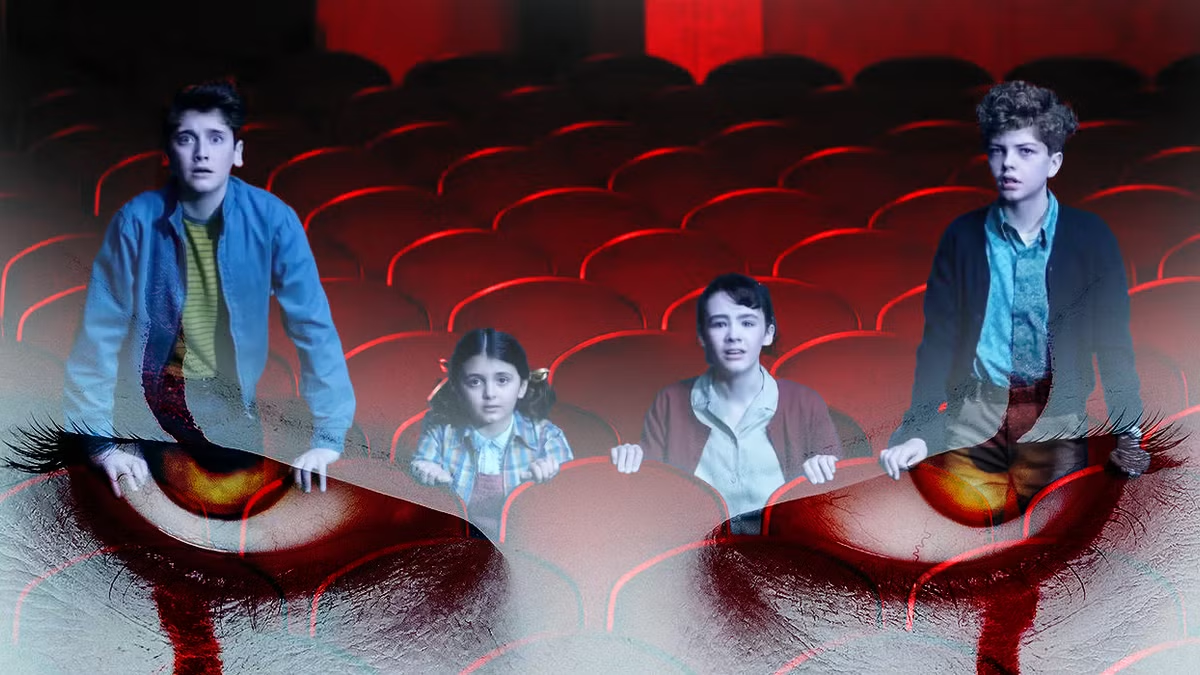
SERIES REVIEW — Stephen King’s darkest small town tears open old wounds once more: IT: Welcome to Derry doesn’t just bring Pennywise back; it also drags into the light the everyday cruelty that has fed the monster for decades. Behind the gleaming shop window of 1960s America simmer domestic abuse, prejudice, and repressed trauma, with Cold War anxiety piling on top. As a prequel, the series deepens the It mythos while holding a merciless mirror up to Derry’s idea of “normal.” It does all this with respect for the source material’s legacy—while pushing the world into new, ice-cold directions.
For generations, Stephen King’s books have fueled fans’ nightmares, but the 1986 novel It—and its central terror, Pennywise—stands above the rest. Ever since that clown, rot has seemed to throb beneath every smile; King’s real power isn’t in otherworldly jump scares but in exposing the dark reflexes of human nature. That’s why he’s considered a master of horror—and why It ranks among his peak works: it’s not only Pennywise’s supernatural threat that chills, but also what the townspeople sweep under the rug day after day.

A “Normal” Facade, Unspoken Violence
IT: Welcome to Derry centers the ordinary, invisible violence of daily life: abuse behind closed doors, inherited and suppressed trauma, and the kind of denial that only strengthens exclusion. HBO’s new King series confronts these realities more boldly and inventively than the two feature films—making it a must-see when it premieres on Sunday, October 26.
As a prequel connected to Andy Muschietti’s box-office hits—It and It Chapter Two—the show reaffirms the rules: an ancient entity, “IT,” awakens roughly every twenty-eight years to feast on the people of Derry, Maine. The Losers’ Club, a band of outsider teens, must face it first as kids and later as adults. IT still prefers to wear the face of Pennywise (Bill Skarsgård returns)—a Victorian circus clown with a smile traced in razor blades.

1962 — The Ashes of the Black Spot
The series steps back in time to earlier “cycles,” focusing first on 1962. For fans of King’s cross-connected universe, it’s a treat to see the story link to a key figure from The Shining. In the novel, Dick Hallorann helped bring to life the Derry bar known as the Black Spot, created for local Black soldiers; during a prior Pennywise rampage, a racist mob burned it to the ground. Hallorann’s “shine” saved a handful of survivors—including young Will Hanlon, who would later become the father of Loser Mike Hanlon.
The show sets this tragedy in motion: Chris Chalk plays the young Dick Hallorann, and Jovan Adepo portrays Leroy Hanlon. It’s the height of the Cold War, and both men are serving in Derry with the U.S. Army. Nuclear dread hangs in the air—schools run “duck and cover” drills, and General James Remar frets over how close Maine lies to Russia across the North Pole. Yet the true threat hides in plain sight: IT.
In the opening episode, Leroy Hanlon says how glad he is to be stationed in Derry—he might finally give his wife, Charlotte (Taylour Paige), and their son, Will (Blake Cameron James), a “normal” life. But the Norman Rockwell postcard quickly warps—and not only because of Pennywise. Brutality seeps up from the everyday: kids are tormented mercilessly, many even at home. Derry may be “normal,” but it isn’t kind—making it the perfect hunting ground for the clown.

New Losers, New Nightmares
Showrunners Jason Fuchs and Brad Caleb Kane torment the next generation of Losers with era-specific, clever methods. Pennywise’s reach stretches far beyond the sewers now, shredding nerves with visions that play on period anxieties, grief, and generational trauma. Because King left this Derry cycle relatively under-detailed in the novel, the series remains unpredictable in the best way: even die-hard loreheads get the paralyzing thrill of “I don’t know what’s coming.”
Tonally, it’s ruthless and intimate; structurally, it’s a mosaic—rearranging familiar King motifs and locations while quietly laying track for Muschietti’s It films.
Can’t Wait for What’s Next
After the five episodes HBO screened for critics, it’s hard not to want more. The world is layered, the young leads feel recognizable and easy to root for, the adults remain unreadable—and the direction pulls it all together with intention and imagination. The series builds out the universe far more solidly and creatively than what Muschietti and his collaborator (and sister), Barbara Muschietti, managed to fully tap in It Chapter Two—not artistically, not critically, and not financially—after the first film’s cultural explosion.
-Herpai Gergely BadSector-
IT: Welcome to Derry
Direction - 8.6
Actors - 8.5
Story - 8.8
Visuals/Horror - 9.1
Ambiance - 8.4
8.7
EXCELLENT
IT: Welcome to Derry digs into how small-town apathy and prejudice feed Pennywise’s supernatural terror. Set in 1962, the prequel thread ties into The Shining’s universe while throwing a new generation of Losers into the grinder. Harsher and more intimate in tone—and assembled with a more deliberate, mosaic structure—the series promisingly fills in the backdrop to Muschietti’s films.


![Pregnant Anne Hathaway Shows Off Her Baby Bump at New Film Premiere [VIDEO]](https://thegeek.games/wp-content/uploads/2026/08/theGeek-Anne-Hathaway-302x180.jpg)


![Tom Hardy’s MobLand Is Heading to Blu-ray Before Season 2 Arrives [VIDEO]](https://thegeek.games/wp-content/uploads/2025/05/theGeek-MobLand-1-302x180.jpg)



![WARDOGS Hits Early Access in September, with a Closed Beta First [VIDEO]](https://thegeek.games/wp-content/uploads/2026/08/theGeek-WARDOGS-Early-Access-300x365.jpg)
![An ex-Bethesda Dev Says Including More than 1,000 Planets in Starfield Was a Bad Decision! [VIDEO]](https://thegeek.games/wp-content/uploads/2025/09/thegeek-starfield-nagy-1-300x365.png)


Leave a Reply