
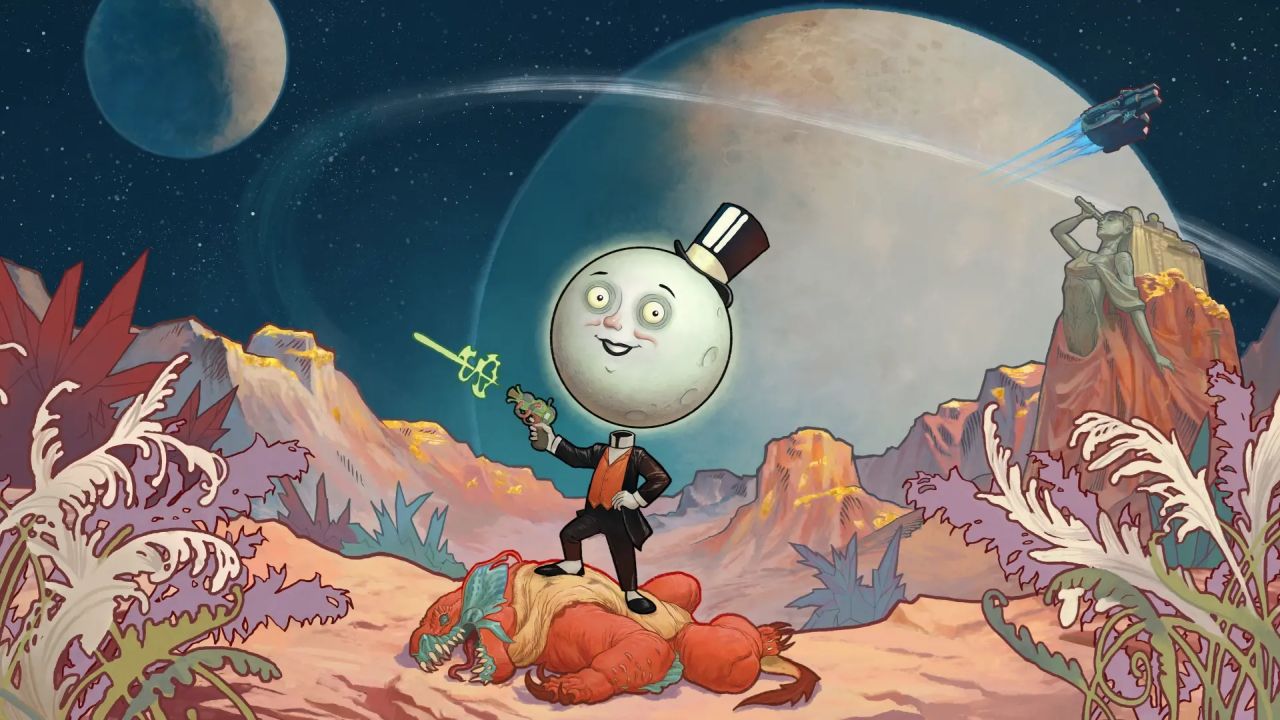
REVIEW — Obsidian returns to the stars: after Halcyon, mysterious “rifts” are opening across the Arcadia system, while mega-corporations and bureaucratic, authoritarian regimes once again tear the colony apart. You play an operative of the Earth Directorate, tasked with untangling the roots of a mysterious betrayal and the forces behind a looming faction war. We tested this much-anticipated Microsoft Games sequel on a PS5 Pro.
A Fallout-like, well-realized universe and a dry, pitch-black sense of humor defined Obsidian’s sci-fi RPG that launched almost exactly six years ago. The Outer Worlds quickly won over fans of Fallout—especially Fallout: New Vegas—despite its flaws. (I write this having finished the base game and every DLC, before it left PS Plus back in the day.) The combat and controls felt a bit clumsy (as if we were hovering a few inches above the ground), and the core loop grew somewhat repetitive over time no matter what weapons we used. The story also leaned on a few familiar templates, although the DLCs did add some spice to that.
Now, at long last, the highly anticipated sequel Microsoft has been promoting is finally here. Obsidian already released one game earlier this year—the somewhat divisive Avowed. This new Obsidian title, however, is a safe bet to burnish the studio’s storied reputation—and here’s why.

Let’s Cut to the Chase, Commander!
The first thing that stands out about Outer Worlds 2 is how much it feels like a genuine sequel. The giant “2” splashed across the box is a giveaway, sure, but even if you somehow missed that, the seamless continuation of the world makes it obvious you’re stepping right back into where the last game left off. There’s no long prologue or reheated onboarding: you’re dropped straight into a fully spinning, grand space opera already in motion.
The story picks up roughly a decade after the first game, in a galaxy still strangled by unchecked corporate greed—though this time we see it through a slightly different lens. You slip into the boots of a commander with the Earth Directorate—think “space cop”—tasked with guarding Earth’s interests, often by sticking your nose into the shady dealings of galactic megacorps. Naturally, your very first mission goes sideways (because of course it does): our hero bails out in an escape pod and drifts off into the void. Ten years later, you’re pulled back into a universe that’s somehow even worse for wear, determined to learn what broke—and how to set it right.
Even from the jump, the decade-long time skip feels eventful. Auntie Cleo has completely swallowed Spacer’s Choice, resulting in a nightmarish corporate merger—the galaxy’s newest consumerist beast, Auntie’s Choice. Meanwhile, strange spatial rifts are tearing open across star systems, swallowing ships and crews without warning, and rumors of new wars and conflicts ripple through the colonies. It’s a terrible time to be an ordinary citizen—but as a player, I can’t help but love it. That chaos, tension, and uncertainty are the perfect fuel for storytelling. If the opening hours are any indication, The Outer Worlds 2 is one hell of a ride.

Snark on the Surface, Substance Beneath
It’s funny how a familiar universe can feel both comforting and brand-new after a few years away. The sequel opens with a punchy intro that reminds you why the first game worked, while making it clear that a lot has changed in meaningful ways. From the opening scenes, it’s obvious Obsidian took a hard look at what clicked, what didn’t, and rebuilt most of it with more confidence and heart.
The original Outer Worlds was clever, stylish, and loaded with sharp, dark satire, but it sometimes struggled to decide whether it wanted to be a shooter, an RPG, or a send-up of corporate dystopia. The second game has no such identity crisis. It knows exactly what it is: a more mature, emotionally grounded story in a universe that finally feels truly alive.
What grabbed me first in The Outer Worlds 2 wasn’t the gunplay or the shiny visuals—it was the tone. The writing has real weight this time; you can feel the team trying to say something beyond just landing punchlines. The jokes are still there (and arguably land even better), but because they’re not constantly shoved in your face, they hit harder. Your crew isn’t just colorful archetypes or quip machines anymore; they’re people who second-guess themselves, who regret things, who crack a little when they think no one’s watching.
You can tell each companion’s backstory was written to matter, and it shows. I found myself hesitating over choices not to min-max outcomes, but because I didn’t want to let down someone who’d earned my trust. That kind of emotional pull is something the first game never quite managed. The tonal shift ripples through the narrative, too. Corporate greed and bureaucracy still loom over everything, but they’re no longer the main event—more of a backdrop to something personal, depending on how you play. It’s less “look how funny capitalism is” and more “look what it does to the people caught in its gears.” The in-your-face mockery is dialed back, and that helps immensely. The story cuts deeper, trading loud, ironic moments for quiet ones that sting. It’s a subtle evolution, but it gives the game a sense of purpose that lingers across your choices.

Matters of Faith—or Just Money?
When you build your character, you also pick an origin trait that reflects who you were before joining the Earth Directorate—anything from a criminal background or brushes with danger to a trade, vocation, or scientific training. It doesn’t lock you into a single playstyle, but it regularly unlocks extra dialogue options that let you answer in more colorful, personalized ways. Even the prologue is dotted with hidden avenues. After a bit of cosmetic tweaking and a few starter perks, the game throws you straight into the deep end: a tutorial-laced opening chapter thick with conspiracy and space rifts. The Outer Worlds 2 begins with mystery and intrigue—a puzzle worthy of the planet- and station-hopping you’ll dive into soon after. That prologue arc ties up neatly—maybe a little too neatly. Not because it’s rushed, but because I wanted more; the hook is strong enough that it could have supported a few extra chapters and a denser structure.
From the moment I touched down on Paradise Island—the lush, tropical coastline of Eden, an Earth-like world—the gears of Outer Worlds 2 started spinning fast and rarely slowed. (At one point, a body was literally crushed in the gears of a moving platform during a side quest—my prize was a pair of rocket boots that unlocked a double-jump, no regrets.) Obsidian’s dialogue still cloaks a lot in sardonic comedy—even murder; especially murder—but beneath the surface, it’s poking at capitalism and religion again. And while your conclusions may differ depending on your choices and beliefs, I’m happy the sequel challenges both with sharp writing and twisty turns.
We all know “capitalism is bad,” and the executives at the top are worse—but what about the manager stuck in between? How tightly are the bourgeoisie and religion intertwined in their ideal society? Are “free” markets ever truly free? Obsidian isn’t reinventing the wheel, but it has something to say—and gives you room, in both dialogue and mechanics, to answer back.
All of this is capped by excellent first-person action-RPG combat (yes, there’s a third-person camera now for those who want it, but it’s more a curiosity than a best-in-class view). Compared to this sequel, the first game’s firefights feel quaint. Gunplay here is tighter, snappier—simply more satisfying. The weapon list is finite, but mods and variants—plasma, shock, and more—create the feel of a much broader arsenal. Legendary pieces and the even rarer “science” weapons keep things wild and unique; you’ll at least test-drive every one you find. Personal favorites: the Moon Man machine gun that levels up with use—more damage, more rate of fire—and the Repeater rifle that brands weak-spot targets with a doom marker. Melee still isn’t my go-to, but a rainbow-hued energy sword literally turned fights into a rhythm game (complete with a gospel-style praise break after enough consecutive hits). Enemy AI is sneakily mean, too: I died in The Outer Worlds 2 more often than in most recent RPGs because I had to adapt—swapping grenade types, timing companion abilities—whether it was Niles’s taunting roar or Aza’s cleansing fireburst—to make it out alive.
The Strangest Crew in the Galaxy
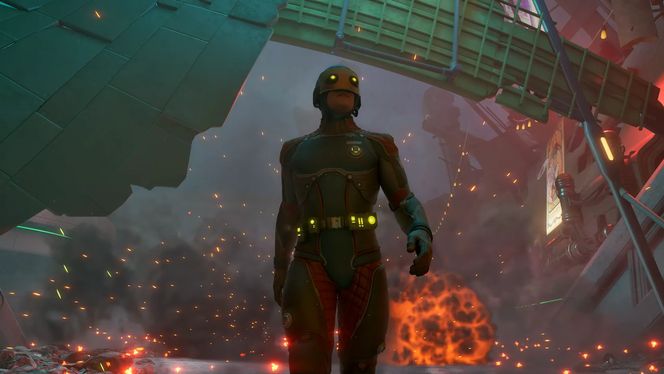
No self-respecting spacefarer goes alone. You’ll once again recruit a colorful crew representing the setting’s major factions—starting with Lieutenant Niles Abara, who embodies our starting organization, the Earth Directorate. Niles begins as a bright-eyed idealist with big dreams and an even bigger sense of duty, and as time passes (especially after the big story time jump), it’s easy to see why he’ll be a fan favorite. Without spoilers, two other standouts for me were Mirasol and Inez. Mirasol is a cold, calculating assassin from the newly introduced Order of the Ascendant, while Inez serves as a combat medic under the freshly merged Auntie’s Choice conglomerate. Both are fantastic in the field—Mirasol’s precision and crowd control make her a blender, and Inez is exactly the kind of healer you’ll hate to leave behind.
Companion quests are a mixed bag: some pop up a bit late, when you’re already closing in on the finale and have less headspace for another character arc; others are strong enough to lock that crew member into my permanent on-foot trio. Do them all, though—the reward is a mod kit that fundamentally changes how that companion functions in combat. Thanks to those kits, I could slot them into the archetypes my build lacked. Playing a nimble, smooth-talking run-and-gunner, I specced Tristan into a tank and Aza into a stealth assassin; suddenly, our trio clicked.
I’m not usually one to replay an RPG immediately after credits, but The Outer Worlds 2 makes a compelling case. Throughout, the game coyly hints that different routes could have resolved situations in entirely different ways. Dialogue trees, strategic choices, and other RPG levers already made my playthrough feel flexible, but there’s clearly plenty left for a second run. The returning Flaw system helps a ton here, playfully calling out your habits to make the adventure feel even more personal. Flaws are optional negatives that riff on your quirks—for instance, my compulsive partial reloads unlocked a flaw that gave every weapon a bigger magazine, but nerfed my damage whenever I fully emptied a clip. I loved this, and seeing new Flaws surface right up to the closing minutes convinced me the game is still watching how you play—even in the finale.

A Vivid World—and Livelier Allies
The louder, borderline gaudy palette might disappoint fans of Obsidian’s grimier, post-apocalyptic aesthetics, but there’s no denying it: The Outer Worlds 2 is the studio’s best-looking game yet. Contrasting, saturated colors paint a colony system begging to be explored, and every planet seems to serve up another jaw-dropper of a vista. The score occasionally feels a touch sparse, but the new in-game radio more than makes up for it. You’ll hear Auntie’s Choice commercials that play like tongue-in-cheek QVC segments (the kind my mom used to watch), propagandistic tunes praising the mighty Sovereign and Protectorate, and 20th-century jazz tracks that scratch that Fallout itch. A nice touch: a few side quests actually come through the radio, like proximity calls for help drifting across the ether.
What really stands out versus the first game is how much more alive your companions feel. Yes, the staples are here—personal quests, unique perks, reactive banter—but the personalities are more nuanced and expressive. Don’t get me wrong, I still adore Parvati, but if I’m craving a heartfelt mid-mission chat, Inez takes the crown. And there are plenty more companions to find—including one particularly unhinged cultist I’ll let you discover yourself. Trust me: meet them all.
Firing on All Cylinders
I ran into a few stubborn bugs while testing: sometimes the D-pad up wouldn’t register when first opening the inventory, and in a couple of spots I had to reload a save because a script didn’t fire and I couldn’t progress. Minor gripes aside, though, Outer Worlds 2 ran impressively well—even on PlayStation 5, which isn’t exactly Obsidian and Xbox’s home turf. On my PS5 Pro, the game straight-up sang: a steady 60 fps at roughly 1620p, and an equally smooth 40 fps/4K Balanced Mode if you prefer.
Taken as a whole, The Outer Worlds 2 does exactly what you’d hope a sequel would do to its “short but sweet” predecessor: address the gaps, extend the formula, and hand players even more ways to shape the adventure to their own tastes. The throughline of the main plot will likely rhyme across playthroughs by the time credits roll, but the sheer variety of decisions—both in combat and out—and how you apply them in tight situations lend your story its own flavor. The Outer Worlds 2 doesn’t shatter the genre’s mold; it uses it as scaffolding to build the responsive, reflective journey Obsidian’s been steering toward for years. For me, the result is my favorite Obsidian game to date.
— Gergely Herpai “BadSector” —
We received the PlayStation 5 Pro review code from Xbox PR.
Pros:
+ Gorgeous, consistent art direction and a memorable visual world
+ A more mature story and characterization; real emotional stakes alongside the black humor
+ Varied, context-sensitive audio landscape (from ambient to rock)
Cons:
– Feels short; we’d have happily stayed 2–3 hours longer
– Long load times and the lack of fast travel can occasionally break momentum
– Hitting 60 fps practically requires DLSS/analog upscaling
Developer: Obsidian Entertainment
Publisher: Xbox Game Studios
Genre: Sci-fi action RPG (first-person RPG)
Release date: October 29, 2025
The Outer Worlds 2
Gameplay - 9.2
Graphics - 8.4
Story - 8.8
Music/Audio - 8.4
Ambiance - 9.2
8.8
EXCELLENT
The Outer Worlds 2 is a model sequel: it surpasses its predecessor in every respect, whether in the scale of its world, the depth of its role-playing systems, or the emotional impact of its story. Obsidian hasn’t reinvented the genre, but what it does, it does with confidence and wit — the result is a sci-fi action RPG set in a living, responsive universe that could easily become the studio’s best work to date. Despite a few minor technical hiccups and a relatively short main campaign, The Outer Worlds 2 is an unmissable experience for every sci-fi RPG fan.












Leave a Reply