

SERIES REVIEW – At first glance, Absentia (original title Absentia) looks like just another “FBI versus serial killer” thriller, with everything built around a missing agent and a suspicious billionaire. A few episodes in, though, it becomes clear that what we are watching is far more personal and much darker: the drama of a broken woman, a family blown apart and a system where trauma never really closes, it just keeps tearing open again. Across three seasons, Absentia gradually shifts from a fairly standard procedural into a psychological nightmare and a globe-spanning conspiracy, keeping Emily Byrne’s scarred face in the camera’s sights the whole time and, through her, all the fears the series stirs up in us.
The basic premise is strong on its own. Emily Byrne, an FBI agent in Boston, disappears while hunting a serial killer who cuts the eyelids off his victims. Her body is never found, but her husband Nick, their young son Flynn and her colleagues eventually let go, because even grief seems to have an expiry date once the system has stamped the file “declared dead”. Six years later, a half-dead woman is pulled out of a rusty tank. She barely remembers anything, but she is very much alive: Emily steps back into a life that has rearranged itself without her.
The first season of Absentia plays this absence very smartly. It is not enough that Emily has no idea who tortured her or why, she also has to face the fact that her husband has moved on, that a new wife, Alice, is raising her son and that her own home now belongs, emotionally, to someone else. One of the most powerful layers in the series is this tragically everyday family situation: what do you do with someone who comes back from the dead after you have already mourned them and convinced yourself they were never coming home?
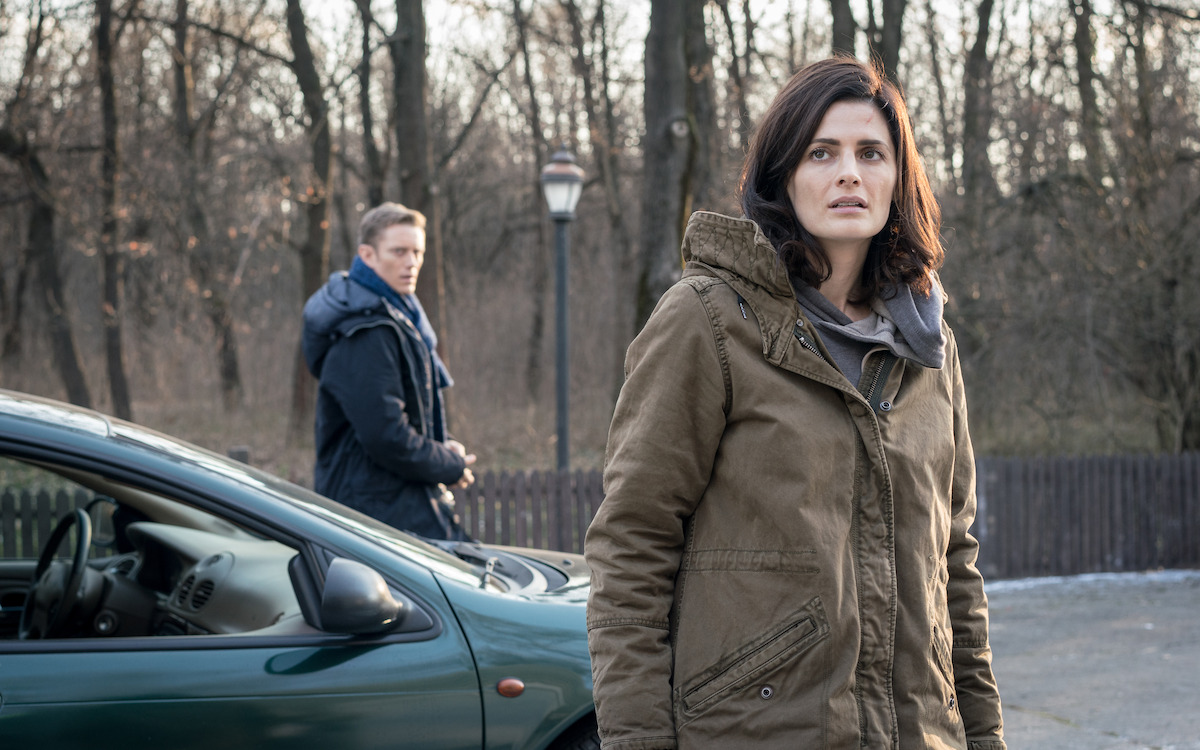
The Missing Agent and the Suspicious Billionaire – What Is at Stake in Season One
On the crime side, the opening season starts out with what looks like a very familiar setup. The killer behind the eyelid-less victims is, in the eyes of law enforcement, Conrad Harlow, a cold-eyed, money-drenched eccentric who seems to tick every box on the serial-killer bingo card. When Emily is rescued, and mutilated bodies start turning up again, nothing is clear anymore. If Harlow is in prison, who is killing outside? If he did not do it, who put Emily through all of this? And if he did, how can he still be killing from behind bars?
All through season one, the series keeps rocking the viewer’s trust back and forth. On the one hand, we see Emily, whose every gesture says “victim who has suffered too much”; on the other, the investigation thread keeps raising the possibility that she may not have been just a passive pawn. Tommy Gibbs, a burned-out but sharp Boston detective, watches her from the sidelines, and the FBI treats her like a sidelined witness who knows far too much: someone they need, but never fully believe.
The credibility gaps – an agent who seems able to slip out of duty at will, breaking every rule in the book, and a suspect list that grows almost comically crowded – sometimes push the story into “okay, I will let that slide” territory. Absentia still works at this stage because Stana Katic’s Emily stays very human underneath every overwritten twist: a woman trying to be a cop, a mother, and a survivor all at once, without really fitting comfortably into any of those roles.

Experiments, Demons, and Moldova – the Darker Orbit of Season Two
Season two opens with a bold choice. Instead of running another “who is the killer?” lap, it focuses on what is left of a person who has spent years as a subject in psychological and medical experiments. Emily is officially back in the FBI, but the way she operates still looks more like guerrilla warfare than clean, by-the-book fieldwork. She sleeps badly, makes bad calls, and is driven forward by anger and fear, so we finally see that trauma did not evaporate the moment the badge was pinned back on her chest.
The new cases, each tied to crimes that are stranger and more sadistic than the last, slowly circle back to the same origin: those inhuman experiments carried out on Emily. This is where Cal Isaac, the new partner, comes in. He first looks like a stock “tough guy” with a military background, but over the season, it becomes clear he is wrestling with just as many demons as Emily. What makes their dynamic interesting is that it is not there to provide romantic comfort. It is a cautious alliance between two damaged people, one who frequently stumbles and falls apart.
Inside the FBI, new players are pulling strings as well. Julianne Gunnarsen, a profiler, is both Emily’s superior and a constantly skeptical outside eye, while Dr. Semo Oduwale, a respected therapist, uses methods that start to look uncomfortably close to the sins of the past. At a certain point, the story leaves Boston behind and heads to Moldova, where the manhunt finally turns into a proper, pulse-pounding action thriller, with chases, raids, narrow alleyways, and choices you cannot just walk away from to file a report.
Season two takes a while to get up to speed. The early stretch is slow-burning, but even there, one question keeps throbbing under the surface: how far can you excuse someone with “I was only following orders” when those orders meant experimenting on human beings? For Emily, this is not a philosophy seminar; it is deeply personal. Each new victim drags her back into the shadow of the torture that defined those lost years.

Organ Trafficking, Viruses, and a Worldwide Plot – Season Three Turns Everything Up to Eleven
By the time we reach season three, Absentia has clearly outgrown the frame of “one broken FBI agent’s story” and pushes the stakes up to a global level. Dead migrants found with their organs removed drag Emily, Nick, and Cal Isaac into a case where organ trafficking is only the first stop. Behind it looms a chain of illegal drug trials, virus development, and financial and political interests so big that a single FBI case file feels laughably small.
In the meantime, Emily and Nick’s son, Flynn, has grown a lot. He is no longer the small child everyone tries to shield, but a teenager whom his mother’s enemies keep putting back into the crosshairs. His grandfather Warren and his uncle Jack, who is fighting his own battle with alcohol, try to give him something resembling a normal life, while the family farm that is supposed to be a haven turns again and again into the site of shootouts. Family and friends are no longer just emotional support; they are where this “saving the world” story regains a human face.
The season is not shy about going big. Moles inside the FBI, billionaires pulling strings from the shadows, criminal networks using viruses as leverage, together they sketch a world where power stopped caring long ago about how many people have to die for a new drug or a slight edge on the market. Yes, more than once this drifts into “accept it and do not overthink it” territory, and seasoned viewers will spot some twists long before they arrive. But anyone who stays with the series at this point is doing it less for airtight plotting and more because they still care what happens to Emily and the others.
What is striking is that, despite the global stakes, the real tension is still most alive at kitchen tables, in whispered late-night conversations, and in those tiny, intensely human moments. When Emily and Nick argue about how to give Flynn any kind of normal life after so much violence, or when Cal simply cannot shake the reflexes he brought back from the front line, we feel what is at stake much more strongly than in any lab sequence.

Stana Katic as Action Lead and Face of Trauma – What Really Holds the Series Together
If there is one area where you can confidently stamp “this works” across the whole of Absentia, it is Stana Katic’s performance. As a producer, she is present behind the creative choices, and as the lead, she runs a three-season emotional and physical marathon. Emily Byrne is at once a detective, a mother, a victim, and an aggressor, and the show is at its strongest whenever it refuses to separate those roles and simply lets them bleed into one another. In one scene, she is fragile, on the verge of a panic attack, in the next, she is taking someone apart with her bare hands, and both feel equally believable.
You can also feel a female creative hand in the way the other women are written. Alice is not just “the second wife”; she is a mother figure whose own life falls apart when Emily comes back. Julianne Gunnarsen is not a “villain boss” but an agent who is morally torn, trying to stand for both rules and compassion. Even smaller characters, like the hacker Kai, get enough room to show that this world is not run solely by men in grey suits.
At the same time, the series is not afraid of going pitch-black. Torture, psychological abuse, war trauma, medical experimentation at the ethical zero line, Absentia often pushes up against the limits of “how much can you take”. It is not always elegant, sometimes it goes for the cheap shock, and every now and then it overcranks its own mythology, but it sticks to a coherent, oppressive worldview and carries it through all three seasons.
How Much Is the Truth Worth If You Lose Everything on the Way?
Perhaps the biggest strength of Absentia is that it constantly hooks classic thriller tools – cliffhangers, suspect roulette, ticking bombs – back into a very human question: is the truth really worth fighting for if the price is every relationship you have left, all remaining trust and, in the end, your own sanity? Over three seasons, Emily Byrne keeps circling that dilemma, sometimes choosing well, sometimes badly, but never as a neat “role model”, more as someone who stumbles again and again and still refuses to give up.
The series is not flawless. Some twists are predictable, coincidence does a bit too much heavy lifting, the logic sags in places, and by season three, the story is dancing a few steps beyond the edge of plausibility. But for anyone who likes dark, character-driven thrillers where the lead is at least as dangerous to herself as she is to her enemies, Absentia is surprisingly addictive. The first season feels more intimate, the second is more focused on trauma, and the third, despite its excesses, works as a bigger-scale action-thriller finale. Taken together, they make up a series that does not rewrite the rulebook of the genre, but cuts deeper than you would ever expect from “just another FBI show”.
-Gergely Herpai “BadSector”-
Absentia
Direction - 7.4
Actors - 7.8
Story - 6.8
Action/music/audio - 8.2
Ambiance - 7.6
7.6
GOOD
Absentia follows FBI agent Emily Byrne, who returns after six years of captivity and must confront a broken family as well as her own trauma. Over three seasons, the story escalates from a serial-killer investigation to psychological experiments, organ trafficking, and a full-blown global conspiracy. It’s far from perfect, but as a dark, character-driven thriller it remains highly addictive for viewers who can handle emotionally heavy, unsettling stories.













Leave a Reply