
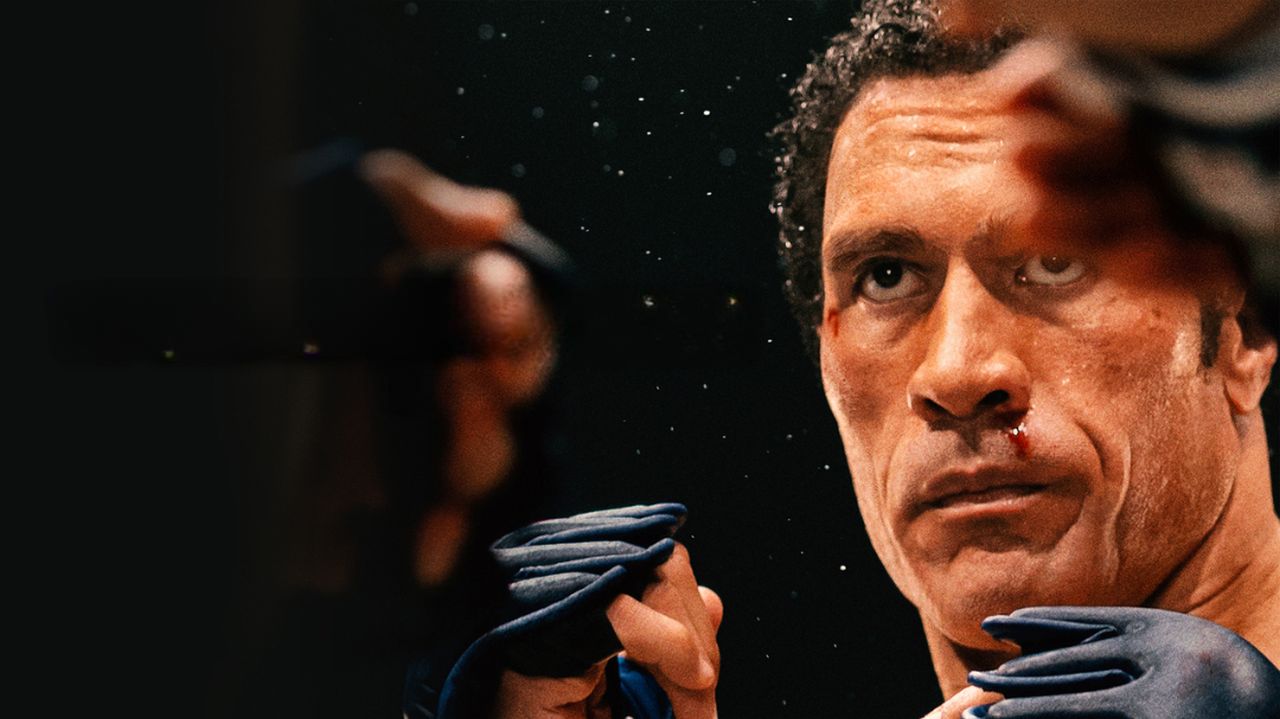
MOVIE REVIEW – Dwayne Johnson has spent most of his professional life selling the image of an indestructible force of nature, yet in The Smashing Machine, he finally lets that façade crumble. Benny Safdie’s A24 sports biopic is soaked in sweat, pain, and emotional chaos, far more concerned with the cracks forming beneath the surface than with the violence happening inside the cage. Johnson delivers one of the most controlled, vulnerable, and human performances of his career, but the film built around him rarely hits with the punch its title promises, settling instead into a solid but not extraordinary character study.
Biographical dramas have always been magnets for awards-season attention: from Oppenheimer to Gandhi, from Lawrence of Arabia to Schindler’s List, the genre is practically engineered for prestige. The Smashing Machine clearly wants to join that lineage. On paper, it has all the ingredients: A24, a Safdie brother behind the camera, a stripped-down Dwayne Johnson, addiction, fractured relationships – everything you’d expect from an Oscar-season contender. But critics have largely landed around the 6/10 mark, calling it a respectable yet uneven film with impressive moments that never fully ignite. The movie is technically sharp, emotionally scattered, and ultimately more admirable than unforgettable.

Oscar Hopes in the Cage or Just Another Polished Biopic?
From the first scenes, it’s clear this isn’t just a typical sports movie. We’re pushed right up against the cage with Mark Kerr, the camera clinging to raw faces, trembling hands, and split skin in a near-documentary style. Biopics are routinely accused of being “Oscar bait”, and The Smashing Machine doesn’t escape that label. The narrative arc is textbook: glory, downfall, delirium, self-destruction, sobriety, a grasp at redemption, all stitched together from real events. Yet many reviewers note that Safdie hits these familiar beats cautiously, without the wild energy and nerve-shredding tension that defined his earlier films.
Because of this restraint, the film often comes across as competent craftsmanship rather than a groundbreaking sports drama. Its mix of 16mm, 70mm, and battered VHS textures creates a gritty, tactile atmosphere, but there’s still a strange sense of distance, as if Safdie is deliberately keeping the story from becoming too chaotic or too emotional. Several critics point out that in avoiding the usual sports-movie clichés, the film also avoids bigger psychological risks, resulting in a strong but not truly memorable experience.
Mark Kerr: Unbeatable in the Cage, Breaking Apart at Home
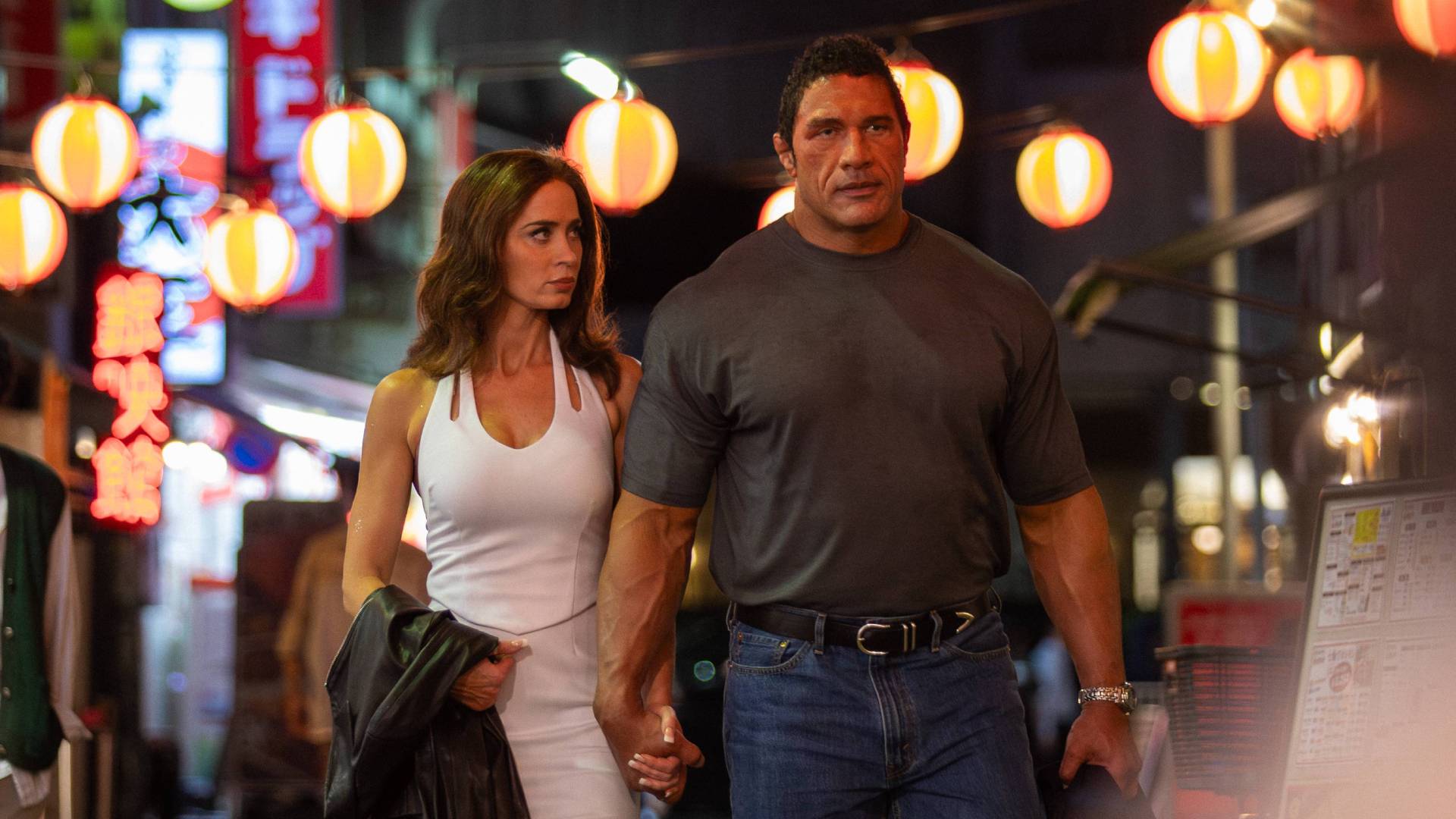
The story covers 1997 to 2000, the years when Mark Kerr (Dwayne Johnson) was both a dominant UFC figure and a man quietly falling apart. The film follows him through a brutal double life: a seemingly unstoppable fighter in the ring and a terrified, opioid-dependent shell of a man outside it. His body is failing, his nerves are frayed, and the painkillers blur the edges of a life he’s barely hanging onto. Fear, self-loathing, and guilt swirl together until every day becomes another climb toward the edge.
His relationship with Dawn (Emily Blunt) only amplifies that collapse. Their dynamic is a whirlwind of accusations, emotional instability, jealousy, and circular arguments. Many reviews call these scenes exhausting – and intentionally so – because they mirror the suffocating dysfunction Kerr can’t escape. As losses begin to mount, the media shifts its tone, fans turn on him, and Kerr spirals deeper into a fog of self-doubt and chemical dependence.
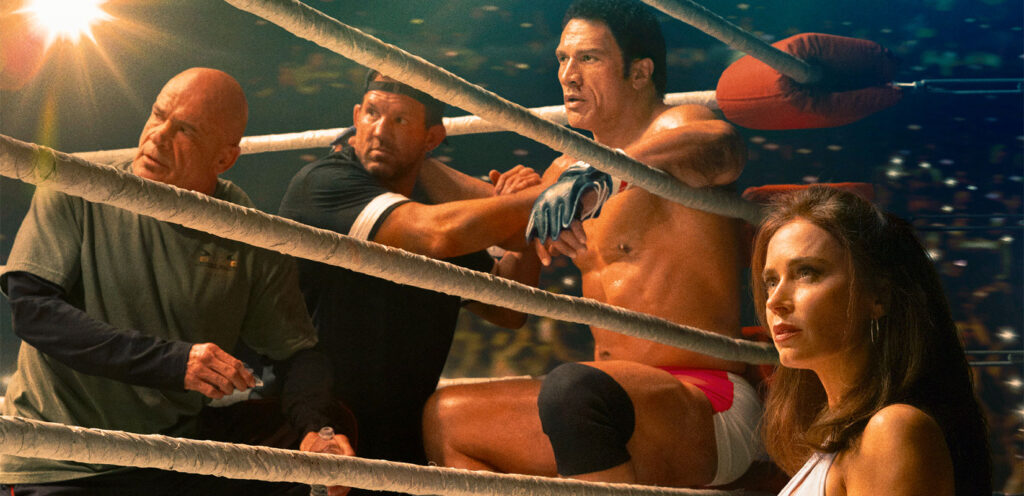
The emotional anchor of the film is Mark Coleman (Ryan Bader), the friend-turned-coach who becomes the heart of the story. Their bond is both professional and deeply personal: Coleman grounds Kerr, challenges him, picks him up from the floor – literally and figuratively – and supports him without pity or shame. Their friendship is depicted with honesty and warmth, offering some of the movie’s most affecting scenes. Safdie uses their relationship to show what loyalty and masculine vulnerability can look like without melodrama or embarrassment.

A Broken Rock – Surprisingly Honest Masculinity Inside the Cage
Johnson’s performance is a direct rebuke to the invincible persona he’s spent decades cultivating. Kazu Hiro’s subtle prosthetics reshape his face just enough to erase the “movie star glow”, but the real transformation comes through Johnson’s restrained physicality: shaky breaths, glassy eyes, a posture slowly collapsing under emotional weight. He doesn’t shout the performance; he lets it leak out piece by piece.
Kerr is portrayed as gentle, soft-spoken, and perceptive, a man who becomes terrifying only inside the cage. His voiceover reflections reveal a fighter who understands violence intimately but doesn’t thrive on hatred or aggression; he simply does the job he was trained to do. This duality is the backbone of the film, and critics consistently highlight it as Johnson’s most nuanced work to date. Many even call it the role that could finally push him into awards-season conversations.
The film’s treatment of masculinity is refreshingly human. The men in this story cry, collapse, hug one another, acknowledge their mental health struggles, and openly ask for help. Safdie presents these moments with empathy instead of irony, creating a rare portrayal of male vulnerability in combat sports cinema. Even reviewers who were lukewarm on the overall film single out this emotional honesty as one of its strongest achievements.
A Chaotic Girlfriend, a Strange Finale, and a Running Time That Overstays
Emily Blunt’s Dawn has been one of the film’s most divisive elements. She’s written almost like a caricature of the “volatile, unpredictable partner”, locked in endless cycles of yelling and emotional outbursts. Blunt commits fully, but the character feels unbalanced and underdeveloped, more like a narrative device than a human being. Many critics note that the real Dawn was likely far more complex than what we see here.
Safdie’s direction is technically assured. The handheld, documentary-infused cinematography drags us into the fights, and Nala Sinephro’s score adds layers of tension and dread. Still, many reviews argue the pacing sags and the emotional rhythm falters. Several scenes feel lifted directly from the 2002 Mark Kerr documentary, as though the film borrows too much from its source instead of reshaping it into something new.
The oddest moment arrives during the IMAX epilogue, where the real Mark Kerr appears in a grocery store and ends the scene with a wave straight out of a vintage Hawaii Five-0 episode. The tone breaks entirely, leaving the audience more confused than moved. Combined with the bloated 123-minute runtime – at least ten minutes could be trimmed – the film finishes on a strange, anticlimactic note.
A Good Film That Never Becomes A Legend
In the end, The Smashing Machine isn’t a bad film, not at all. It’s competent, often moving, and occasionally powerful, but also too cautious to become truly great. It contains all the hallmarks of a Safdie project, yet lacks the boldness and intensity of their best work. It’s worth a watch, especially for Johnson’s career-best performance, but it’s unlikely to become a long-term favorite.
-Gergely Herpai “BadSector”-
The Smashing Machine
Direction - 6.4
Actors - 8.2
Story - 6.8
Visuals/Music/Sound: - 7.5
Ambiance - 6.6
7.1
FAIR
The Smashing Machine is a gritty but emotionally inconsistent sports biopic anchored by Dwayne Johnson’s most vulnerable performance yet. Safdie’s direction is sharp but overly loyal to documentary roots, making the story feel slow and cautious at times. The movie lands firmly in “respectable but not remarkable” territory—elevated mainly by its lead actor.





![Pregnant Anne Hathaway Shows Off Her Baby Bump at New Film Premiere [VIDEO]](https://thegeek.games/wp-content/uploads/2026/08/theGeek-Anne-Hathaway-302x180.jpg)


![Tom Hardy’s MobLand Is Heading to Blu-ray Before Season 2 Arrives [VIDEO]](https://thegeek.games/wp-content/uploads/2025/05/theGeek-MobLand-1-302x180.jpg)

![Saber Interactive Denies that ChatGPT Wrote One of Its New Games! [VIDEO]](https://thegeek.games/wp-content/uploads/2026/08/rideshare-stimulator-1280x720-1-300x365.jpg)


![The Head of Take-Two Is Lying About the Price of Grand Theft Auto VI! [VIDEO]](https://thegeek.games/wp-content/uploads/2026/08/gta-vi-1280x720-1-300x365.jpg)
Leave a Reply