
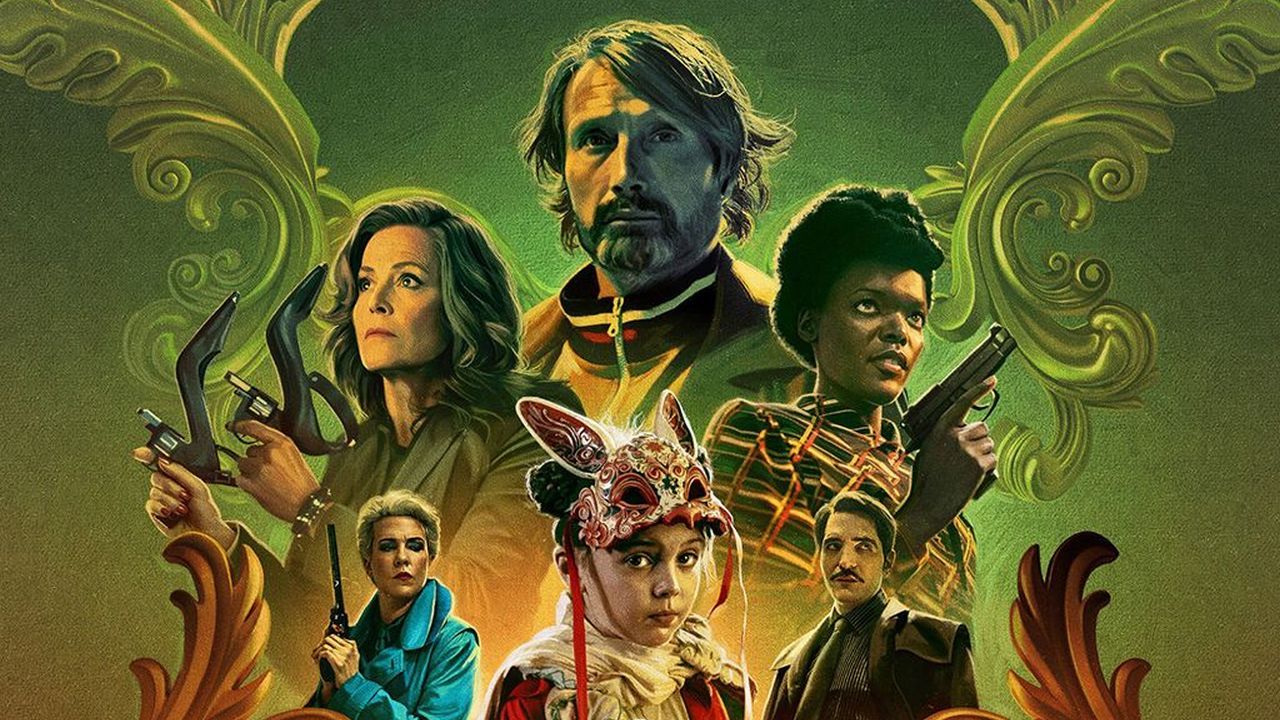
MOVIE REVIEW – Bryan Fuller’s first feature film treats childhood fear as a dark fairy tale, folding grief and trauma into a bizarre hitman story. Dust Bunny is visually indulgent and packed with ideas, confidently building its own offbeat universe even when not every piece fully locks into place. It’s an unsettling, atmospheric debut that entertains, provokes, and leaves behind a lingering sense of unease.
After nearly thirty years working in television, Bryan Fuller finally steps into feature filmmaking, a move that still feels surprising given how long his name has been synonymous with highly stylized cult series. Dust Bunny quickly makes it clear that this delay had nothing to do with uncertainty. Fuller seems to have waited for a project that would let his imagination run free without compromise. The result is a dark modern fairy tale where childhood fantasy collides head-on with the cruelty and indifference of the adult world.
One of Fuller’s long-standing creative obsessions is taking familiar expressions literally and pushing them toward absurd extremes. Here, he builds a macabre premise out of dust bunnies and childhood nightmares. What if the monster under the bed isn’t imaginary at all, but a ravenous creature chewing its way through walls? And what if a child, instead of seeking comfort or adult help, decides to hire a professional killer to deal with it?

The Monster Under the Bed, the Hitman Next Door
At the center of the story is Aurora, a fiercely imaginative young girl who hears screams and growls at night and is convinced a gluttonous monster lives beneath her bed. When her parents disappear, Aurora never questions what happened to them: the dust bunny devoured them. Desperate, she turns to her neighbor, a mysterious man she has previously seen slaying dragons in a nearby alley. Using money stolen from a church collection plate, she pays him for the job, and as he learns more about the girl’s deeply troubled background, he ultimately agrees to help.
The film’s first half deliberately drifts through its own meticulously designed spaces. Dialogue is sparse, and the narrative advances through images, mood, and small behavioral details rather than exposition. Fuller resists urgency, allowing the viewer to sink into a world that feels oddly familiar yet distinctly warped, where fear has physical weight and reality operates according to fairy-tale logic.

An Expanding Yet Fragile Universe
As Dust Bunny progresses, its initially simple setup begins to accumulate layers. Enter Laverne, the hitman’s handler, who hints at a larger, John Wick–style underworld operating just beyond the frame. Sigourney Weaver attacks her scenes with voracious energy, signaling through extravagant meals that monsters in this film are not confined to children’s bedrooms. The grotesque humor lands most effectively when danger and irony sit comfortably at the same table.
It’s difficult not to think of stories built around uneasy alliances between children and professional killers, but Fuller filters this familiar dynamic through his own brightly stylized, slightly artificial lens. That approach is both the film’s greatest strength and its biggest risk. Viewers willing to accept the arch humor and fairy-tale exaggeration will likely enjoy the ride; those who don’t may find themselves bouncing off the film entirely.
As more characters enter the narrative and the world appears to broaden, the story pushes past its most obvious childhood-trauma metaphor. Still, there’s a persistent sense that this universe is suggested rather than fully explored. Many elements feel deliberately sketched, like ornate embroidery concealing empty spaces beneath.
Spectacular Images, Uncertain Lessons
Fuller’s command of visual storytelling is unquestionable. The film’s imagery is lush and excessive, with production design and color often masking the thinness of the narrative underneath. Jeremy Reed’s opulent sets and Nicole Hirsch Whitaker’s shadow-rich yet sumptuous cinematography create a world that’s easy to lose yourself in, even when the underlying allegory refuses to resolve into a single, coherent message.
The performances are among the film’s strongest components. Sophia Sloan and Mads Mikkelsen share an engaging, believable chemistry, and their dynamic carries much of the film’s emotional weight. Even so, there’s a lingering sense that both actors had more to offer, material that might have surfaced with a deeper script and longer narrative arcs.
Ultimately, Dust Bunny feels exactly like what it is: a debut feature that reflects both a seasoned creative voice and the limitations of a first outing. Fuller’s cinematic arrival is unmistakably his own, even if the final result plays more like a stylish, kid-centered hard-R genre experiment than a fully realized statement.
-Herpai Gergely “BadSector”-
Dust Bunny
Direction - 6.5
Actors - 6.8
Story - 5.4
Visuals/Music/Sounds - 8.4
Ambience - 6.7
6.8
GOOD
Dust Bunny is a visually daring, tonally confident film that tackles childhood fear through dark fantasy. While its narrative depth doesn’t always match its aesthetic ambition, the visuals and performances keep it engaging throughout. Bryan Fuller’s first feature may be more promise than payoff, but it’s a distinctive and memorable debut.

![Pregnant Anne Hathaway Shows Off Her Baby Bump at New Film Premiere [VIDEO]](https://thegeek.games/wp-content/uploads/2026/08/theGeek-Anne-Hathaway-302x180.jpg)


![Tom Hardy’s MobLand Is Heading to Blu-ray Before Season 2 Arrives [VIDEO]](https://thegeek.games/wp-content/uploads/2025/05/theGeek-MobLand-1-302x180.jpg)



![WARDOGS Hits Early Access in September, with a Closed Beta First [VIDEO]](https://thegeek.games/wp-content/uploads/2026/08/theGeek-WARDOGS-Early-Access-300x365.jpg)
![An ex-Bethesda Dev Says Including More than 1,000 Planets in Starfield Was a Bad Decision! [VIDEO]](https://thegeek.games/wp-content/uploads/2025/09/thegeek-starfield-nagy-1-300x365.png)

Leave a Reply