
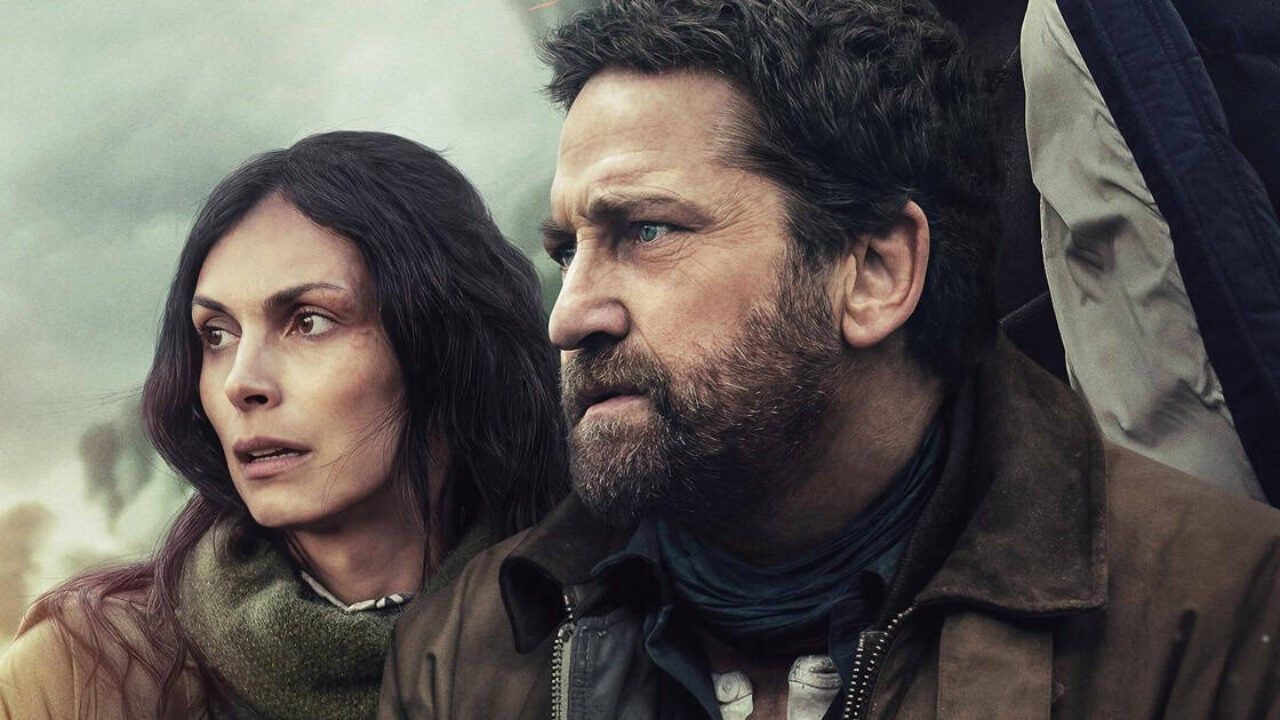
REVIEW – If you’re sick of end-of-days vibes, here’s the bad news: Greenland 2: Migration doesn’t offer shelter – it piles on more doom like it’s getting paid per disaster. Ric Roman Waugh keeps hurling catastrophes at the screen with the energy of someone collecting achievement badges, except instead of tension or emotional punch, the main thing you feel is exhaustion. This isn’t a story about surviving the apocalypse – it’s about surviving a sequel that seems barely convinced by its own premise.
Anyone looking for a break from reality – especially the nonstop news out of the U.S., which often feels scarier than fiction lately – is probably barking up the wrong tree if they choose a movie with “Greenland” and “Migration” stamped right into the title. The follow-up to the surprise Gerard Butler post-apocalyptic hit Greenland, now arriving as Greenland 2: Migration, basically has one message: think you’ve got enough problems already? Don’t worry, it brought extras.
And that’s the frustrating part: this movie actually has pieces it could’ve built something solid with. Visually, it can look legitimately impressive. Flooded cityscapes, a half-melted Eiffel Tower, and the dried-out remains of the English Channel carved into canyon-like trenches all suggest the filmmakers wanted the destruction to feel huge, iconic, unforgettable. But the narrative trudges forward like it’s clocking in for a shift – as if someone is simply checking boxes on a list labeled “mandatory suffering,” and calling it a day.
At its core, the plot is painfully simple: a nonstop conveyor belt of fresh misery dumped onto the shoulders of one American family, while the film can’t be bothered to make any of it feel urgent, heavy, or genuinely suspenseful. The Garritys are forced to fight their way through the wreckage of a broken world, led by blue-collar dad John (Gerard Butler), a man seemingly engineered to “handle it” in every imaginable situation – assuming the screenplay doesn’t decide to kneecap him for the next set piece.

Apocalypse as wallpaper: disaster after disaster, with tension missing in action
The movie throws the whole catalogue at you: earthquakes, meteor strikes from comet debris, volcanic ruptures, superstorms, a tsunami, and of course the obligatory “Eastern European marauders,” who show up less as characters and more as cardboard cutouts. On paper, this is the kind of threat package that should wake up even a mediocre thriller. In practice, Waugh can’t squeeze real suspense out of it. The stakes are enormous, yet every sequence plays like you already know exactly where it’s headed – and most of the time, you do.
Despite the title, “migration” isn’t a dramatic arc here. It’s more like a guided tour through disaster postcards: one spectacular ruin after another, each trying to outdo the last. Five years after Comet Clarke tore a massive wound into southern France and effectively ended modern civilization, the Garritys are still alive. Allison (Morena Baccarin – yes, from Deadpool), their now-teen son Nathan (Roman Griffin Davis), and John (Butler) are holed up in Greenland with an elite group of scientists and a handful of military personnel, living inside a post-apocalyptic bunker built into the remains of Thule Air Base.
It’s a setup that could’ve worked – it’s got scale, it’s got stakes, it’s got the right ingredients. But the film doesn’t know what to do with its own world. The bunker never develops a real atmosphere, the danger never truly lands, and survival itself has no believable rhythm. Greenland 2: Migration is constantly trying to “be about something,” yet it rarely delivers moments you can actually feel.

Catastrophe overload: when the movie mistakes chaos for drama
John is still the same kind of guy: if it pumps, cranks, sparks, or even vaguely counts as machinery, he can fix it. The hazmat suit isn’t a dramatic costume so much as his everyday work gear, because he regularly heads out on scavenging runs through the wreckage. And the Greenland shoreline becomes a gift shop for convenient plotting: a destroyer washes up, lifeboats wash up, useful supplies wash up – basically anything the story needs, whenever it needs it.
The bunker’s leadership barely has time to decide it would be “the humane thing” to rescue nearby survivors who managed to send a distress signal, when the next plot trigger hits: an earthquake collapses part of the complex. The film even tosses in a “You’ve gotta be kidding me” kind of line – which lands less like a joke and more like the audience speaking through the characters.
Of course, the Garritys push on. They keep moving because the movie needs them moving. They keep going even when the faction arguing that “slowly dying is still DYING” makes a disturbingly logical case. Then the genre’s most reliable crutch appears right on schedule: rumors of an Eden-like promised land, bursting with fresh life, breathable air, and clean water. The myth centers on the massive crater left by Comet Clarke – and from that point on, it becomes the family’s next big mission, and the film’s next chain of required pit stops.
Gorgeous ruins, hollow people: spectacle without a pulse
Butler isn’t playing this like a swaggering action hero. He goes for a quieter kind of grit – a grounded father trying to keep it together. That could’ve worked beautifully. But the movie doesn’t give him the emotional runway. There’s no real internal journey, and barely any moments that show him as a person instead of a story function. The new supporting characters don’t fare better: they show up briefly, say their lines, and vanish into the smoke of the next effects-heavy sequence – not because the world is cruel, but because the script can’t spare the time to let them exist.
The biggest issue is that the entire thing is emotionally dead. Events happen, tragedies occur, danger escalates – and it somehow slides right off you. The screenplay feels like it’s stacking familiar panels: “here’s a disaster,” “here’s another loss,” “here’s a frantic escape,” then we’re on to the next checkpoint. The VFX team does heroic work trying to make the destruction feel real, and sometimes it does. But without a beating heart underneath, it’s still just illustration – a moving brochure for catastrophe.
Waugh – Butler’s go-to director (from Greenland, the Has Fallen films, and Kandahar) clearly knows this genre inside and out. But here he seems to lean hard into the “the visuals will carry it” philosophy. The problem is: visuals don’t carry everything. Not when the film has nothing to say about people. There’s no meaningful human conflict, no believable survival logic, no true moral crossroads – nothing that isn’t built from well-worn disaster-movie clichés.
The one joke left in an era where humor is supposedly extinct is how quickly humanity forgets the difference between classic rock and yacht rock. It’s the kind of line that doesn’t land as funny so much as it reminds you of what’s missing: personality, texture, life – something beyond rubble.
By the end, the movie feels like someone tossed the biggest spectacle moments from 2012 and The Day After Tomorrow into a shiny new sandbox: storms, floods, debris, collapses – it’s all here. What’s not here is what actually matters: human relationships, real tension between people, intelligence, willpower, and that spark that makes survival more than sprinting from one disaster to the next.
If this is the “promised land,” then thanks – we’ll take our chances back under the bunker.
-Herpai Gergely “BadSector”-
Greenland 2: Migration
Direction - 4.2
Actors - 4.4
Story - 3.8
Visuals/Music/Sounds - 4.5
Ambience - 4.1
4.2
WEAK
Greenland 2: Migration is undeniably impressive to look at, but as a story - and especially as an emotional experience - it’s strangely empty. Despite nonstop catastrophes and massive ruin porn, the film never manages to generate real suspense or believable drama. The result is a slick, expensive disaster march where the CGI does most of the heavy lifting, while the characters mostly drift along for the ride.












Leave a Reply