
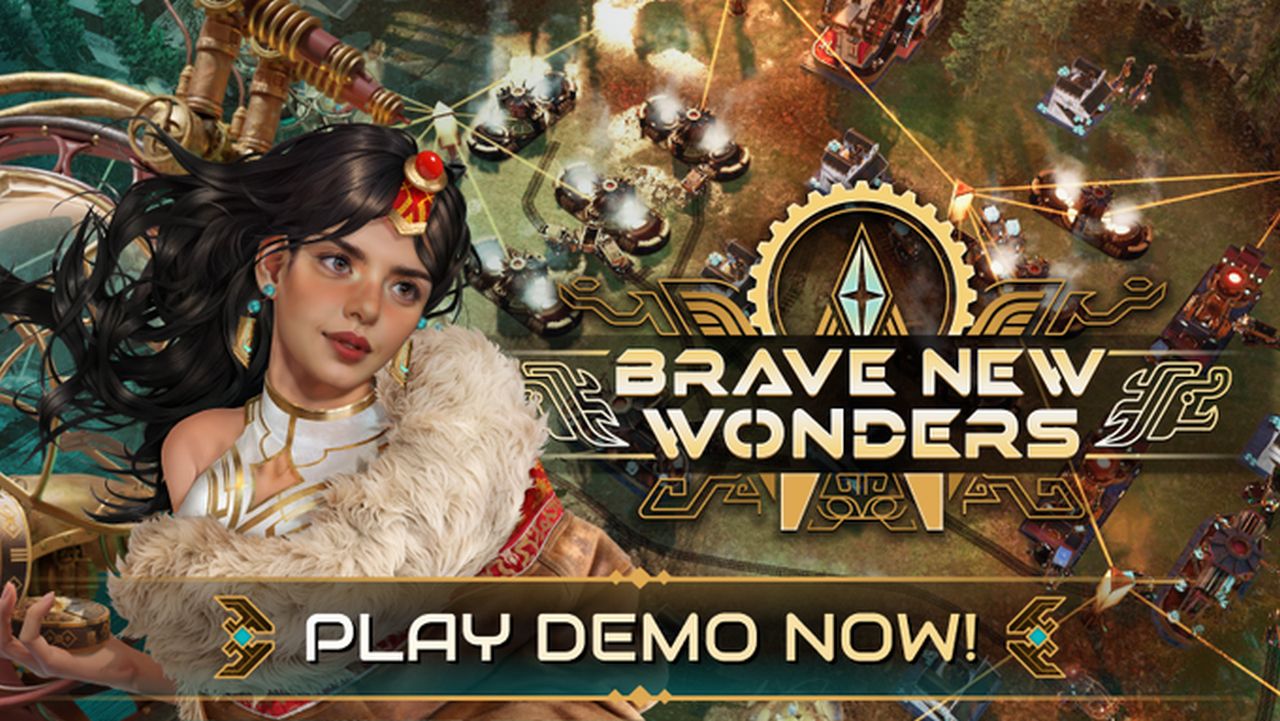
A group of former Google developers has pulled off something rare: using AI to make a game better to play, not easier to mass-produce. Brave New Wonders is out to prove that artificial intelligence can be more than a shortcut for copying and cutting costs. In their hands, prompts aren’t a gimmick – they’re a core gameplay mechanic.
A few months ago, after getting hooked on watching Alexelcapo play Satisfactory, I quickly realized I wasn’t alone in my strange obsession with placing conveyor belts in factory games. This streamer – one of the most recommended Spanish-speaking creators not only for his takes on the industry and the medium, but also for his quirky way of approaching less mainstream, less common games – has become one of the strongest advocates for this dangerously addictive genre.
For the last few days, I’ve been playing a strategy and automation game on Steam that, interestingly enough, embodies the yin and yang of much of what it’s trying to say. On one side, it’s yet another reminder of how the Zeigarnik effect – the tension created by closing loops even when they never truly end – turns these games into pure addiction machines. On the other, it openly clashes with that gut-level distrust many players feel toward anything that smells like AI. But the AI here isn’t what we’ve gotten used to seeing.
The Brave New Wonders Revolution
Developed by former Google employees with backgrounds in artificial intelligence, Brave New Wonders proudly presents itself as a game built by humans, with artists and developers who explicitly banned generative AI during production: “The moment people see ‘AI’ in the description of a game, many assume the whole game was made by AI, and that’s simply not true.”
With Brave New Wonders, however, there’s a crucial distinction: “It is built by real people – artists, engineers, designers – who create, design, review, and carefully polish every resource and system. The visual style, world design, animations, and game structures are all handcrafted.”
They argue that “human collaboration and creative intent are at the heart of the project”, and that far from leaning into the increasingly common industry rhetoric, “the team behind it deserves recognition for their work.” Still, few games feel more “AI-infused” – because underneath that message, artificial intelligence is absolutely central to the project. Not in the art pipeline, but in the gameplay itself.
At its core, the game plays very much like what we’ve seen in Factorio or the previously mentioned Satisfactory. In a world packed with resources, you build supply chains: mine iron, ship it to a smelter, move the output to another facility, and then transform it again into something new. It’s a resource-management challenge that grows steadily until the very end, creating that endless “fix this, then stop – wait, fix one more thing” loop that can swallow entire evenings.
In video game design, few things are harder than keeping a player hooked without them even noticing, but Brave New Wonders starts from a slightly different place. In most games, that hook comes from the effort involved in building and managing those production lines.
I need to move materials from this mine to that warehouse using a conveyor belt, then route them into a factory to create an item, then ship that item into a second factory, then branch the line because another machine needs the same component… But the City From Naught team proposes a different thought: what if I could automate that whole process too? What if I did it by writing a prompt – the same way I’d ask Gemini or ChatGPT to do something for me?
Playing Like You’re Talking to ChatGPT
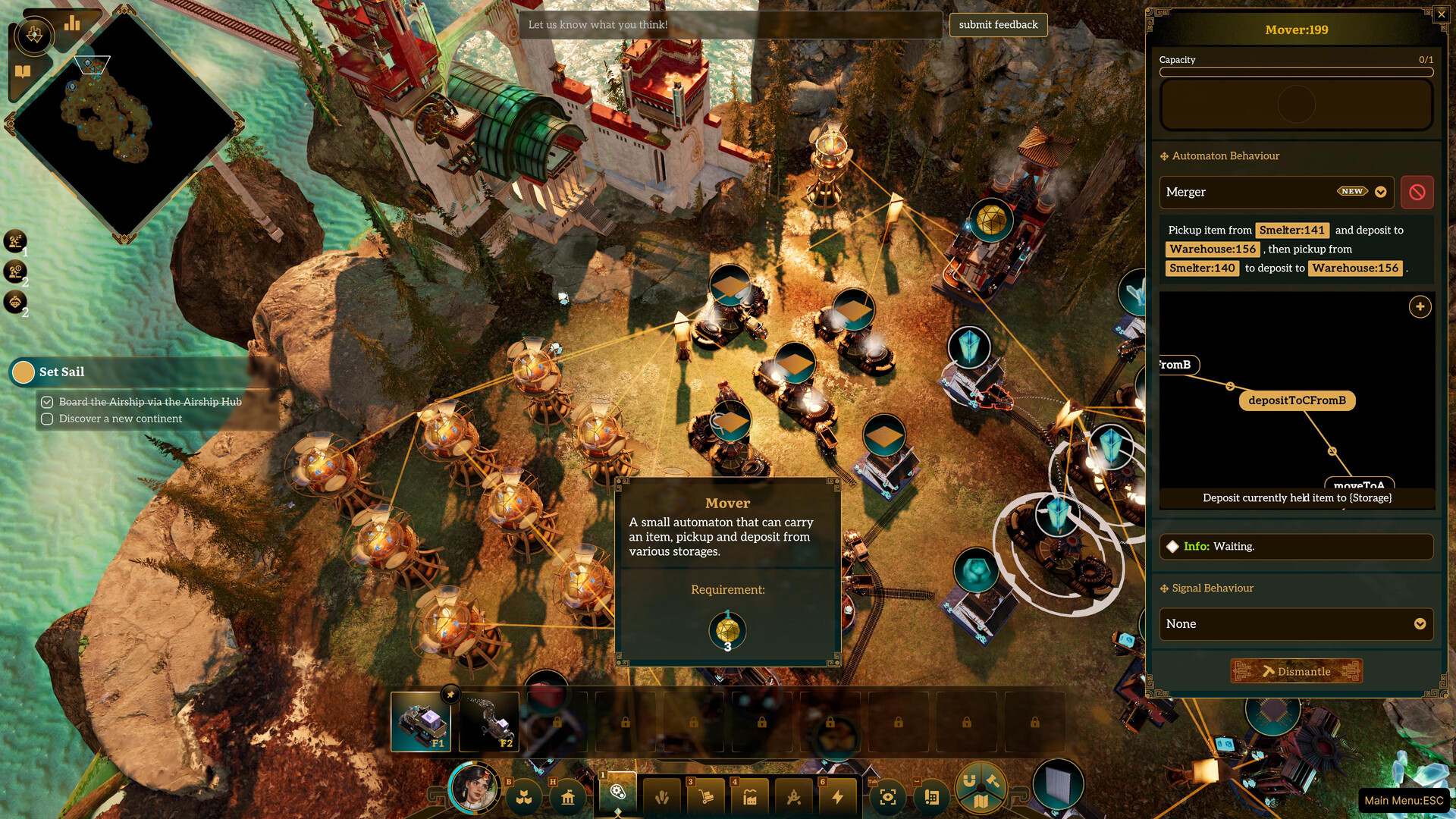
Instead of thinking in conveyor belts, Brave New Wonders builds its entire resource and item-management system around robots. So you take a mining robot and tell it to extract a specific mineral from here and deliver it over there. What starts out as something that looks like a couple of clicks becomes surprisingly complex once you unlock certain technologies.
At that point the game basically says: now that you’ve learned the fundamentals, it’s time to move up. The problem is, the jump isn’t from one step to the next – it’s like going from the ground floor straight to the roof of a skyscraper. That’s when you can tell an automaton: collect ore from this vein and bring it to this smelter, and if that vein is empty go to this other one, and if the smelter already has enough to run then don’t leave it there, move the excess to this warehouse.
Doing that with a click would already be impressive, but the AI twist is that you can do it with the exact same sentence, simply stacking in every variable you can think of. You type it out, and the game handles the translation: it turns your text into an automated workflow its system can interpret, executing your rules exactly as written.
“Between natural language input and in-game execution, we have a dedicated behavior layer built on top of deterministic state machines. Instead of letting the AI directly control the game, the language model is used strictly for intent interpretation. It translates the player’s text prompt into a set of structured and validated actions that map to predefined states and transitions.”
The shift matters not just because of what it does for gameplay – which is significant – but because it breaks from the tired narrative we’ve been hearing about AI for years now. When you finally see an idea that isn’t about the company making more money by paying people less, it’s genuinely refreshing to watch prompts and artificial intelligence serve a purpose beyond that.
“AI is, ultimately, just a tool. A technological advancement that makes certain types of game design possible for the first time. We don’t believe games should shy away from AI out of fear, but we also don’t believe it should be used simply because it sounds impressive.”
For indie developers, there’s really only one metric that matters: does it make the game more fun? If AI meaningfully expands player creativity, reduces friction, or enables experiences that were previously impossible, then it’s a valuable addition. If not, it’s just noise.
While Brave New Wonders still isn’t on Steam and has work left to do regarding pacing and how approachable its premise is, the idea that another kind of AI is possible in games is genuinely encouraging. Having a clear example of AI being used in a way that adds value without undercutting artists and authors might be the best kind of future this technology can offer.
Forrás: 3djuegos














Leave a Reply