
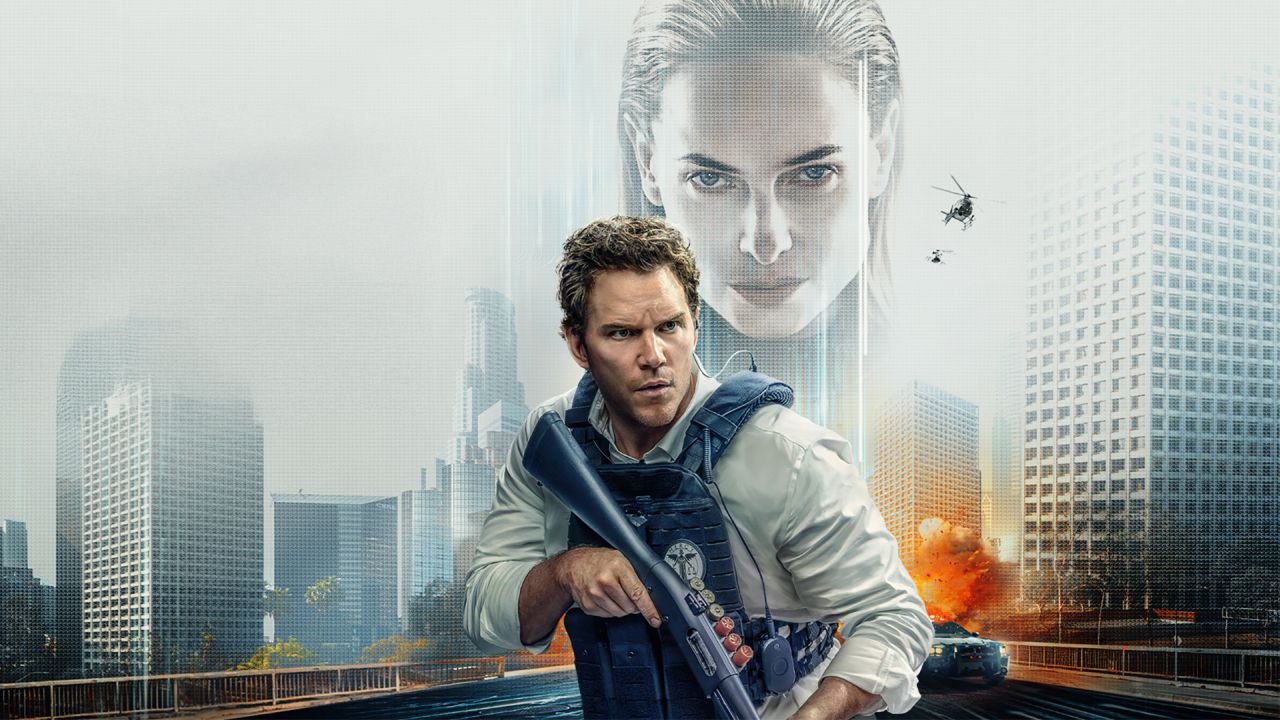
MOVIE REVIEW – Mercy starts from a strong hook: an AI-run death-penalty court, a ticking clock, and an investigation that plays out through screens. It moves fast and lands real tension at times, but the script keeps tripping over its own worldbuilding and logic. Rebecca Ferguson holds the whole thing together more often than the story does.
Timur Bekmambetov is essentially the grandmaster of “screen-told” movies (laptops, phones, CCTV feeds, chat windows, video calls, digital traces) – a form where the story doesn’t merely use screens, it’s built from them. The approach reflects a modern life that’s become ruthlessly display-centered, and it often pushes back, deliberately, against the “rules” of classical film language: it’s not uncommon for the texture to lean into phone-camera immediacy and the illusion of found footage. Of course, Bekmambetov hasn’t only been at home in this space – you only have to think of how well Night Watch and Day Watch landed back then. But with Profile, and as a producer on Unfriended, Searching, and Missing, his name has fused with the format so completely that he has effectively become its most recognizable face. Mercy doesn’t just fit that tradition: it’s a brisk, fresh, inventive next step for it, especially with Rebecca Ferguson’s commanding presence anchoring the whole thing.
An AI Court That Doesn’t Ask – It Sentences
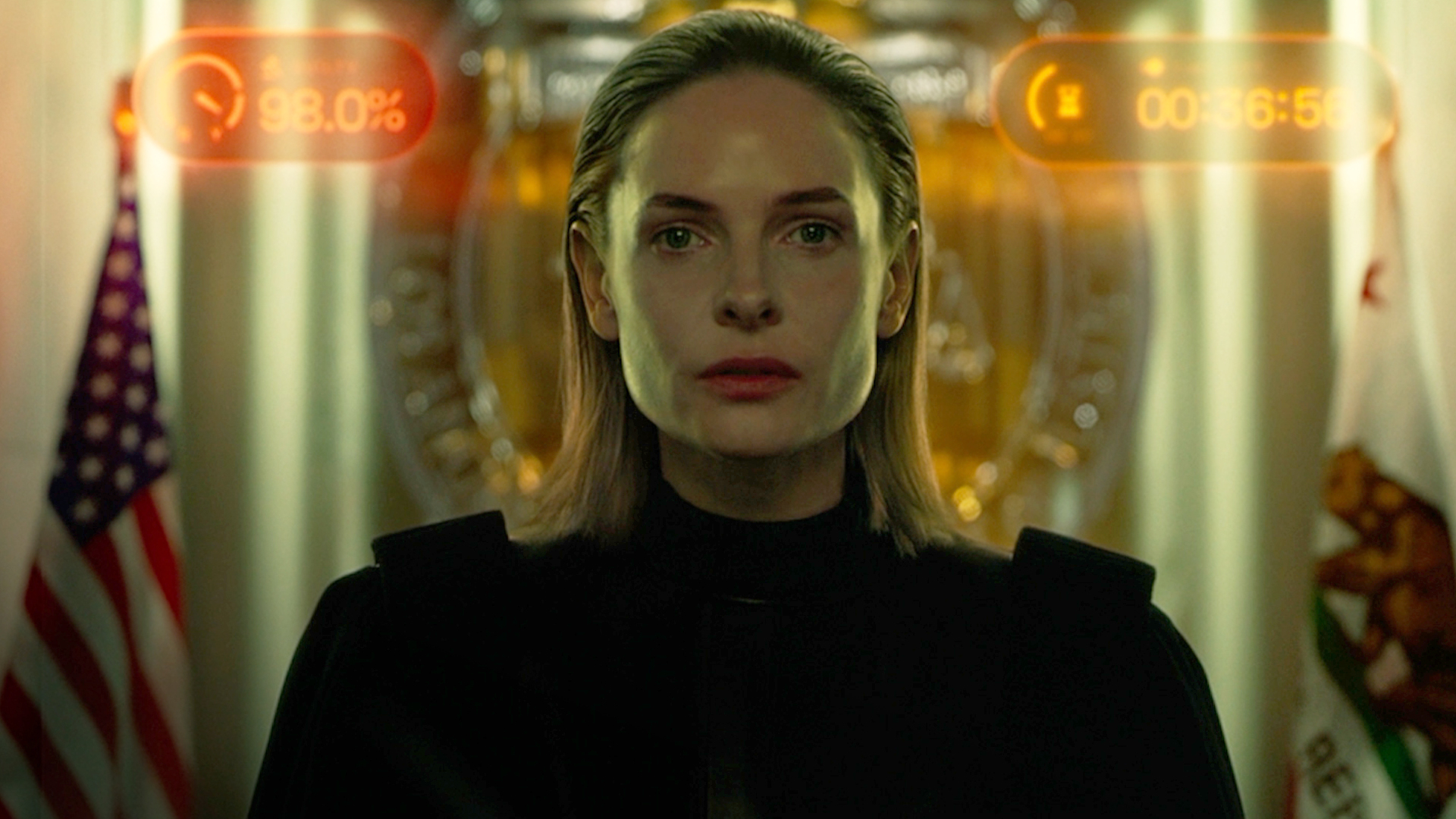
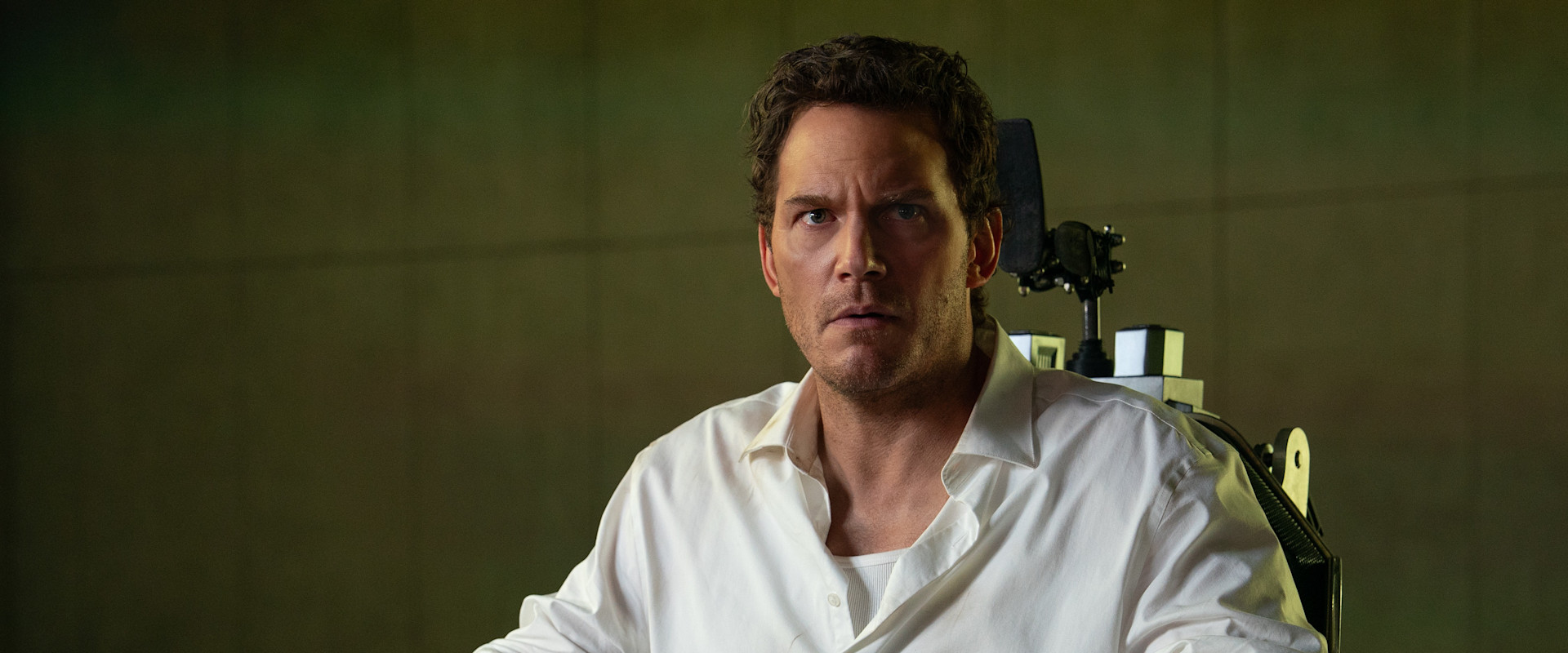
Mercy is set in near-future Los Angeles, where crime has climbed so high that the authorities have created the “Mercy Court” – an AI-run tribunal that rules on death-penalty cases when the odds of a defendant’s guilt are “statistically exceptionally high.” On paper, that can even sound fair: the defendant gets full access to the evidence and court files to prove their innocence. Except they have to do it under a ruthless time limit: the clock is ticking, and the system doesn’t even pretend it isn’t greeting them with a verdict already loaded. The protagonist, Detective Chris Raven (Chris Pratt), ends up in that chair, facing Judge Maddox (Rebecca Ferguson), who coolly tells him that, by the numbers, it’s practically certain he murdered his wife, Nicole (Annabelle Wallis). Chris is also a relapsing alcoholic, with only fragmented memories of the crucial night, yet he insists he’s innocent. There’s only one way forward: he has to dig the truth out of the files, the traces, and the help of his partner Jaq Diallo (Kali Reis) – a truth that keeps pulling him deeper, and looks less and less like a “simple” murder case.
A screen-told thriller, at its best, can crank tension up brutally: it dispenses information, misdirects, sets pace, and drags the viewer in as if they were investigating themselves. At its weaker points, though, it can easily turn static, claustrophobic, into monotonous “window-watching” where it’s just messages, searches, and clicks on repeat. But Mercy knows exactly how to dodge that trap: by using AI-based crime-scene reconstruction it opens up the space, injecting real sense of movement, action, and physicality into a story that could have stayed a plain digital investigation in other hands. The choice is both smart and necessary, and Bekmambetov proves that this cinematic language isn’t a dead end – you just can’t get stuck recycling the same few tricks. Mercy feels genuinely fresh because of it, and it suggests there’s still serious headroom in this approach.

Chris Pratt Unravels, Rebecca Ferguson Gives the Program a Pulse
As Chris Raven, Chris Pratt largely works: he’s packed with panic, anger, fear, and that raw desperation of someone who knows he could lose his life within minutes. His investigation is frantic and detail-driven yet logical, and the film doesn’t gloss over the fact that this man is loaded with weaknesses and bad choices – things you can’t wash away with a single “I’m innocent.” In the most heightened scenes he can read a bit stiff, as if he doesn’t always hit the exact tone, but overall he carries this breakneck, time-locked ordeal. One of the film’s best ironies is that Rebecca Ferguson plays an AI judge, yet she supplies the story’s finest layers. She’s such a strong actress that she creates the effect by pulling back: she keeps Maddox machine-disciplined while still letting a slow-blooming complexity show through. Her Maddox is obsessed with “pure truth,” and as the film progresses she grows more nuanced – she feels more human, without the script ever going for the cheap move of literally turning her into one. Kali Reis gets fewer subtleties to play, but her presence is strong, and as a world champion boxer it’s no surprise she’s especially convincing in the close-quarters fight moments.
Overall, Mercy is a fast, tightly paced, desperate investigation orbiting a brutal crime. At the same time, it leaves a lot of questions open, and a few promising directions flash by without being fully explored. Without spoilers: the Mercy Court is sold as an “emergency solution” born after crime supposedly spiraled out of control – and Maddox pushes that pitch in promotional videos, effectively marketing the system to society. Those promos are filled with violence, fear, and criminality, while the street footage shown in the film leans harder on poverty, collapse, and hopelessness. Sure, you can argue an AI death-penalty system would deter crime, but even real-world capital punishment doesn’t work that way, so that’s a steep assumption. And that’s where one of the film’s biggest omissions shows: Chris’s life hinges on a system he once supported, we see its flaws, but the script doesn’t really dare to dig into how perfectly built this machine is for manipulation. Deepfakes, false perception, hyperreal lies – if a film is building on AI threats, this is the territory its premise is screaming for. And yet the opportunity is mostly left untouched.
When a Good Idea Picks a Fight With Its Own Logic
The half-finished worldbuilding leads, in multiple places, to logical and statistical impossibilities. The film’s core proposition is that a supposedly “infallible” AI death sentence isn’t infallible – which is already a scandal when the system is designed for executions. That’s both shocking and profoundly unjust. At the same time, there’s a narrative thread in which part of Chris’s heroic arc is that he actively tries to save the Mercy Court and preserve the AI system. If this tribunal is this authoritarian and this flawed (and the film presents it that way), preserving it is not heroic, yet the story tries to frame it as such. It doesn’t add up. There are further issues that can’t be discussed without major spoilers, but the short version is that the script sometimes feels like it’s arguing with itself, and it handles certain situations as if it doesn’t fully grasp the consequences of its own world. Mercy clearly reaches for contemporary, sensitive themes, but it isn’t always obvious that it has a consistent position on them.
Even so, Mercy is fundamentally an enjoyable, twisty, complex, and surprisingly action-heavy investigative thriller. One of the advantages of screen-told movies is that they’re cheap and easy to produce: characters communicate through screens, receive information there, talk there, get recorded there – often a laptop and a phone are enough. But that strength can easily become a weakness, because you need a genuinely creative hook, otherwise it turns into a claustrophobic stream of messages. The format still has plenty of potential: Host worked with low-cost tricks, and Searching nailed it through a strong story and a great central performance. Most films in this lane, however, lock themselves into the screen’s perspective. Mercy is strongest because, while it stays faithful to that viewpoint, it genuinely opens up the space through futuristic reconstructions, avoiding monotony and even pointing toward a new direction for this cinematic language.
Good Pace, Strong Performances – But a Few Knots Remain in the Script
Alongside the reconstruction concept, Chris Pratt delivers a perfectly solid lead, and Rebecca Ferguson is simply excellent as the AI judge. Still, some twists move too fast: even on a big screen there are moments where you blink and you’ve already missed something essential. On top of that, certain machinations and character plans feel shaky, and the world only holds together on the surface. The script undeniably has strong pieces, but there are a few frustrating points where it’s obvious one more rewrite pass was needed for everything to click. Even so, this is a successful sci-fi detour: the film is willing to push at the genre’s rules, and as a result it delivers an entertaining techno-thriller murder mystery that can hold attention throughout.
-Herpai Gergely “BadSector”-
Mercy
Direction - 6.2
Actors - 5.6
Story - 6.2
Visuals/Music/Sounds - 6.8
Ambiance - 5.6
6.1
FAIR
Mercy builds a tense, fast-paced investigative thriller on a strong core idea, and the AI court framework makes it feel sharply of-the-moment. Rebecca Ferguson’s subtle, memorable work clearly elevates the material, and the film’s digital storytelling also gets a few genuinely smart upgrades. But the world-building and internal logic wobble at points, so it doesn’t land with quite the impact its premise deserves.


![Dexter Returns in the First Look at Dexter: Resurrection Season 2 [VIDEO]](https://thegeek.games/wp-content/uploads/2026/07/theGeek-Dexter-Season-2-302x180.jpg)







![[TGA 2025] Tomb Raider: Legacy of Atlantis: Another Remake of the First Game! [VIDEO]](https://thegeek.games/wp-content/uploads/2025/12/theGeek-Tomb-Raider-Catalyst-Legacy-of-Atlantis-Remake-Crystal-Dynamics-300x365.jpg)



Leave a Reply