
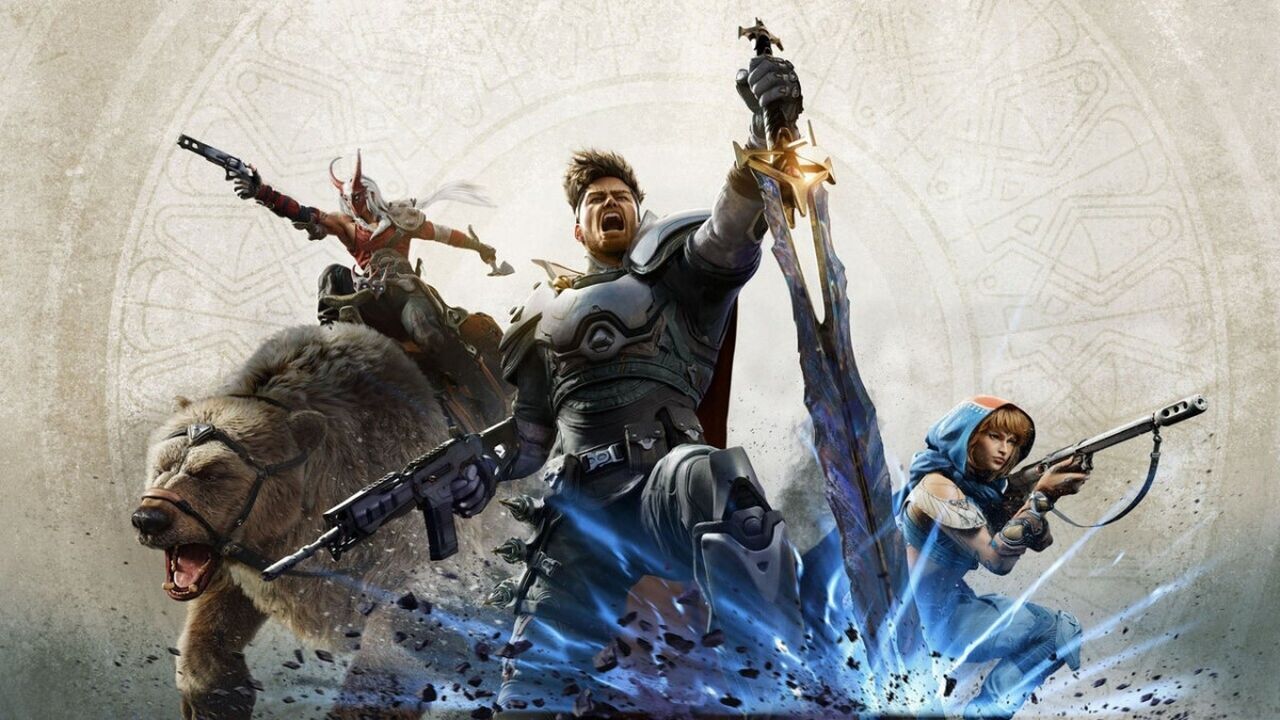
REVIEW – The market is already drowning in live service shooters, and now there is one more body in the water. Even if you ignore how quickly people wrote Highguard off the moment it showed up, the uncomfortable truth is that, in its current state, it can get boring in two days. The real question is whether anyone will still care in three, six, or twelve months – or if this is destined to stay exactly where it landed.
This was the final reveal at The Game Awards. From the creators of Titanfall, this is not what we expected.

Riding Bearback
Story is barely a thing, unless you count a few lines tucked behind eight character skins. The core loop feels like several shooters stitched together and pushed out the door before it was ready. Weapon handling is not refined, and while the game clearly wants to look distinctive, it mostly plays like something unfinished – a promising prototype masquerading as a launch build.
Visually, it is fine in the most generic way possible. Optimization is worse than it should be, voice work and sound effects are forgettable, and the music sometimes feels like it simply never showed up. That brings up the obvious question: does free-to-play save it? The one genuinely friendly touch is that battle passes do not expire, but it does not take long to realize the roster is not balanced, the edges are rough, and you have seen most of what Highguard currently offers.
The game launches with eight Wardens: Atticus, Slade, and Scarlet as attackers; Redmane as a bruiser; Una and Kai as defenders; Condor as a scout; and Mara as support. There are five maps, and everything is locked to 3v3 on arenas that feel built for much larger lobbies. Have the developers lost the plot? These spaces could easily hold 8v8, yet you spend a huge chunk of each match sprinting, looting, and waiting for the action to finally find you. It is like buying an RTX 5090 to play Minesweeper.
Monthly content drops are promised, but right now they are just that – promises. Highguard is a hero shooter with a mash-up identity: base building (Fortnite), flag play (Quake), tactical bomb scenarios (Counter-Strike), and looting all thrown into the same pot. The broad objective is to take control of the Shieldbreaker, then plant a bomb on the base generators.
It reads like a little Apex Legends, a little Rainbow Six: Siege, and it is almost impossible to communicate cleanly in a single trailer – Wildlight Entertainment did not manage it. The Raid phase is the more appealing half of the structure: you enchant the Siege Tower, the base shield drops, and then the real fighting begins. With friends, it can be genuinely fun. Solo, the cracks show immediately.
Even the “mounted” gimmick feels underfed: there are only three rideable animals – a big brown bear, a panther, and a horse. More broadly, the strongest impression is that the game arrived incomplete, and that only fueled the backlash and the flood of negative reviews on Steam.

Too Early For Players, Too Late To React
The maps are simply too big for this format. They feel designed for larger teams, and it is hard not to suspect the size was meant to force looting into the foreground – which backfires. You gather materials quickly before the Shieldbreaker phase truly ramps up, and after that you are stuck in a long, exhausting grind for the currency, Vesper.
Mining crystal nodes feels like mandatory busywork, and together these systems drag the pace down. The loop turns into repetition: after Raid Defense, it resets, and roughly half of every match becomes a running-and-looting routine across oversized terrain just to upgrade your kit. Time-to-kill is too long, weapons often feel weak, and the gap between them is big enough that balance problems become obvious fast.
Redmane is the easiest example – picking that Warden can feel like self-inflicted pain. On top of that, performance is not stable, and servers can get shaky. Condor is close to a free win, and Kai is not far behind: one gets half a minute of wallhack-style vision, the other turns into a killing machine after popping an ultimate, plus a passive that repairs walls for free. Who greenlit this as a launch-ready build? And why does it still feel half-finished?
And yet, it might be worth a look, simply because it costs nothing and does not ask you to hunt down a demo. There is an interesting idea buried in here. The problem is that, right now, the lack of polish makes it more shocking than convincing.
Where To Next?
Highguard lands at a 5.5/10. There are good parts – the Raid phase can work – but at the moment this is an empty, half-baked, content-light release. Waiting three or four months is the sensible move, because in its current form you can burn out in a single weekend, and then you will have no reason to come back.
For now, it is forgettable. The bigger issue is that we are drowning in live service games, while single-player, offline, PC titles without Denuvo are what we need more of. Not this.
-V-
Pros:
+ The Raid phase
+ A varied cast with distinct roles
+ Battle passes that never expire
Cons:
– Laughably light on content right now
– Maps are oversized for tiny teams (3v3)
– Weak balance (and plenty of other rough edges)
Developer: Wildlight Entertainment
Publisher: Wildlight Entertainment
Release date: January 26, 2026
Genre: yet another live service FPS headed for the trash
Highguard
Gameplay - 7.3
Graphics - 6.2
Story - 2.7
Music/Audio - 6.3
Ambience - 6.5
5.8
AVERAGE
Thin and unpolished, but the concept is not completely hopeless.










Leave a Reply