
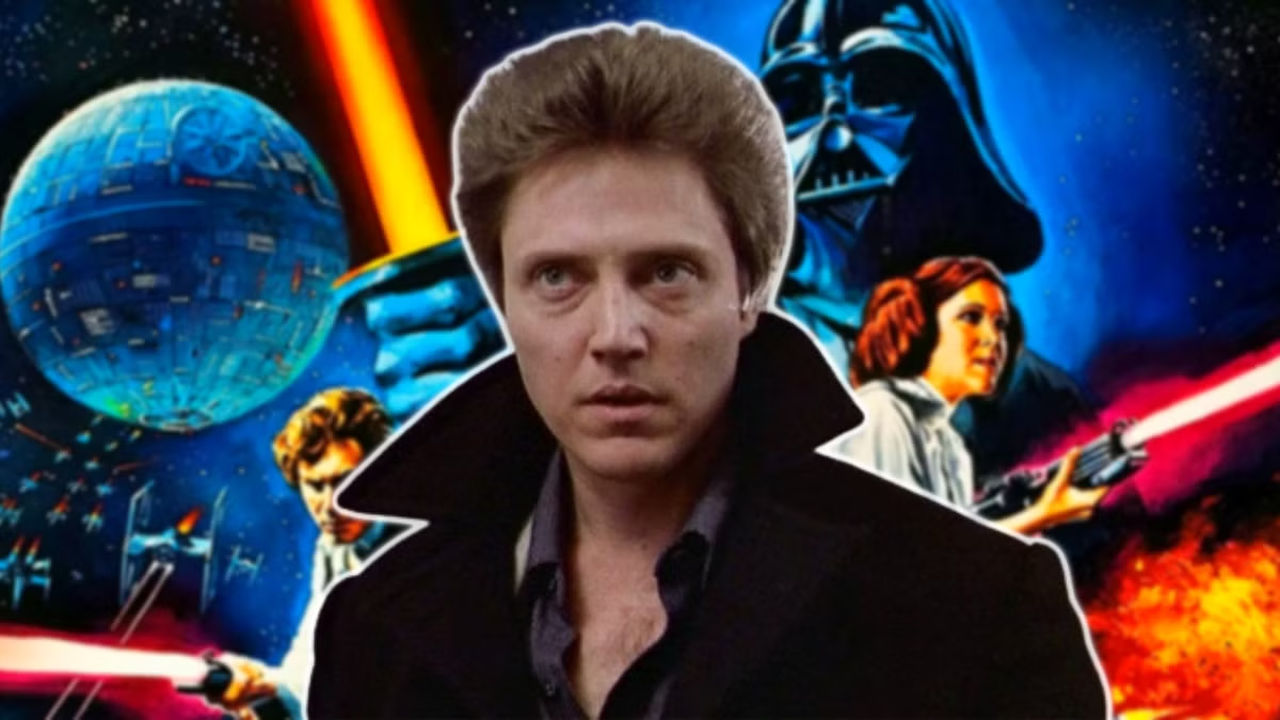
MOVIE NEWS – George Lucas once said: “I’ve found the perfect actor for Han Solo.” And the name he had in mind was Christopher Walken. Star Wars also would not have been the same without Marcia Lucas, the editor who gave the first film its heart, its emotion, and its narrative spine – and made sure the Force actually guided the story.
There is no Star Wars without George Lucas. That much is obvious, right? His vision, his ambition, and his talent for imagining a one-of-a-kind galaxy lit the fuse for one of cinema’s defining phenomena. But if we treat the saga as something that began and ended with him, we miss a foundational part of the story: Marcia Lucas. The impact of George Lucas‘s ex-wife on the original saga was not merely significant – it was the difference between an experimental sci-fi gamble and a world-changing hit that reshaped popular culture.
With Marcia‘s recent, extensive interview with Nacelle Company, this is the right moment to spotlight her legacy, explain why she mattered so much, and remember a blunt truth: without her sensitivity, her ruthless critical eye, and her craft, the first Star Wars film would very likely have failed.
The birth of a phenomenon: inspiration and opportunity
The seed of Star Wars truly took root after George Lucas watched Stanley Kubrick‘s 2001: A Space Odyssey. Struck by Kubrick‘s visual realism and narrative reach, Lucas wanted a space film where ships felt physical, as if they belonged to a lived-in, touchable world. After American Graffiti proved a success, he sold the project to 20th Century Fox in 1975 and jumped in. At the time, young filmmakers were chasing something else entirely: not the role of studio employee, but the status of full author, involved in writing, directing, and editing.
Marcia Lucas was already a proven professional. She had credits on Martin Scorsese films such as Alice Doesn’t Live Here Anymore and on American Graffiti, and she had already shown exactly what she could do in the cutting room. She was not initially meant to be directly attached to Star Wars, but as the film evolved and the edit became a mountain to climb, she ended up deeply embedded in the work. Her contribution was never just about splicing scenes together; from the start, she understood that the film’s emotional core had to live in the characters, the Force, and the human moments that could connect audiences to the strange tale Lucas was trying to tell.
Marcia Lucas was not simply George Lucas‘s wife – she was one of the few people who could counterbalance his technical drive with an emotional and narrative perspective. She was the one who suggested, for example, that Obi-Wan Kenobi should die at the hands of Darth Vader on the Death Star, a turn that lands the second act with real emotional weight and lets his voice guide Luke in the final climax. Choices like that sit at the core of modern storytelling, and they underline a simple point: without her, the film would have hit far less hard.
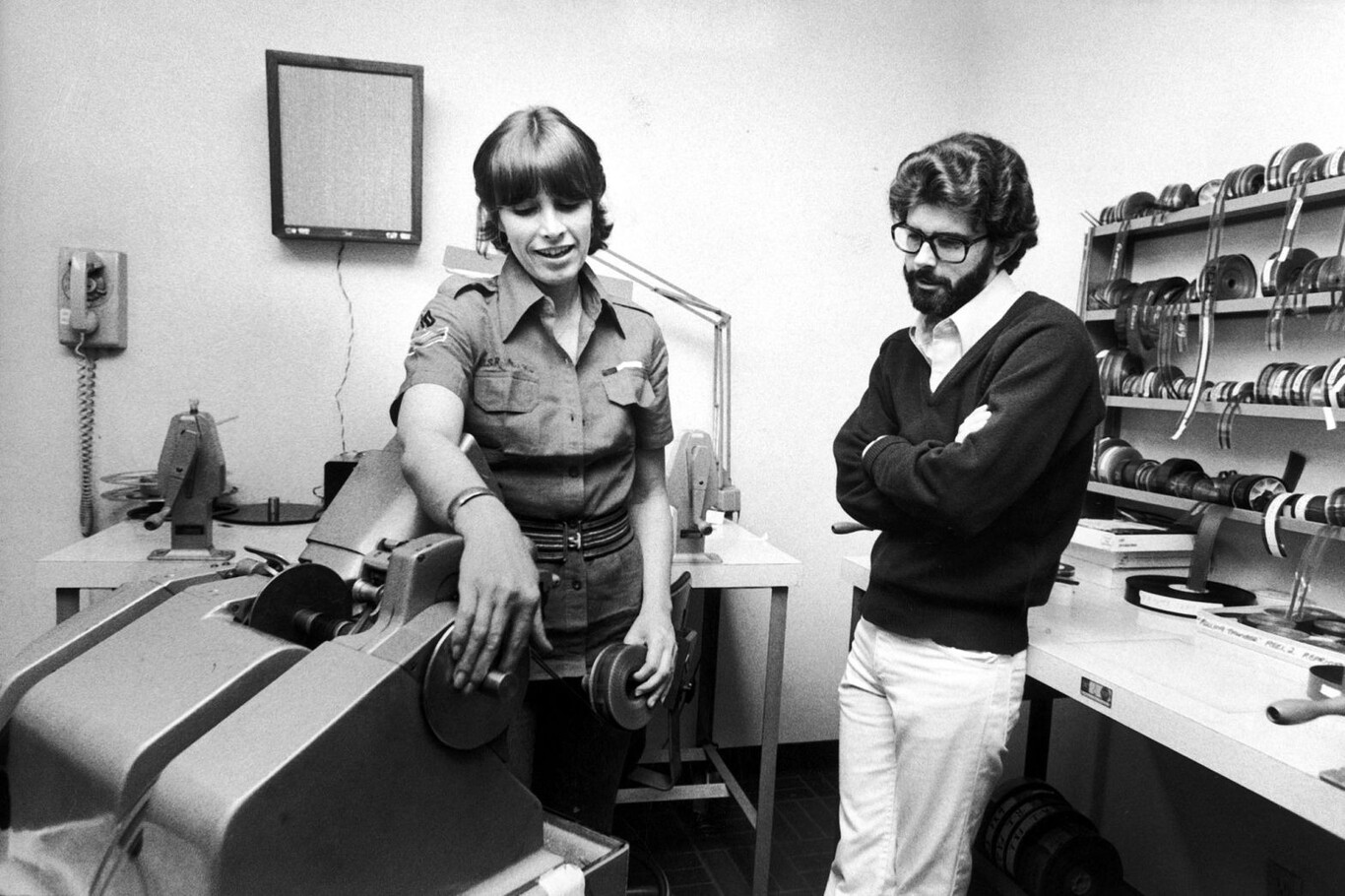
Mark Hamill says Marcia Lucas was “the heart of the films”
She also essentially rebuilt the Battle of Yavin in the edit, even pulling from World War II visual references to sharpen the tension and help ILM lock the pacing that sequence demanded. Her instincts mattered in precisely the moments where other professionals – even established directors like Coppola – did not fully grasp the dramatic weight the film needed. She understood that the Force was not just a plot device, but the film’s soul. She even defended that spiritual dimension against skeptical voices such as Brian De Palma, who also assisted Lucas on the movie, arguing that this element could not simply be cut away.
In the cutting room, she also softened and shaped performances: balancing Luke Skywalker‘s youthful temperament and making Han Solo feel more human, while creating beats that would become cinema staples. Her influence is quiet, but deep – from the famous “good luck” kiss between Luke and Leia to the tiny gestures that make R2-D2 and C-3PO feel alive. Marcia Lucas was, in Mark Hamill‘s words, “the heart of the films”.
Before Harrison Ford became the definitive face of the galaxy’s most famous smuggler, George Lucas briefly had a different idea for Han Solo: Christopher Walken. Marcia confirms in her interview that the actor known for Pulp Fiction and A View to a Kill was seriously considered early in casting. That path collapsed once Ford – who had already worked with Lucas on American Graffiti – rose to the top after auditions and recommendations, including input from friends such as Steven Spielberg. What would Lucas have been without that circle? It is tempting to imagine how different the tone might have been with Walken as Han, but it was Marcia who helped ensure that both casting and editing choices served the story’s emotional coherence.
Balancing career and private life
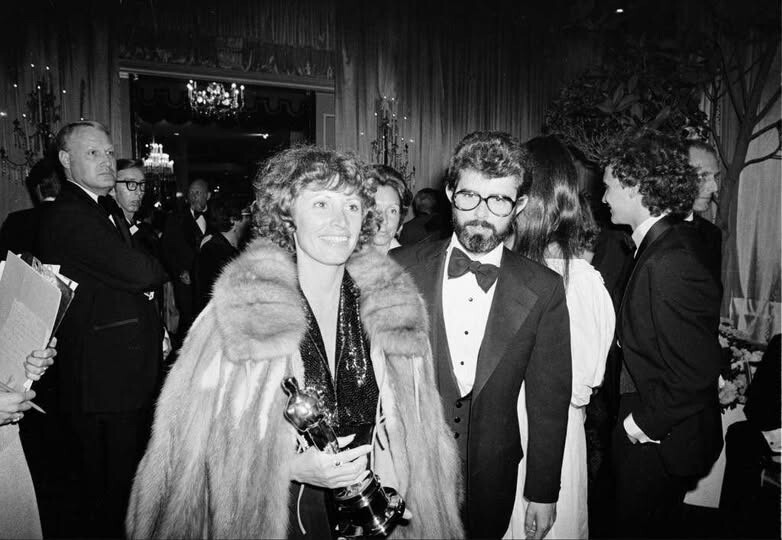
Marcia Lucas also wrestled with the classic dilemma: a demanding career versus family life. After marrying Lucas in 1969 and working as an assistant editor on THX 1138, she took on a major role in American Graffiti and later became crucial to Star Wars. But after adopting their first daughter, Amanda, she gradually stepped back from the industry to focus on family.
The 1983 divorce hit on both a personal and professional level. Marcia says that George, wounded by the split, all but erased her from Lucasfilm‘s official history, reducing her to a footnote in the company’s 25th-anniversary book. “That was a knife to my heart”, she said in the interview, describing how she was ignored in the official narrative despite helping design the Lucasfilm logo and even suggesting the company name. Still, she is frank about what she contributed and the impact it left on Hollywood: she won the Academy Award for Best Film Editing for Star Wars in 1978, and her work across Scorsese and Coppola projects cemented her reputation as one of the era’s most important editors.
Her view on the prequels and the Disney era
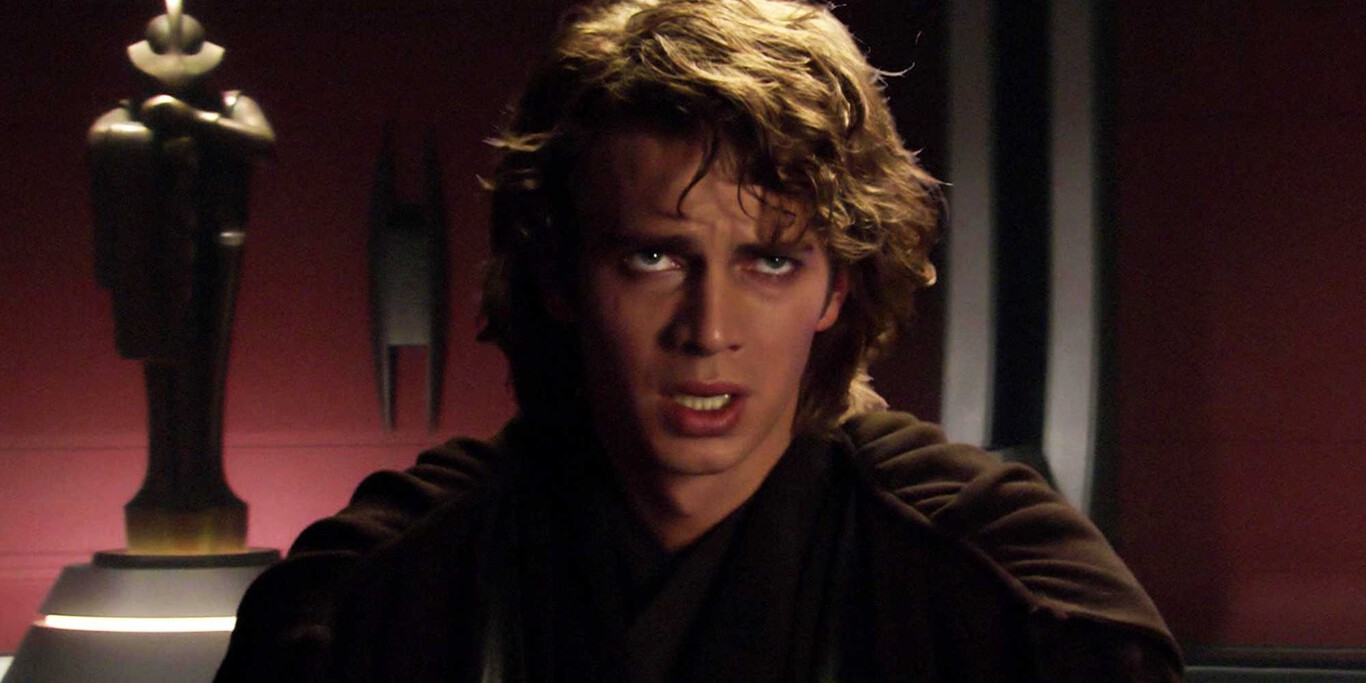
Marcia Lucas does not soften her opinions on later chapters. She criticizes the prequels for lacking authentic human relationships and for leaning too heavily on digital spectacle, which she argues drains emotion and depth from the characters. She says she cried after seeing The Phantom Menace because it felt like crucial narrative opportunities had been thrown away.
On Disney, her stance is critical but not one-note: she appreciates series such as The Mandalorian, yet she mourns what she sees as unnecessary alterations to the original story, including Han Solo‘s death and the narrative unraveling of Luke. For Marcia, decisions should be driven by story and character – not by effects or marketing templates.
The voice of a forgotten creator
In her Nacelle Company interview, Marcia Lucas speaks with a mix of nostalgia and steel. She acknowledges what those years with George Lucas meant and how, together, they made something that defined generations, but she also insists her contribution has been unfairly minimized. “We were a team. I designed the logo, suggested the name, injected emotion into every scene. And yet, after the divorce, they decided I didn’t exist”, she recalls.
Her message to Star Wars fans is straightforward and pointed: great films are great for a reason, and behind them sit uncelebrated talents who shape emotion, rhythm, and story. Marcia Lucas is exactly that kind of talent – her influence has outlived decades, even when the official narrative pushed her aside. In the end, talking about Star Wars means talking about George Lucas, but doing it without Marcia is simply unfair: thanks to her, the heart of Star Wars is still beating.
Forrás: 3djuegos
![The X-Files may finally continue with Mulder and Scully back in action [VIDEO]](https://thegeek.games/wp-content/uploads/2026/08/theGeek-X-Files-season-12-302x180.jpg)
![Pierce Brosnan’s box-office flop becomes a surprise Netflix hit [VIDEO]](https://thegeek.games/wp-content/uploads/2026/08/theGeek-Fast-Charlie-Pierce-Brosnan-302x180.jpg)

![Saber Interactive Denies that ChatGPT Wrote One of Its New Games! [VIDEO]](https://thegeek.games/wp-content/uploads/2026/08/rideshare-stimulator-1280x720-1-302x180.jpg)


![The Head of Take-Two Is Lying About the Price of Grand Theft Auto VI! [VIDEO]](https://thegeek.games/wp-content/uploads/2026/08/gta-vi-1280x720-1-302x180.jpg)

![The Nintendo Switch 2 Keeps Pace with the Xbox Series S Even in the Case of the Oblivion Remaster! [VIDEO]](https://thegeek.games/wp-content/uploads/2026/08/oblivion-remastered-switch2-1280x720-1-302x180.jpg)
![The X-Files may finally continue with Mulder and Scully back in action [VIDEO]](https://thegeek.games/wp-content/uploads/2026/08/theGeek-X-Files-season-12-300x365.jpg)
![Pierce Brosnan’s box-office flop becomes a surprise Netflix hit [VIDEO]](https://thegeek.games/wp-content/uploads/2026/08/theGeek-Fast-Charlie-Pierce-Brosnan-300x365.jpg)
Leave a Reply