
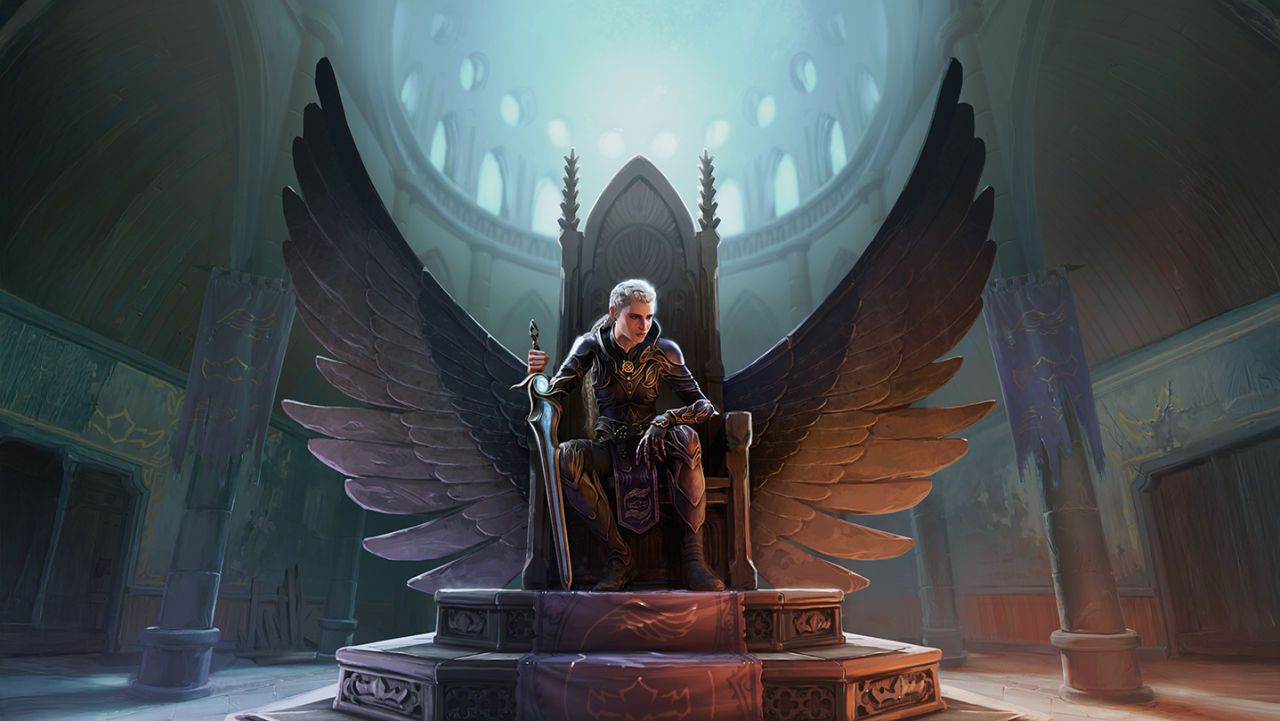
REVIEW – Disciples: Domination returns to Nevendaar five years after Disciples: Liberation and sells you the idea of a turning point – then plays it painfully safe. The grid-based, turn-based battles are still strong, the dark fantasy mood holds, and the difficulty knob has clearly been cranked up. But for most of the ride, it feels less like a true sequel and more like a big, pricey overhaul that keeps striking a sequel pose – and yes, it charges like one.
When the developer swap was announced, I had the same reflex as a lot of people: maybe this is the moment they finally dare to touch the fragile parts. Artefacts Studio steps in where Frima Studio left off, and on paper that kind of handover should be permission to take real swings – rethink combat flow, reshape exploration, rebuild progression with sharper intent. In practice, Domination clings to Liberation‘s blueprint: the same structure, the same cadence, the same comfort zone. There are balance tweaks, the challenge is meaner in places, and a few excesses have been reined in, but the overall package lands closer to a hefty update than a sequel that opens a new chapter.
That’s the frustrating part, because the foundation is still good. The tactical fights shine when you’re actually doing math in your head – positioning, unit synergies, and hunting weaknesses instead of just trading numbers. And the Disciples brand of bleak fantasy still refuses to turn into a “cozy stroll”: wins usually have teeth, even when the game occasionally pretends otherwise. What’s missing is nerve. This isn’t about content volume, it’s about willingness to risk change. Domination would rather preserve what already worked and call it a day – and it sometimes feels oddly proud of how closely it shadows its predecessor.

Avyanna sits the throne again, and you can hear the cracks
The story picks up fifteen years after Liberation. Avyanna still rules Yllian, but she’s no longer the unbreakable “I will hold this together” figure – she reads like someone who’s learning, day by day, how heavy a crown can get. The realm she forced under one banner is starting to splinter: racial tensions resurface, a mysterious magical anomaly spreads, and Orion – childhood friend, historic ally – turns away before returning as a spirit with warnings about what’s coming. A new playable faction joins the board with the Dwarves, while old cult shadows and ancient trouble thicken the backdrop.
You’re given dialogue choices that shape Avyanna’s standing with the five major factions and, in theory, her persona – except the consequences rarely land with much force. The plot is coherent and easy to follow, but it handles its own themes with gloves on. It raises an interesting question – “how long can you keep something intact that wants to fall apart?” – then steps back, careful not to say anything too sharp.
Liberation got more emotional mileage out of Avyanna’s past and Orion’s place in it, and it had a stronger pull to keep you moving. Here, the framework is familiar but the attachment points feel thinner – fewer moments that make you care beyond the mission list. The narrative isn’t broken, it’s restrained, sometimes almost distant. It’s like the new team wanted to respect the previous game while being scared to disturb it – so the story does its job (ties missions together) but rarely swings hard enough to leave a mark.

Combat still works, but the loop refuses to evolve
Mechanically, Domination keeps the same identity Liberation established: turn-based battles on a grid where positioning, enemy composition, and party interplay decide outcomes. The system holds up. You read the opposing army, you shift between the three stances (High, Medium, Low) as situations change, and you lean on elemental strengths and weaknesses to break defenses. When the right combos click, the fights are genuinely satisfying – the kind of tactical payoff that makes you say, “fine, one more” at an unreasonable hour.
The problem is consistency without escalation. After the first handful of hours, the core battle grammar stays largely the same, and the game doesn’t introduce new mechanics that meaningfully change how you approach an encounter. The difficulty is higher, no doubt, and some bosses demand real prep – but too often it asks for patience more than ingenuity. I don’t mind a tactics game that refuses to let you coast, but here it sometimes feels like it’s stricter without being smarter, and it doesn’t always earn that attitude.
Army composition remains the spine. The five playable factions – Empire, Elves, Undead, Demons, and Dwarves – push different profiles in durability, mobility, and damage. The Dwarves are a solid addition with a tougher, control-leaning style, but they don’t disrupt the broader balance. Yllian functions as your hub with faction-specific buildings; upgrades unlock stronger units and specialized abilities. Reputation affects dialogue and events, yet it rarely creates true strategic forks – it’s more like variations on a theme you already know.
Companions let you tune your toolkit and offer narrative support, but management stays fairly linear. Once you lock into an efficient formation, there’s not much pressure to rethink it – and over time that smooths the experience into something a bit too predictable.

Avyanna is the win condition, and the team often becomes scenery
Progression still revolves around Avyanna. Like in Liberation, she’s the tactical hinge: devastating abilities, faster stat growth, and a real ability to flip fights that look lost. On paper, that should sell the fantasy of a ruler growing into a force of nature. In practice, it tilts too many battles sideways.
More often than not, allies don’t feel like comrades – they feel like moving cover. They absorb hits and distract enemies while Avyanna “solves” the encounter. That dynamic already existed before; Domination doesn’t really correct it, and sometimes amplifies it. It’s not rare to win by pushing Avyanna forward and letting everyone else buy you a couple of turns. It works, but it blunts a combat system that could have demanded more true party-level resource management.

Lots to do, not many moments that surprise you
Resource management follows the game’s general caution. Gold, iron, wood, and essence fuel buildings, recruitment, and gear upgrades, but the economy is tuned to avoid genuinely painful decisions. Side missions add rewards, yet they’re usually short detours – often sending you back to already visited areas – useful for experience and loot, rarely meaningful for story or tactics.
Gear has rarity tiers and modification options, but it rarely reaches the point where a build dramatically changes how you play an entire stretch. You upgrade a weapon, reinforce armor, move on. It’s functional, not transformative.
The five large regions – each tied to a faction – stick to the established formula: real-time exploration on isometric maps with points of interest, gatherable resources, and obstacles gated by specific companion skills. There are smart shortcuts to unlock and alternate routes that reward thorough exploration. Still, discovery often feels like “collection” rather than revelation – you learn the layout, you harvest the map, you keep going.
Backtracking is frequently required as narrative progress and systematic completion intertwine, but over time that loop becomes routine instead of strategic. Yllian remains the central hub for recruitment, building upgrades, companion conversations, and equipment improvement. The city’s reconstruction is justified by its decaying state, yet mechanically it echoes Liberation closely: invest resources, unlock better troops, expand your options. It functions – it just doesn’t deliver that satisfying sense of “look how far I’ve come” growth that makes hub management memorable.

Strong mood, uneven tech – and an AI that can’t decide who it is
Visually, Domination stays faithful to the series’ dark fantasy aesthetic. Maps are detailed, faction designs are instantly readable, and color choices help distinguish territories and atmospheres without drowning you in UI. But the presentation doesn’t hide everything: animations can be stiff (especially in combat), and the overall look isn’t the clear leap a sequel tends to promise. Not a downgrade – just not a step forward.
Stability can wobble as well: small bugs, brief slowdowns during heavier moments, and occasional odd behavior crop up. The AI is the biggest swing. Sometimes it pressures you well, sniffs out weakness, and hits at the right times. Other times it ignores obvious advantages like it either forgot how to play or simply can’t be bothered. That inconsistency changes how difficulty feels: tense sequences can be followed by stretches that a human opponent would never allow. In the end, the increased challenge leans too often on AI unpredictability rather than carefully tuned balance.
Verdict: solid continuity, but it plays it safe to a fault
Disciples: Domination chooses total continuity. It patches a few imbalances, raises the challenge, preserves the parts that already worked, and keeps the grim tone intact. What it doesn’t do is take the bold step that would turn a good strategy RPG into a memorable one. If you want exactly what Liberation delivered – a bit tougher, a bit cleaner – you’ll be fine. If you hoped for a real shift, you’ll likely land where I did: this is careful maintenance that insists on calling itself a sequel.
-Gergely Herpai “BadSector”-
Pro:
+ The grid-based, turn-based battles still deliver real tactical satisfaction when synergies click
+ A consistently bleak dark fantasy mood, with distinct factions and readable art direction
+ Higher difficulty and cleaned-up balance – tighter pressure in the better fights
Con:
– Overly cautious sequel: few meaningful additions, lots of “same, just more punitive” energy
– Avyanna’s dominance tilts too many battles and reduces the party to support props
– Uneven AI and minor technical roughness
Publisher: Kalypso Media
Developer: Artefacts Studio
Genre: Strategy RPG, turn-based tactical combat
Release: February 12, 2026
Disciples: Domination
Gameplay - 7.2
Graphics - 7
Story - 5.8
Music/audio - 7.1
Ambience - 6.7
6.8
FAIR
Disciples: Domination faithfully preserves Liberation's strengths - grid-based tactical battles, grim tone, and faction-driven army building - while tightening difficulty and smoothing some balance. It’s held back by conservative design, Avyanna’s outsized impact on combat, and an AI that swings between pressure and passivity. If you accept it as a refined continuation rather than a true leap, it can still steal your evenings - just don’t expect a new identity.






![The Alighieri Circle: Dante’s Bloodline: A Divine Drama Amid September’s Flood of Games [VIDEO]](https://thegeek.games/wp-content/uploads/2026/08/theGeek-Alighieri-Circle-1280x720-1-302x180.jpg)
![Clive Barker’s Hellraiser: Revival Is Already in the Works for the Nintendo Switch 2! [VIDEO]](https://thegeek.games/wp-content/uploads/2026/08/theGeek-Hellraiser-Revival-1280x720-1-302x180.jpg)
![Head to the Pondverse in The James Pond Legacy: The Pond Is Not Enough [VIDEO]](https://thegeek.games/wp-content/uploads/2026/08/theGeek-James-Pond-Legacy-1280x720-1-302x180.jpg)






Leave a Reply