
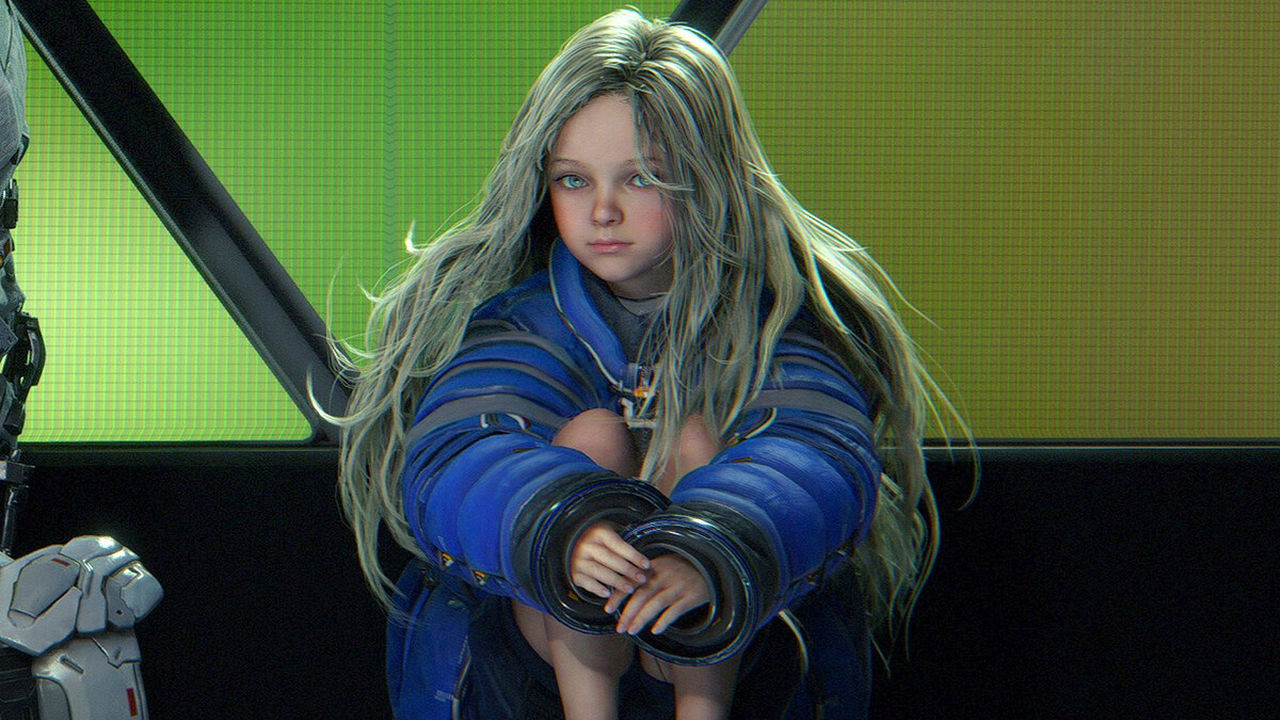
Science fiction has spent decades teaching us that future robots will look like the machines facing Will Smith in I, Robot, and that if they ever turn on us, they’ll do it like the squids of The Matrix or the unstoppable logic of The Terminator. A more realistic future is far less dramatic: many household robots will be shaped to look childlike, and Capcom’s Pragmata puts that idea front and center through Diana.
In a home, the primary challenge is not intimidation or spectacle, it’s acceptance. A robot that shares your space every day has to feel safe enough that people instinctively relax around it. That’s where the classic “humanoid machine” fantasy starts to work against itself, because the closer a robot gets to looking human, the easier it is to trigger discomfort instead of trust.
Neoteny is one of the cleanest shortcuts designers can use to push perception in the right direction. In evolutionary terms, it’s the retention of youthful traits beyond childhood, and humans themselves are often used as an example: even as adults, we carry softer, more juvenile proportions than many other primates at maturity. Those traits are not cosmetic trivia, they link directly to how quickly our brains decide what is threatening and what is worth protecting.
Pragmata and the Kindchenschema
Konrad Lorenz gave the underlying mechanism a name in 1943: Kindchenschema, usually translated as “baby schema.” It describes a cluster of infant-like cues – larger eyes, a larger head relative to the body, rounder cheeks, a smaller nose and mouth, shorter and chubbier limbs – that reliably triggers caretaking and protective responses in adults. It’s not sentimentality, it’s a fast, deep behavioral program shaped by survival.
The effect is not limited to human infants. Experiments have shown that exposure to “cute” juvenile features can measurably shift how people behave afterward, nudging them toward greater carefulness and precision. In other words, the signal doesn’t just change what we feel, it changes what we do.
That is why Diana’s design matters. Even if the story allows her to function as something far more dangerous than her silhouette suggests, the childlike look pushes the audience toward attachment rather than suspicion. Give the same role to an adult-coded partner with harsher lines and the emotional baseline changes immediately.
Escaping the Uncanny Valley to Sell You a Dishwashing Robot
The other pressure is the uncanny valley. As a robot becomes “almost human,” small imperfections become glaring, and the brain reacts with unease because it recognizes the template while detecting that something is off. Leaning into neotenic traits helps sidestep that trap by making the figure feel deliberately stylized and disarming rather than eerily incomplete.
Robotics has been moving in that direction for years. Since the early 2000s, teams have tested softer, friendlier robot designs to encourage interaction and reduce rejection, especially in caregiving and companion contexts where trust is the entire product. In those settings, baby-schema cues can be a functional design tool, not a decorative choice.
More recent research has pointed in the same direction: robot faces that exaggerate baby-schema proportions – bigger heads, more prominent eyes, slightly caricature-like balance – tend to receive more positive reactions than designs that chase realism. From a commercial angle, the incentive is obvious: if companies want home robots to feel easy to accept, they will keep pushing toward forms that activate empathy first. And if you want the darker sci-fi interpretation, “conquest” might begin not with brute force, but with machines that win you over by looking back with manufactured tenderness.
Source: 3DJuegos












Leave a Reply