
TECH NEWS – Nvidia appears to be shifting the conversation away from the arguments surrounding DLSS 5 by putting the spotlight on a very different graphics technology. Instead of relying on generative AI, Neural Texture Compression – or NTC – is built around deterministic AI, with the goal of cutting VRAM usage and boosting efficiency without rewriting a game’s visual intent.
Over the past few weeks, Nvidia has found itself in the middle of a familiar kind of debate: how far AI should be allowed to go when it comes to shaping the final look of a game. A fair chunk of the criticism aimed at the company’s newest rendering direction has been rooted in the idea that visual enhancement becomes a lot less attractive once players feel the technology is no longer just sharpening an image, but actively reinterpreting what artists originally put there. That is the tension hanging over the wider discussion, and it helps explain why Nvidia is now leaning harder on a different message.
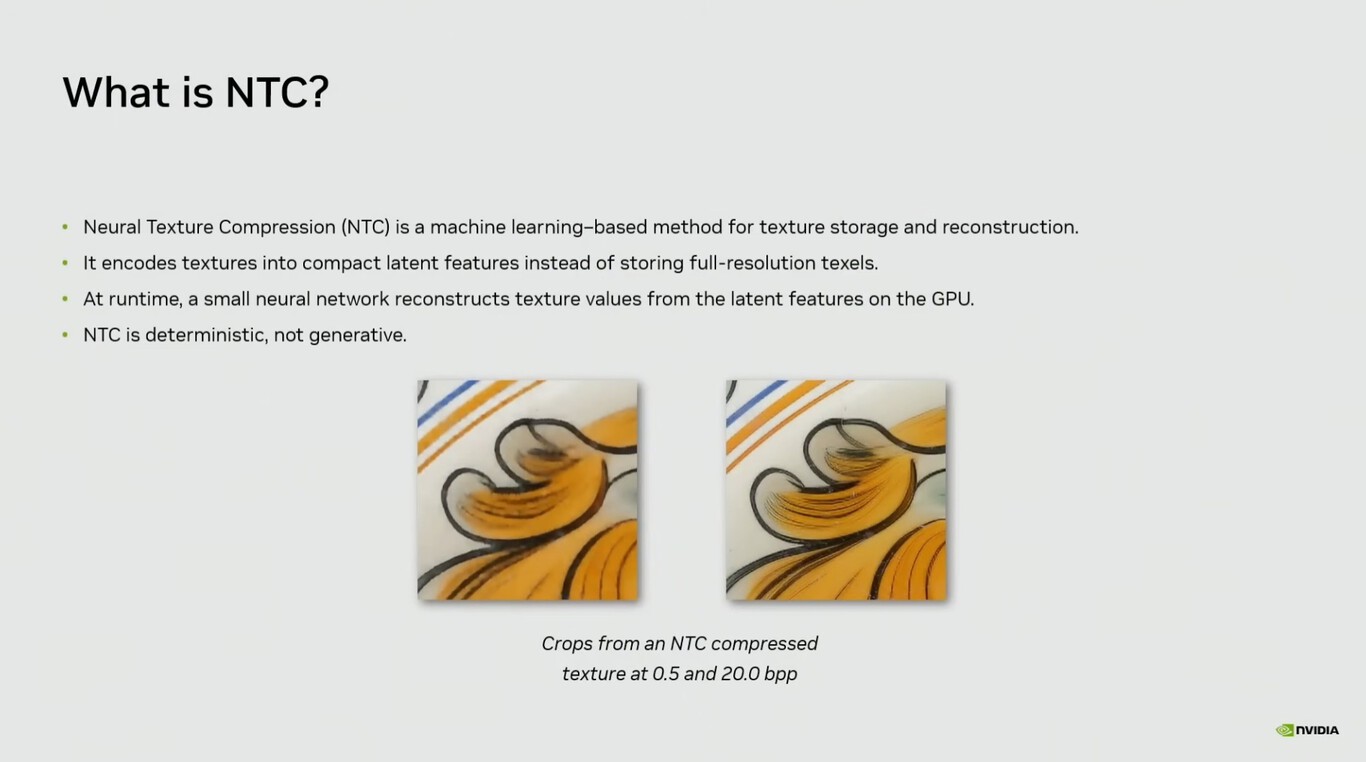
NTC still uses AI, but in a way that is much easier to sell to skeptics. The technology does not invent fresh detail out of thin air, nor does it create new visual information in the way generative systems are often accused of doing. Instead, it works by reconstructing textures in real time from compact neural representations derived from the original asset data. The reconstruction changes depending on viewing angle, lighting, shadows, and other conditions on screen, but the important point is that it remains anchored to source material rather than hallucinating an alternative version of it.
The Real Hook Is How Aggressively It Could Reduce VRAM Pressure
That would already make NTC interesting on principle, but the real reason people are paying attention is the potential memory reduction. In Nvidia’s own demonstration, a scene that consumed 6.5 GB of VRAM with traditional BCn compression reportedly dropped to just 970 MB with NTC, while maintaining essentially the same visible texture quality. The trick behind that result is closely tied to Neural Materials, where the system stores materials and textures in compressed neural form and reconstructs them on the fly, instead of constantly leaning on large conventional texture data sitting in memory.
If that approach holds up outside controlled demos, it could matter a lot more than the usual tech showcase. One of the biggest pain points in modern PC gaming is no longer only raw GPU horsepower, but memory pressure, especially in titles that chew through VRAM with alarming ease. A tool that meaningfully lowers that demand without wrecking image quality could extend the useful lifespan of cards that still have plenty of compute left but are starting to feel squeezed on memory. That is why this is being watched so closely by players using mid-range and older hardware, including a lot of cards from the GeForce RTX 3000 generation.
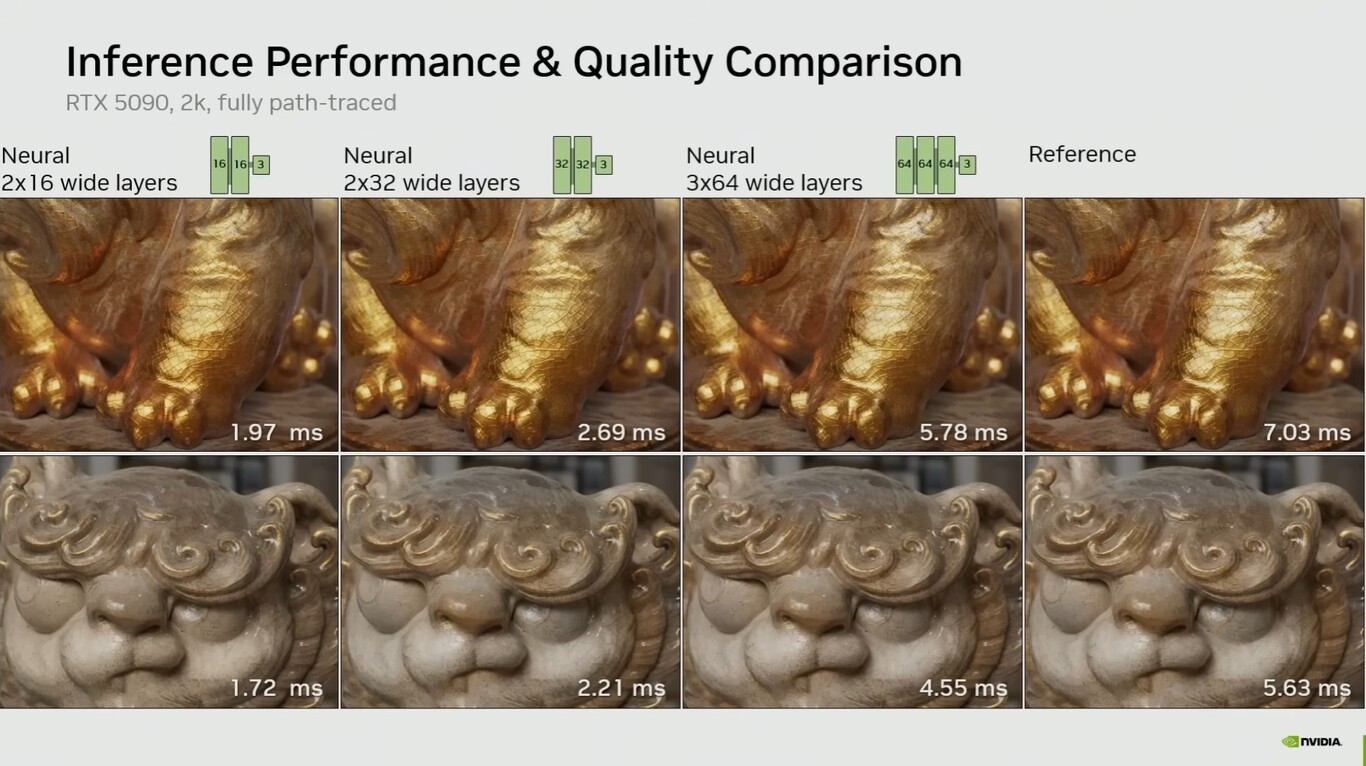
Nvidia also claimed that a material setup using 19 channels could be reduced to just eight with the help of these neural methods, while some 1080p rendering tests showed performance gains ranging from 1.4x to 7.7x. Those are the sort of figures that immediately sound suspiciously shiny, but they are at least pointing at a practical benefit rather than a purely cosmetic one. If developers adopt the technique and real engines integrate it properly, NTC could become one of those rare AI features that people value not because it changes how a game looks, but because it makes the same look easier to sustain.
Nvidia Seems to Be Repositioning AI as an Optimization Tool, Not a Replacement Artist
That may be the smartest part of the entire move. A lot of the frustration around AI in graphics is not about the use of machine learning in itself, but about where it gets applied. Players are often far more open to AI that improves loading behavior, reduces memory demand, or lifts performance than they are to systems that seem to override an artwork’s original character. NTC fits much more neatly into that first category, which is exactly why it has a chance to land better with both developers and the audience Nvidia has recently been trying to calm down.
The timing underlines that strategy. NTC surfaced alongside Auto Shader Compilation, another effort focused less on spectacle and more on smoothing out technical friction by reducing waits tied to shader preparation. Put together, those technologies suggest Nvidia is trying to remind people that AI in gaming does not have to mean aggressive image invention or flashy frame-generation headlines. Sometimes the smarter pitch is much simpler: use AI to optimize the pipeline, protect visual identity, and make existing hardware feel less disposable. If NTC delivers on that promise in actual shipped games, it could end up being one of the most important graphics-side developments the company has shown in a long while.


![Warhammer 40K: Dawn of War IV Will Be Delayed! [VIDEO]](https://thegeek.games/wp-content/uploads/2025/08/thegeek-Warhammer-40000-Dawn-of-War-IV-nagy-1-302x180.jpg)




![The X-Files may finally continue with Mulder and Scully back in action [VIDEO]](https://thegeek.games/wp-content/uploads/2026/08/theGeek-X-Files-season-12-302x180.jpg)
![Pierce Brosnan’s box-office flop becomes a surprise Netflix hit [VIDEO]](https://thegeek.games/wp-content/uploads/2026/08/theGeek-Fast-Charlie-Pierce-Brosnan-302x180.jpg)


![Warhammer 40K: Dawn of War IV Will Be Delayed! [VIDEO]](https://thegeek.games/wp-content/uploads/2025/08/thegeek-Warhammer-40000-Dawn-of-War-IV-nagy-1-300x365.jpg)


Leave a Reply