
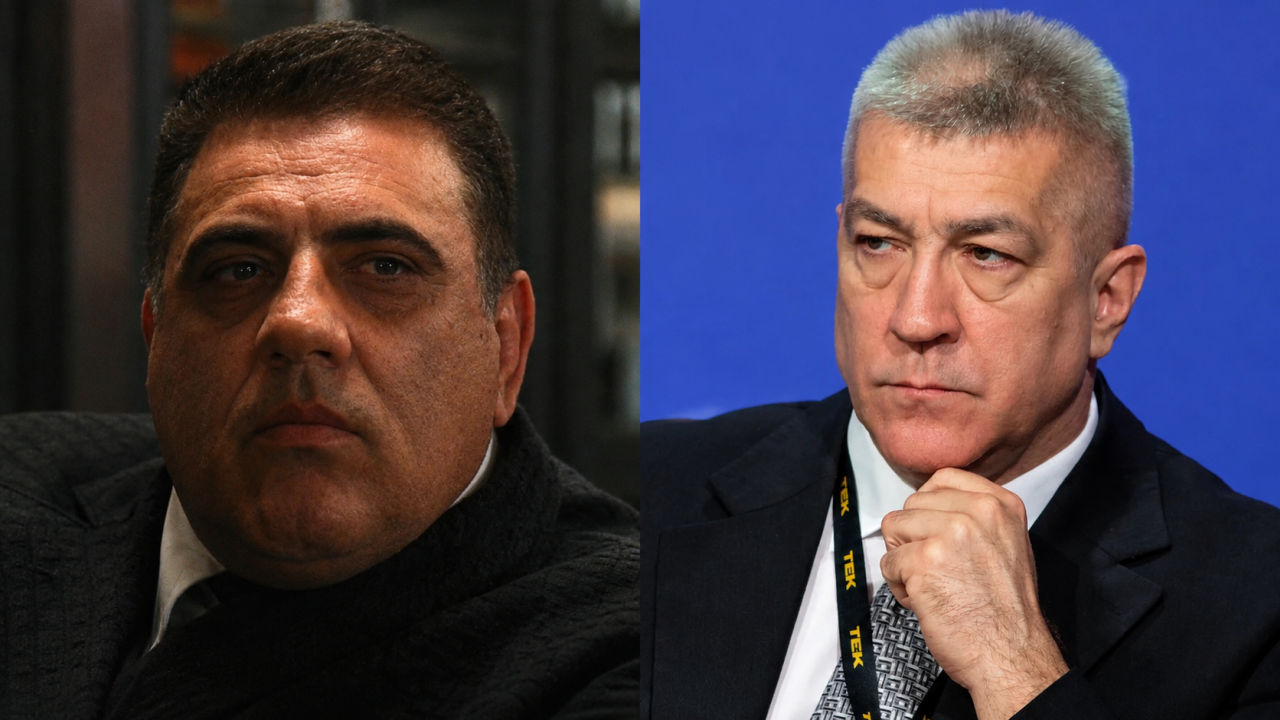
MOVIE NEWS – The Luca Brasi and János Hajdu photo montage works at first because of the striking facial resemblance: the broad, heavy jaw, deep-set eyes, hard mouth line and the still expression that signals trouble before either man has said a word. But the joke is now about much more than appearance. The gold convoy case, Hajdu’s suspect interrogation and the new security director role he received at Fidesz have added a political subplot for which it would be difficult to find a more accurate cinematic language than Francis Ford Coppola’s gangster epic.
Luca Brasi, played by Lenny Montana in The Godfather, is not merely one of Vito Corleone’s men. He is the family’s most feared and unquestioningly loyal enforcer, a figure whose arrival alone tells the entire room that the Don’s will has arrived with him. He does not sit at the head of the table, he does not present the strategy, and he does not make the final decisions, but he is the man sent in when a sensitive matter can no longer be handled through calls or polite negotiations. That is why the comparison with János Hajdu works. The shared point is not limited to the broad face, close-cropped hair, pronounced nose and severe downward expression. Both figures instantly evoke the same role: the person working close to the center of power, present for difficult assignments and suddenly visible once the decisions made in the background begin to have tangible consequences.
Luca Brasi’s story is especially dark for that reason. Don Corleone sends him to pretend that he is ready to defect in front of Virgil Sollozzo’s people, gain their trust and learn what they are preparing with the Tattaglia family. Vito does not knowingly send him to his death, but his order puts Brasi on the mission from which he does not return. Sollozzo sees through the act, Luca walks into a trap and is strangled, while the Corleone family later learns his fate through the bulletproof vest hidden inside a fish. The Don stays in the background while his most loyal man carries the danger created by the family’s own power struggle.
When the enforcer carries the consequences of the sensitive operation
In the gold convoy case, the Budapest Investigative Prosecutor’s Office questioned János Hajdu as a suspect on suspicion of seven counts of unlawful detention involving ill-treatment of the victims. According to prosecutors, seven Ukrainian money couriers were held for at least nine hours on Hajdu’s instructions even though the National Tax and Customs Administration treated them as witnesses and customs officers repeatedly requested that their handcuffs be removed. The prosecution says the detention had no legal basis and that fabric obstructing their vision was used in a manner violating human dignity. Hajdu filed a complaint against the suspicion, denied committing a crime, gave a statement and is defending himself while remaining at liberty, meaning responsibility in the case remains a matter for an ongoing criminal procedure rather than a concluded legal finding.
What makes the Luca Brasi parallel genuinely sharp is not the existence of the criminal case itself but the political dramaturgy taking shape behind it. An internal prosecution document presented by 444 also raised the possibility of examining the responsibility of Viktor Orbán, Örs Farkas, János Hajdu and Tamás Demeter, although the document itself does not amount to a final legal finding. Orbán did not publicly step forward to take political responsibility for the decision behind the gold convoy operation, but he visibly stood by Hajdu: shortly after the suspect interrogation, he appointed him Fidesz’s security director and welcomed his return with the words, “Welcome back on board, General.” In cinematic terms, this is the moment when the Don does not explain the family’s entire story, but instead brings close the man whose name has already become part of the prosecution narrative around the sensitive operation.
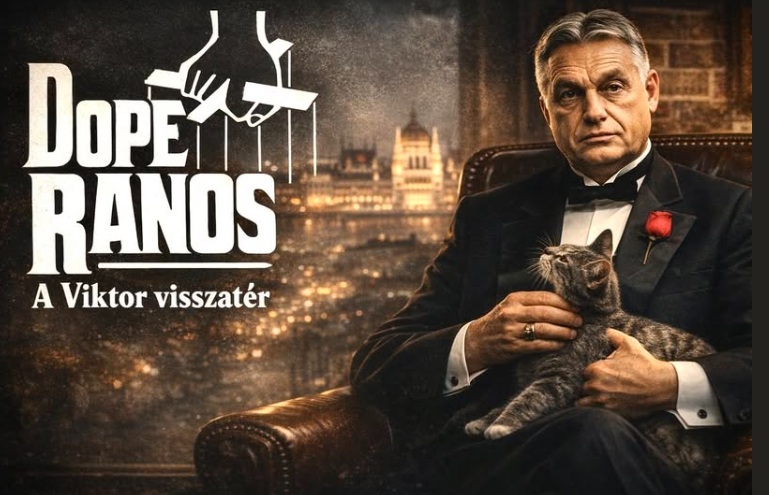
Orbán had also given this reading its most obvious pop-culture key shortly before the election. On his own Facebook page, he promoted his conversation with Dopeman through an image in which he appears as a suited mafia boss petting a cat, framed in a way that openly evokes The Godfather posters. At the time, the post could be read as a cynical campaign meme that simultaneously mocked and reinforced Orbán’s own power image. In light of the gold convoy case, Hajdu’s situation and his fresh Fidesz appointment, it can also be understood as a kind of self-confession: the Don does not carry the consequences of the dangerous operation himself, but sends in the Luca Brasi-type figure and continues to keep him at his side.
That is not a literal claim that Fidesz is an actual Cosa Nostra. It is political satire that happens to fit the power logic of The Godfather with unsettling precision. In this metaphor, Orbán is the center of decision-making, while Hajdu is the loyal, intimidating enforcer whose role becomes truly visible once legal consequences begin to appear at the lower points of the command chain. theGeek has written before about a public-life story made clearer through a familiar movie formula: in the radnaimark.hu case, the kompromat logic of From Russia with Love provided a strong frame. This time, though, it is not James Bond looking back at Hungarian public life. It is Luca Brasi, and that is a far darker joke.
Source: Prosecution Service, 444, Telex, Viktor Orbán’s Facebook page, Klubrádió







![Stranded Deep 2: After Two Years, We Finally Get to See More of It! [VIDEO]](https://thegeek.games/wp-content/uploads/2026/09/Stranded-Deep-2-1280x720-1-302x180.jpg)
![Sony Is Following the Same Path Xbox Took in 2013! [VIDEO]](https://thegeek.games/wp-content/uploads/2026/09/Live-TV-on-PS5-1280x720-exact-302x180.png)

Leave a Reply