
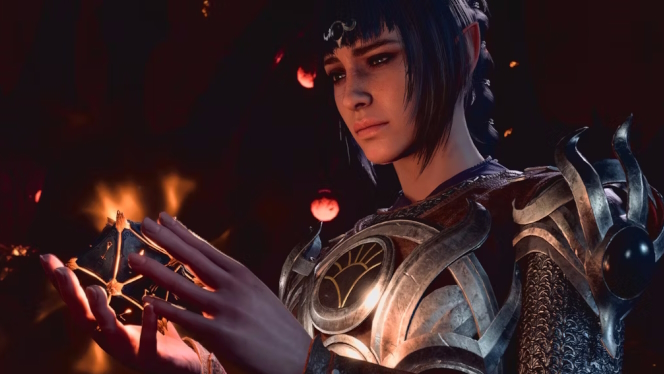
Hasbro knew exactly who to call after Larian Studios walked away from Baldur’s Gate 4: James Ohlen, one of the key creators behind the first two Baldur’s Gate games, as well as a veteran of Star Wars: Knights of the Old Republic and Dragon Age: Origins. His answer was not a cautious maybe. It was a direct refusal. Ohlen believes that Larian Studios set a standard that would be incredibly difficult to match, while the practical work needed to build a new Baldur’s Gate would be punishing even for an experienced RPG team.
When Larian Studios ended its work on Baldur’s Gate 3, it was not because there was no demand for another game. The opposite was true. A sequel looked like one of the safest commercial decisions Hasbro could possibly make after the enormous success of the third installment. Larian Studios had even created an early, partially playable version of Baldur’s Gate 4, but Swen Vincke and his team eventually decided that they did not want to spend more years inside the same licensed world, the same long early-access process, the same endless iteration, and the same set of rules owned by another company. The studio instead wants to return to worlds it controls itself and focus on its next major RPG.
That is why Hasbro approached James Ohlen, who was then leading Archetype Entertainment while the studio worked on Exodus. Ohlen said that Hasbro CEO Chris Cocks called him almost immediately after learning that Larian Studios would not take on the sequel. “Hey James, what do you think about doing Baldur’s Gate 4?” The answer was brief: “I wouldn’t do it. I would fail.”
Coming from a designer who worked on several of BioWare’s defining RPGs, this was not false modesty. Ohlen’s point was that Baldur’s Gate 3 was not built merely by combining talented writers, strong artists, and a valuable Dungeons & Dragons licence. Larian Studios spent years developing the technology, tools, and internal production methods that allowed player decisions, companion reactions, quests, combat, and systemic world interactions to constantly affect each other. Any studio taking on Baldur’s Gate 4 would inherit more than a famous series. It would inherit an audience ready to measure every choice against what Larian Studios already achieved.
Competing With Larian Would Be “Insanity”
Ohlen’s central argument was blunt: he did not want to compete with Baldur’s Gate 3. “Making Exodus was hard enough, but competing against Baldur’s Gate 3? That would be insanity.”
In his view, Swen Vincke’s advantage is not simply that Larian Studios has stronger marketing or more money than every rival. The studio’s tools, institutional knowledge, and team all work together to create an advantage that would be extremely difficult for an outsider to copy. Ohlen said that Vincke remains a master of building this kind of RPG because Larian Studios has been developing every essential element together for years: the technology, design rules, content pipelines, and countless small processes that players eventually experience as natural depth. Another studio would not only need access to those elements. It would need to learn how to use them as one complete system.
The engine problem makes that even harder. Larian Studios built Baldur’s Gate 3 with its own Divinity Engine, technology that had already been shaped through the development of the Divinity: Original Sin games. A different team would either need to create equivalent technology from scratch or build a production process around another engine that could handle the same level of complexity. That does not merely mean attractive locations, character models, and turn-based battles. It means supporting a huge number of player choices, multiple solutions to quests, changing relationships between companions, major story branches, and the countless small reactions that make the world feel responsive.
Ohlen believes that would require at least five years of difficult work. “We’re talking about half a decade of horror, building all that stuff.” He even raised the possibility of Hasbro licensing the Divinity Engine from Larian Studios, much as Black Isle once built on BioWare’s Infinity Engine, but he does not think that would solve the real problem. A game engine cannot automatically transfer the internal experience, creative habits, and team dynamic that allowed Larian Studios to turn its technology into a game as detailed as Baldur’s Gate 3.
Baldur’s Gate 4 Needs Rule-Breakers, Not a Safer Imitation
Ohlen does not believe that Baldur’s Gate 4 is impossible to make. He believes it should not be handed to a studio that tries to cautiously reproduce the Baldur’s Gate 3 formula. The next game would need an identity of its own, because a restrained imitation would lose the comparison with Larian Studios before players had even spent an hour with it. In Ohlen’s view, the ideal team would be one confident enough to break conventions and bold enough to approach the series with its own ideas rather than trying to become a second Larian.
He pointed to the early BioWare team as an example. The developers were not following a proven template when they made the original games. They worked with the belief that they could outdo every other RPG studio, even though many of them had never created a game before. That attitude may sound reckless today, but Ohlen thinks that kind of ambition is exactly what a new Baldur’s Gate would need. A fourth entry would not have to reject Larian Studios’ legacy, but it could not survive forever beneath its shadow either.
Hasbro still wants to return to the Baldur’s Gate universe, yet there is no publicly announced studio attached to the fourth installment. James Ohlen has since left Archetype Entertainment and game development after burnout caused by the combined pressure of studio leadership and creative direction. Larian Studios does not plan to return to the Forgotten Realms in the near future, while Ohlen has no interest in trying to surpass a game whose development foundation was built by another studio over more than a decade.
Baldur’s Gate 4 therefore remains more of a possibility than a concrete project. Hasbro does not merely need an experienced RPG developer now. It needs a team strong enough not to make a copy of Baldur’s Gate 3, and brave enough to accept the comparison that comes with following it.









![Stranded Deep 2: After Two Years, We Finally Get to See More of It! [VIDEO]](https://thegeek.games/wp-content/uploads/2026/09/Stranded-Deep-2-1280x720-1-302x180.jpg)
![Sony Is Following the Same Path Xbox Took in 2013! [VIDEO]](https://thegeek.games/wp-content/uploads/2026/09/Live-TV-on-PS5-1280x720-exact-302x180.png)




Leave a Reply