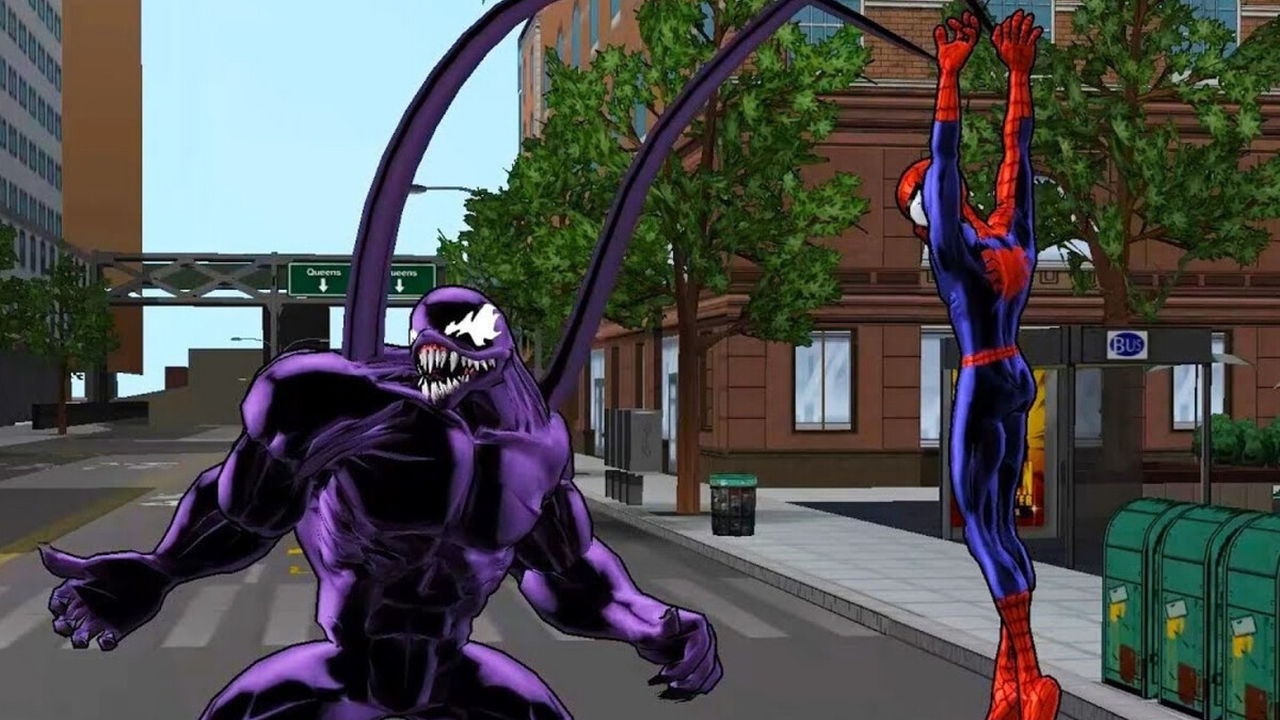
Ultimate Spider-Man did far more than allow players to control Venom, as it rebuilt movement, combat, and even the relationship with the city around the instincts of a villain. Two decades later, superhero games have rarely shown the same commitment to giving an antagonist an identity that exists through gameplay rather than simply through story.
The first time Ultimate Spider-Man hands control to Venom, it does not pause for an elaborate explanation or attempt to justify his behavior with an emotional cinematic. Instead, the player receives a straightforward tutorial, a crowded city, and an appetite that immediately becomes impossible to ignore. Keeping Eddie Brock alive requires feeding the symbiote, and the lesson is delivered by directing Venom toward a nearby child holding a balloon. From that moment onward, the rules are unmistakable: civilians are not merely scenery, and combat is not limited to faceless soldiers, machines, or traditional enemies. Almost everything in the city can become food.
It is also worth remembering what audiences generally expected from licensed games during the early 2000s. Most players assumed they would receive a short but functional adaptation supported by recognizable music, familiar characters, and enough references to the source material to justify the purchase. Many releases met that modest standard, a few, such as Harry Potter and the Prisoner of Azkaban, proved more ambitious than expected, and only a small number felt genuinely exceptional. Ultimate Spider-Man earned a place in that final group because its visual design, writing, movement, and dual-protagonist structure all served the same creative purpose.
A Comic Book Game That Truly Felt Like a Comic
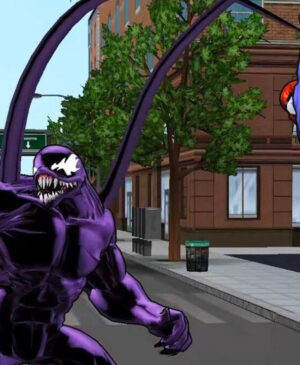
The cel-shaded presentation of Ultimate Spider-Man was never just a fashionable visual effect. It reflected the identity of the Ultimate comics, whose Mark Bagley artwork relied on clean outlines, bold colors, and exaggerated movement. Translating those qualities into animation gave the game an energy that stood out immediately, making it feel less like a conventional adaptation and more like a comic book that had suddenly learned how to move. Brian Michael Bendis, the writer who had helped redefine Peter Parker for the Ultimate line, also worked on the game’s story, allowing its visual and narrative directions to reinforce one another.
Marvel created the Ultimate universe at the beginning of the 2000s as a way to modernize its heroes without forcing new readers to understand decades of continuity. Peter Parker became a teenager again, major relationships were rewritten, and familiar characters received new beginnings shaped by a more contemporary world. For many players who grew up with the PlayStation 2, Xbox, and GameCube, this game became their first meaningful introduction to that version of Marvel. It succeeded as an entry point because it assumed audiences already understood Spider-Man while carefully explaining who Eddie Brock was and why his connection to Peter mattered.
Playing as Spider-Man already provided a dependable foundation. The web-swinging systems inherited from Spider-Man 2 remained satisfying, the city felt active, movement had a convincing rhythm, and the missions delivered what players expected from the hero. Yet the campaign quickly revealed that it was built around two equally important perspectives. Peter Parker’s missions occupied one half of the structure, while Venom’s increasingly destructive journey formed the other. Once the symbiote entered the story, it became clear that he was not a bonus character or a secondary attraction, but a protagonist carrying the same narrative importance as Spider-Man.
Venom was not treated as an optional mode or a reward waiting to be unlocked after completing the main game. He moved according to different physical rules, fought with a completely separate rhythm, and interacted with the city in a way that reflected his nature. Spider-Man escaped danger through speed, webs, and acrobatics, while Venom climbed, smashed, overpowered enemies, and consumed people to keep the symbiote alive. Feeding was therefore more than a health-management mechanic. It continually reminded the player that this character had no heroic responsibility toward the city around him. The same streets Peter wanted to protect became a hunting ground for Venom, and that deliberate imbalance made both sides of the game more distinctive.
The Problem Is That Almost No One Followed Its Example
What makes the design so remarkable today is the absence of a clear successor. Superhero games released over the following twenty years found many uses for villains, turning them into bosses, alternate costumes, DLC leads, or selectable multiplayer characters. Few, however, attempted to build an entire set of mechanics around what made a particular villain fundamentally different from a hero. Ultimate Spider-Man did not merely tell players that Venom was dangerous; every major system made them experience that difference directly.
Batman: Arkham Knight, for example, dramatically expanded Batman’s capabilities through the Batmobile, but the player never truly occupied a perspective beyond Batman himself. inFamous explored morality by allowing its protagonist to develop toward heroism or villainy, yet those paths remained separate choices rather than two simultaneous identities within the same campaign. Marvel’s Spider-Man 2 finally made Venom playable, but the character’s importance to the plot greatly exceeded the amount of time spent controlling him. The possibility of a fully developed alternative style was present, although the game ultimately used Venom for a different narrative purpose.
Modern superhero games are also shaped by licenses whose owners carefully protect the image of their characters. These productions are designed for broad audiences and usually reward actions that make players feel powerful without forcing them to remain morally uncomfortable for long periods. Asking players to inhabit a genuinely disturbing perspective can become a commercial risk when a major franchise is involved. It is much easier to present a villain as a reflection of the hero than to give that character a complete identity supported by unique needs and behaviors. Ultimate Spider-Man could take that risk in 2005 partly because relatively few people were scrutinizing how far an Activision game with Spider-Man on the cover might push its ideas.
That willingness to commit is the strongest reason to revisit the game today, or to discover it for the first time. Ultimate Spider-Man is neither flawless nor untouched by age, but it asked a design question that remains largely unanswered: what changes when a villain is constructed as a genuine protagonist? When that character possesses a unique mechanical language, a different relationship with the world, and motivations expressed through play, should they still be reduced to an extension of the hero? The game had a confident answer in 2005, while the rest of the industry is still searching for one twenty years later.
Source: 3DJuegos