
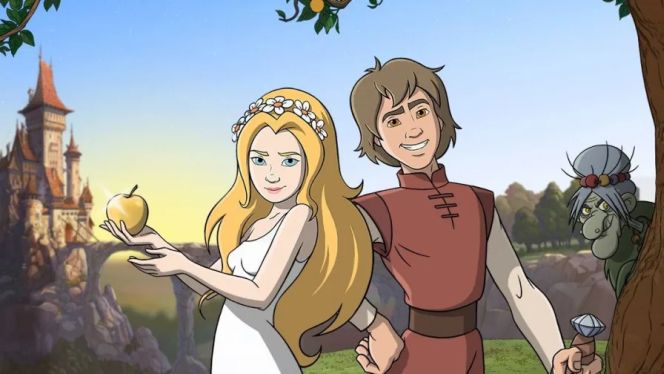
MOVIE REVIEW – Over five decades after Hungarian animation legend Attila Dargay first envisioned it, Csongor and Tünde finally arrives as a full-length animated feature. Based on Vörösmarty’s poetic 1830 play and realized with clear reverence for Dargay’s style, the film is undeniably charming – but it plays things too safe to become a new animated classic.
It’s nearly impossible to separate Csongor and Tünde from the towering legacy of Attila Dargay. The very fact that a film once shelved in the 1970s is now premiering in 2025 is, in itself, a kind of cultural event. Brought to life by Cinemon Entertainment with support from the Hungarian National Film Institute, this long-dormant passion project is now complete. Directors Csaba Máli and Zsolt Pálfi steer the helm, with a script by Krisztián Balassa and production by Réka Temple. Dargay’s widow and longtime creative partner, Irén Henrik, provided consultation. The final result? Respectful. Lovingly made. But just shy of truly memorable.
Looking Back, Playing Safe
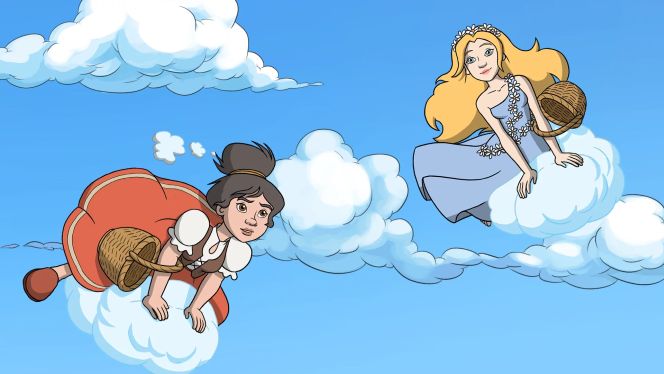
The film’s most striking quality is its visual design. Painstakingly hand-drawn in 2D, it echoes Dargay’s iconic aesthetic so perfectly that at times it feels like watching a lost episode of Vuk or Saffi. This is both a strength and a limitation. The nostalgia factor is powerful, and the style is beautifully preserved – but the film never quite dares to reinterpret or evolve beyond it. It’s a love letter, yes, but also a timid one.
The story, drawn from Vörösmarty’s romantic-fantasy tale, follows Prince Csongor’s search for meaning and his fated love with the fairy Tünde. The screenplay simplifies the complex poetic text for younger audiences, which is understandable, but occasionally too cautious. The dialogue lacks rhythm or lyrical spark, and while the themes of courage and longing remain, the delivery feels more like a well-meaning bedtime story than a sweeping myth.
Beauty Without Fire
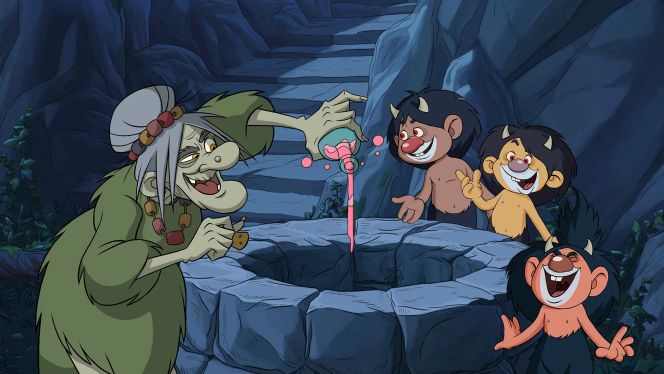
The musical score is pleasant, atmospheric, and well-integrated, but never asserts itself emotionally. This quiet modesty extends to the whole film. It’s beautifully animated, competently edited, and full of technical care – yet somehow, it all feels slightly detached. The most vibrant moments come from the comedic devilish side characters, who bring a flash of mischief and pace. Csongor and Tünde, the leads, are sweet and pure – but emotionally flat. They’re symbols more than characters.
Tempo is another issue. Some scenes linger too long; others rush past essential beats. The story arc holds no surprises. It faithfully follows the source material, but never interrogates it or adds new layers. Instead of embracing the poetic ambiguity and philosophical depth of the play, the film trims complexity for clarity – and ends up a little dull for it.
Tribute or Missed Opportunity?
To be clear: Csongor and Tünde is not a failure. In fact, in many ways, it’s a success. It introduces a generation of children (and adults) to a cornerstone of Hungarian literature and celebrates one of animation’s true greats. But it stops short of greatness itself. It’s a tribute, not a statement. A respectful echo, not a new voice.
What’s missing is risk. For all its artistic care and reverence, the film lacks boldness – the spark of originality that makes good adaptations feel vital. The animation is meticulous, the sound is clean, the voice acting solid… but the soul doesn’t quite ignite. It feels like the filmmakers were asking, *“Would Dargay approve?”* instead of *“What do we want to say today?”* And that hesitation echoes in every frame.
As a result, Csongor and Tünde (2025) is not so much a new chapter in Hungarian animation as it is a thoughtful postscript. A beautiful, faithful, and clearly heartfelt film – but one whose heart beats just a little too quietly.
– Gergely Herpai “BadSector” –
Csongor and Tünde
Direction - 7
Actors - 6.5
Story - 6.5
Music/Audio - 7.5
Ambience - 7.4
7
GOOD
Csongor and Tünde is a lovingly crafted homage to Hungarian animation and literature, offering gentle charm and technical elegance. While it may not reach the heights of Dargay’s greatest works, it’s still a worthy, if slightly cautious, return to a beloved visual tradition. Recommended – especially for nostalgic hearts.








Leave a Reply